
The last date to file a revised return for AY 2026-27 (FY 2025-26) is 31 March 2027 or before the assessment is completed, whichever is earlier. A revision filed on or before 31 December 2026 costs nothing. From 1 January to 31 March 2027, a fee under section 234I applies: Rs 1,000 (total income up to Rs 5 lakh) or Rs 5,000 (above Rs 5 lakh).
Spotted a missed deduction, a wrong bank account, an unreported interest income or an AIS mismatch after filing your income tax return? The revised return under section 139(5) is the cleanest way to fix it. The Finance Act 2026 has given taxpayers more time than before, but it has also put a price tag on the extra months. With 48 days left until the fee-free cut-off on 31 December 2026, this guide explains exactly what changed and how to decide when to revise.
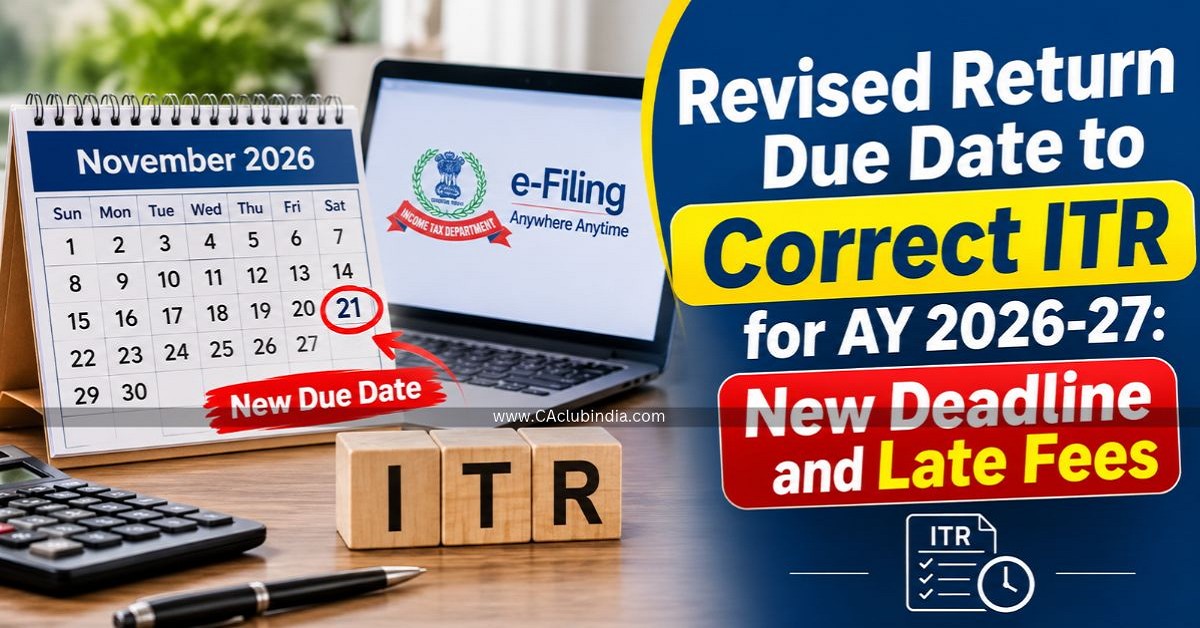
Revised ITR Last Date for AY 2026-27 at a Glance
| When you file the revised return | Total income up to Rs 5 lakh | Total income above Rs 5 lakh |
| On or before 31 December 2026 | No fee | No fee |
| 1 January 2027 to 31 March 2027 | Rs 1,000 (section 234I) | Rs 5,000 (section 234I) |
Note: After 31 March 2027: Revision not allowed. Only an updated return (ITR-U) under section 139(8A) is possible.
What Changed Under the Finance Act 2026?
Earlier, a revised return had to be filed before the end of three months prior to the end of the assessment year, which meant 31 December for AY 2026-27. The Finance Act 2026 substituted section 139(5) with effect from 1 March 2026. The outer limit is now the end of the relevant assessment year, which is 31 March 2027 for AY 2026-27. The Act also inserted a new section 234-I, again effective from 1 March 2026. It levies a fee on revised returns furnished after the old 31 December limit: Rs 1,000 where total income does not exceed Rs 5 lakh, and Rs 5,000 in other cases. In effect, the first nine months are free and the last three are paid.
Revised Return vs Belated Return vs Updated Return
Many taxpayers confuse these three. The belated return deadline has not been extended and remains 31 December 2026.
| Return Type | Section | Use it when | Last date for AY 2026-27 |
| Revised Return | 139(5) | You have already filed (on time or late) and need to correct an error or omission | 31 March 2027 (fee after 31 Dec 2026) |
| Belated Return | 139(4) | You missed the original due date and have not filed at all. | 31 December 2026 |
| Updated Return (ITR-U) | 139(8A) | Revision and belated windows are over and you need to report additional income or correct a return | Within 48 months from the end of AY, i.e. 31 March 2031 |
Who Can File a Revised Return?
- Any taxpayer who has already filed a valid original return under section 139(1), or a belated return under section 139(4). A belated return can itself be revised within the same window.
- The revised return replaces the original in full, so every figure must be reported again, not just the corrected item.
- The right to revise ends once the assessment is completed, even if the date has not yet arrived.
- If you never filed, there is nothing to revise. You need a belated return (before 31 December 2026) or, later, an ITR-U.
Common Reasons to File a Revised ITR
- A deduction or exemption missed in the original return (80C, 80D, 80CCD(1B), HRA and similar).
- Mismatch between the return and AIS, Form 26AS or Form 16 after a deductor filed or corrected a TDS statement late.
- Interest, dividend or capital gains income left out or reported wrongly.
- Wrong bank account, wrong schedule entry or incorrect tax-paid details.
- Claiming an additional refund that was missed originally.
How to File a Revised Return on the e-Filing Portal?
- Log in to the Income Tax e-filing portal with your PAN and password.
- Go to e-File > Income Tax Returns > File Income Tax Return.
- Select AY 2026-27 and the mode of filing as online.
- Choose the applicable ITR form and select the filing type as Revised Return under section 139(5).
- Enter the acknowledgement number and date of filing of the original (or belated) return.
- Correct the relevant schedules, recompute tax, and pay any additional tax, interest and, if filing after 31 December 2026, the section 234I fee through the challan before submission.
- Submit and e-verify within 30 days. An unverified revised return is treated as not filed.
Also Read - Revised Return Due Date Extension
Points to Remember Before You Revise
- Interest on extra tax: if the revision increases your liability, interest under sections 234B and 234C continues to apply on the shortfall.
- Compare AIS first: download the latest AIS and Form 26AS so that you correct everything in one filing. A second revision in the fee window can mean paying more.
- Do not wait for the refund: a revised return restarts processing. Revising early gets you through CPC processing sooner.
- Regime choice: the choice between old and new regime made in the original return is subject to the usual conditions. Review the position with your CA before switching in a revision.
What Happens From Tax Year 2026-27?
AY 2026-27 is the last assessment year under the Income-tax Act, 1961, so section 139(5) governs this year's revisions. For Tax Year 2026-27 onwards under the Income-tax Act, 2025, the revised return provision moves to section 263, with a 12-month window and a fee for revisions beyond nine months. Taxpayers filing in 2027 should check the new provisions before applying this year's dates.
Also Read - Salaried Employee Income Tax Notice in 2026: Top 10 Reasons
FAQs
What is the last date to file a revised ITR for AY 2026-27?
31 March 2027, or the date of completion of assessment if earlier. Revisions up to 31 December 2026 carry no fee.
Is there a fee for filing a revised return for AY 2026-27?
No fee up to 31 December 2026. From 1 January to 31 March 2027, section 234I levies Rs 1,000 if total income is up to Rs 5 lakh and Rs 5,000 otherwise.
Is 31 December 2026 still an important date?
Yes. It is the last fee-free date for a revised return and the last date for a belated return under section 139(4).
Can I revise a belated return?
Yes. A return filed under section 139(4) can be revised under section 139(5) within the same time limit, with the section 234I fee if filed after 31 December 2026.
How many times can I file a revised return?
The law does not cap the number of revisions within the window, and the last valid one replaces the earlier ones. Since revisions after 31 December 2026 carry a fee, correct everything in one go.
What if I never filed the original return?
File a belated return under section 139(4) by 31 December 2026 with the section 234F fee and section 234A interest on any unpaid tax. After that, only ITR-U is available.
What if the revised return window has closed?
After 31 March 2027, you can file an updated return (ITR-U) under section 139(8A) within 48 months from the end of the assessment year, by paying additional tax.
Which Act governs the revised return for AY 2026-27?
The Income-tax Act, 1961. The Income-tax Act, 2025 applies from Tax Year 2026-27 onwards.
You have reached your daily limit of 2 Free Articles
Subscribe to CCI PRO for unlimited access
Why Upgrade to CCI PRO?
- No Ads
- WhatsApp Community
- Daily E-Newsletter
- Unlimited Articles Access
- Profile Visitors
- Link Social Profiles
- Featured Job Posts
- Pro Badge
- Expert GST Guidance
- Unlimited Forum Replies
- Download Content in PDF
Already a PRO member? Login here for an ad-free experience. 07941056694









 CAclubindia
