
Most founders in India pick a business structure by comparing registration fees. That is the wrong comparison. Registration is a one-time cost. The structure decides how you raise money, how much compliance you carry every year, and how hard it will be to change course later. Converting an entity after a few years usually costs far more than choosing correctly at the start.
This guide compares the three most common choices for new ventures: the Private Limited Company, the Limited Liability Partnership (LLP), and the One Person Company (OPC).
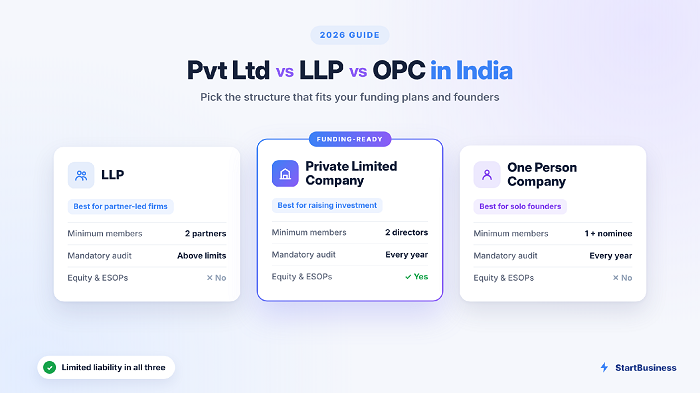

The Three Structures at a Glance
Private Limited Company. A separate legal entity owned by shareholders and run by directors. It needs at least two directors and two shareholders, and it can have up to 200 members. Shareholders’ liability is limited to the capital they put in.
Limited Liability Partnership. A hybrid that gives partnership-style flexibility with limited liability. It needs at least two designated partners, and there is no upper limit on the number of partners. The LLP agreement, not a fixed statutory template, governs how partners share profits and make decisions.
One Person Company. A company with a single member, built for solo founders who want limited liability without bringing in a co-founder. A nominee must be named, who takes over if the member dies or becomes incapacitated.
Question 1: Will You Raise Outside Investment?
If the answer is yes, or even “probably,” a Private Limited Company is almost always the right choice. Angel investors and venture capital funds invest through equity shares, and the Pvt Ltd structure is built for that. It lets you:
- issue new shares to investors in a funding round,
- create share classes with different rights, and
- set up an ESOP pool to attract and keep early employees.
An LLP cannot issue shares or ESOPs, so most institutional investors will not put money into one. Founders who start as an LLP and raise money later usually have to convert to a company first. That takes time and money, and it often happens just when a deal is on the table.
If you are building a venture-backed startup, start with a Private Limited Company.
Question 2: How Much Compliance Can You Handle?
This is where the LLP stands out. A Private Limited Company must have its accounts audited every year, whatever its turnover. It must also file annual returns with the Registrar of Companies, hold board meetings, and keep statutory registers. Missing a filing brings per-day late fees that add up quickly.
An LLP has a lighter load. An audit is required only above set limits on turnover or partner contribution. Its annual filings, a statement of accounts and an annual return, are simpler, and there are no board meeting requirements.
So for consulting firms, agencies, CA and legal practices, architects, and other professional-services businesses with two or more partners and no plans to raise equity, an LLP often gives the best balance. You get limited liability without the full corporate compliance load.
Question 3: Are You Building It Alone?
Many solo founders register as sole proprietors because it is fast and cheap. The catch is that a proprietorship has no legal separation from its owner. If the business takes on debt or faces a claim, your personal savings, home and assets are exposed.
The OPC fixes this. You keep full control as the only member, but the company is a separate legal entity and your liability is limited. Earlier rules forced an OPC to convert into a Pvt Ltd once it crossed certain capital or turnover limits. Those limits have been removed, so an OPC can now grow without being pushed into conversion.
The trade-off is that an OPC carries company-style compliance, including a mandatory audit. When you are ready to add co-founders or investors, you will need to convert it into a Private Limited Company.
A Simple Way to Decide
|
If you… |
Consider |
|
Plan to raise angel or VC funding, or want ESOPs |
Private Limited Company |
|
Run a professional-services firm with partners and no equity funding plans |
LLP |
|
Are a solo founder who wants limited liability |
One Person Company (OPC) |
|
Are testing an idea with very low risk and minimal setup |
Sole proprietorship (but know the liability risk) |
Mistakes Founders Make at Registration
Choosing on price alone. The cheapest registration can become the most expensive structure once you count conversion costs and lost funding opportunities.
Assuming the company name is protected. Approval of a company name by the Ministry of Corporate Affairs does not give you trademark rights. Another business can still file a trademark for the same name in your class. File your trademark around the time you incorporate, not after a dispute starts.
Forgetting post-incorporation duties. A new company has tasks right after registration: opening a current account, filing the commencement of business declaration, appointing an auditor, and registering for GST where needed. These are easy to miss in the rush of launching.
Ignoring the compliance calendar. Annual ROC filings, income tax returns, GST returns and TDS returns each have their own deadlines. Penalties for missing them come from the law, not from your service provider, so missing one will cost you.
Final Word
No structure is best for everyone. The right one depends on your funding plans, your number of founders, your appetite for compliance, and how fast you expect to grow. Spending an hour on this decision now can save months of restructuring later.
You have reached your daily limit of 2 Free Articles
Subscribe to CCI PRO for unlimited access
Why Upgrade to CCI PRO?
- No Ads
- WhatsApp Community
- Daily E-Newsletter
- Unlimited Articles Access
- Profile Visitors
- Link Social Profiles
- Featured Job Posts
- Pro Badge
- Expert GST Guidance
- Unlimited Forum Replies
- Download Content in PDF
Already a PRO member? Login here for an ad-free experience. 07941056694













 CAclubindia
