
Beyond the colours, symbols, and mysterious illustrations lies a world of possible warnings. Every year, the cover of The Economist becomes more than a magazine design - it becomes a puzzle that invites the world to decode the future.
What if the biggest predictions about our future were not hidden in classified documents or secret meetings, but displayed openly on the cover of a magazine?
For decades, the annual prediction editions of **The Economist** have attracted attention for their unusual illustrations, powerful symbolism, and thought-provoking themes. Their covers often combine images of world leaders, technological innovations, financial symbols, wars, political movements, and global challenges.
To an ordinary reader, these may look like creative illustrations. But to curious observers, they resemble a visual map of the future.
The 2026 Cover: A World Caught Between Power and Uncertainty
The 2026 edition, The World Ahead 2026, marked the 40th year of The Economist’s annual future-focused publication. Its central message was clear: the world was entering a period of uncertainty, where political power, economic instability, technological disruption, and international conflicts would shape the future.
Several major themes stand out:
1. The Politics of Global Power
The cover’s political and national imagery reflects a world where powerful nations are competing to shape the international order. The United States, China, Russia, and Europe face important strategic choices.
The underlying question is whether the coming years will bring greater cooperation or an increasingly divided world.
These include some primary themes that resonate as it looks to the politics of global power within and beyond its borders. The United States, China, Russia and Europe face significant decisions in strategic matters posed by the political and national backdrop of the cover. They may face fundamental strategic considerations, both about greater cooperation and more divided world.
2. The Economic warning
A deeper, even less sensational, threat of the emerging economies: financial crisis. Increasing government debt, inflation, trade tensions and the risk of a bond-market crisis can all prove to be the more pressing issues that big economies face. The warning is especially relevant in light of how quickly large economic problems may come into play, because many financial challenges are not easily found in small countries.
3. The Next Revolution of Artificial Intelligence?
AI is revolutionizing industrial, governmental, communication and even global competition. But what’s worse, is whether this staggering amount of investment into AI will lead to sustainable economic growth or just create a financial bubble. The future could also go to those in the industry controlling technology, computer infrastructure, and data.
4. War, Conflict and Global Security
As time goes on we can see a blurred line between peace and war. Traditional warfare, cyber attacks, military fighting, and geopolitical conflicts are evolving as they intertwine. The risks extend far beyond national borders, harming trade, energy supplies, food security, and everyday living.
5. The Future of Human Life
The medical and technological aspects of the cover also call us to consider how rapidly we are moving with our life. From next-generation weight-loss medicines to biotechnology advances, scientific advances might shape healthcare and the world pharmaceutical industry. These aren’t simply scientific tales; they could turn the course of the economy and the world around them.
The Economist Group
The 2027 Cover: What Could Be Coming Next?
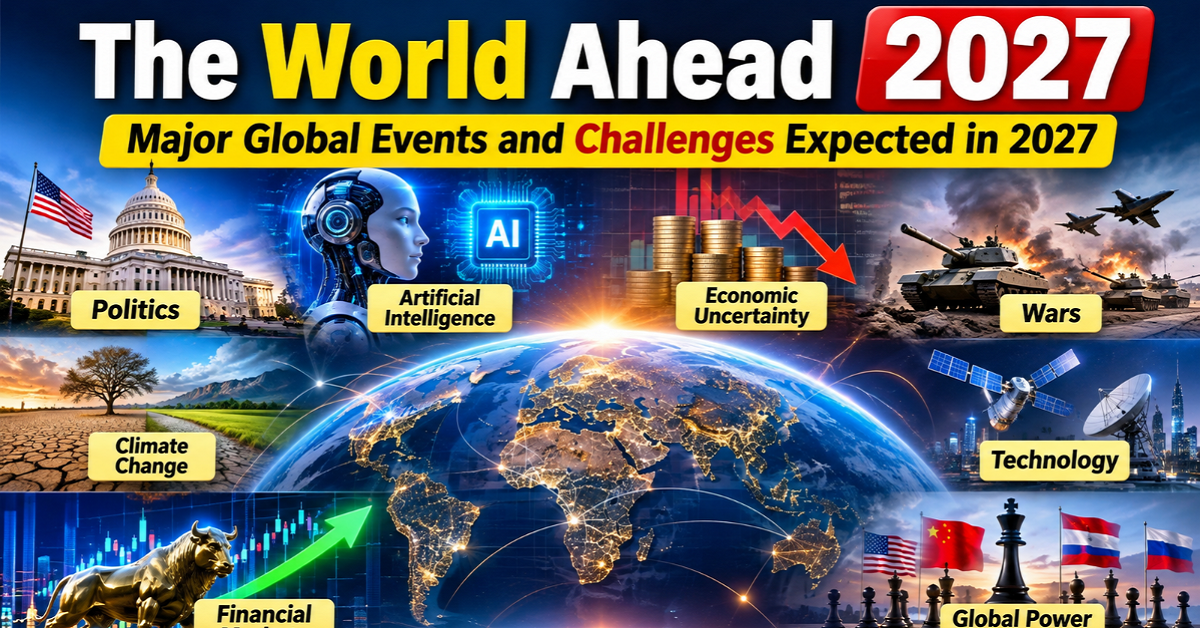
The latest edition, The World Ahead 2027, takes the discussion even further. Its themes suggest that the coming year could be shaped by political upheaval, financial pressure, artificial intelligence, climate challenges, and international tensions.
According to The Economist’s official announcement, ten major developments deserve attention. The Economist Group
Some of the most striking predictions include:
- The Post-Trump Era: A new phase of American politics could reshape international relationships.
- Aftershocks of the Iran War: Energy supplies, regional stability, and global food security could face further pressure.
- The AI Backlash: Artificial intelligence could trigger financial, political, and cybersecurity challenges.
- The Global Debt Problem: Rising government debt and bond-market pressure could expose serious weaknesses in major economies.
- Taiwan’s Moment of Peril: Tensions involving China and Taiwan could become a defining geopolitical issue.
- The Climate Crisis: Extreme heat, wildfires, and changing weather patterns could intensify.
- The New Space Race: Cheaper space launches and private space stations could accelerate humanity’s expansion beyond Earth.
These are forecasts and risks identified by the magazine, not guaranteed future events.
Are These Predictions or Carefully Designed Warnings?
This is where the real debate begins. Millions of people each year view The Economist’s annual cover and attempt to connect its illustrations to future world events. Others feel the patterns, others feel coincident, and some suspect the imagery is messages that ordinary readers fail to understand.
However, there is a stark distinction between predicting an event and knowing that it is going to happen. The Economist uses journalists, researchers, economists, and international experts to examine current developments to forecast possible future scenarios. And its covers communicate their thoughts visually by symbolic representation. There is no established evidence that the magazine has secret knowledge of future events or that the imagery indicate a coordinated hidden agenda.
Nonetheless, its ability to pick out critical global risks deserves attention in these annual editions.
The Bigger Picture: Who is Shaping Tomorrow?
Perhaps the greatest issue is not what the cover expects but the problems that surround it.
Who will become world-class in technology?
- Will artificial intelligence assist to strengthen economies or destabilise them?
- Will global competition restructure international power?
- Should international competition be followed by another global economic calamity?
- Will nations which control energy, technology and critical resources become an integral part of the apocalyptic 2023?
Conclusion: The Future Is Not Hidden - It Is Being Shaped.
The annual cover of The Economist is more than an illustration. It is a visual summary of the political, economic, technological, and social forces that could influence our future.
Its predictions should neither be accepted blindly nor dismissed without examination.
The real lesson is to look beyond the artwork, investigate the underlying analysis, question the assumptions, and understand the forces shaping global events.
Because the most powerful prediction is not the one that tells us what will happen tomorrow. It is the one that makes us recognise what is already happening today.
DISCLAIMER: This article is for informational, educational and analytical purposes only. Predictions, interpretations, and future scenarios included on The Economist’s cover derived from publicly available data, editorial themes and independent observations. They should not be taken as reliable facts, secret revelations, or guaranteed future event predictions. The symbolic elements for the magazine’s cover may be of different interpretations. Involves any interpretation of these symbols to actual events is an interpretation; it cannot be confirmed in a certain reality, nor the evidence of concealed intention. Readers are encouraged to be independent readers, verify information using reliable sources, and not make speculative predictions certainties. The future will never be definitively determined, and no prediction will guarantee the future.










 CAclubindia
