 Ayush
Ayush
Option trading has become popular in recent years due to online trading platforms. Due to this participation and derivatives volume are increased immensely. In this environment, depending only on price charts or traditional indicators is not sufficient. Many moves in the spot market are now driven by positioning and risk management in the derivatives segment.
Because of this shift, many active traders now rely on option chain data to understand what the market is preparing for. Option chains give a clearer picture of where bigger players are active and how aggressively risk is being taken at different price levels.
What Is an Option Chain?
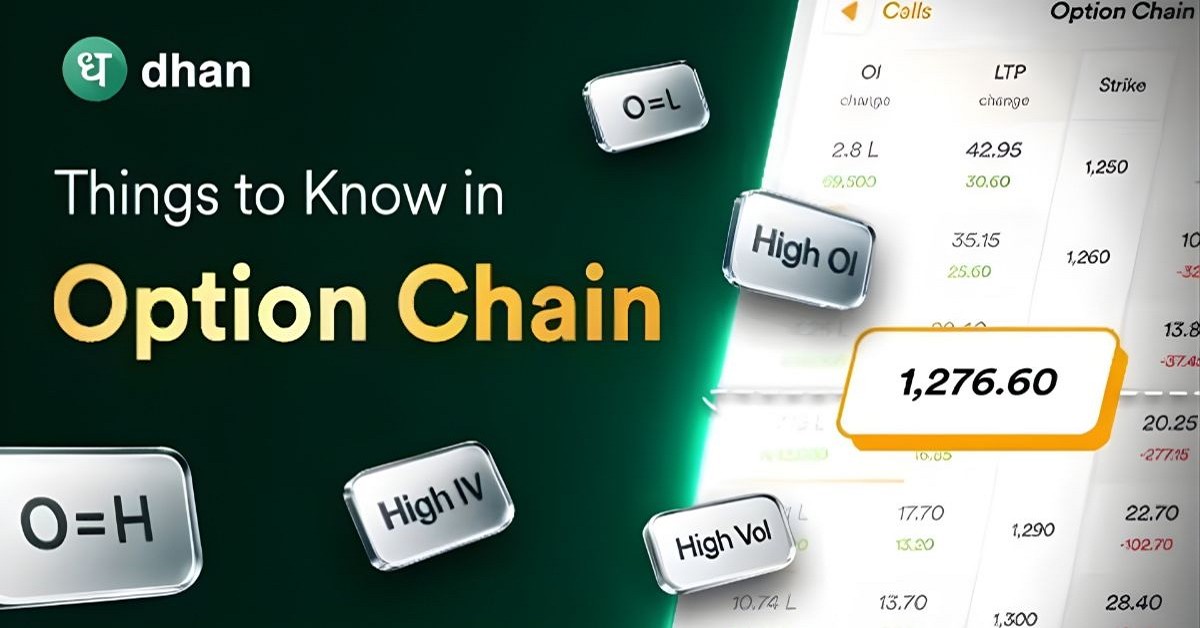
A table that lists all call and put options for a specific underlying asset at various strike prices and expiration dates is called an option chain . The important information for a strike price, such as option prices, open interest, change in open interest, volume, and implied volatility, is shown in each row.
Strike prices are displayed in the centre of the option chain table, while information pertaining to that particular strike price is displayed in the side columns. Call option data is displayed on one side of the strike price (typically the left side), while put option data is displayed on the opposite side.
Why Traditional Indicators Alone Are No Longer Sufficient
Indicators are backward-looking, meaning they analyse the data from the past and provide the indication based on it. It creates a lag for online trading. In highly volatile or range-bound markets, indicators generate false signals, leading to whipsaws.
Option chains provide the live data. You can see the trend building, through which you can make an early entry. Generally, you will start noticing shifts in positioning before the price itself begins to move.
Reading Market Behaviour Through the Option Chain
Option positions start changing before the price reacts. By observing changes in premiums and open interest, traders can sense where risk is slowly getting crowded.
Ratio of Put-Call
The put-call ratio calculates how well bullish and bearish positions are balanced. Excessive fear is indicated by a very high put-call ratio, which raises the likelihood of a bounce. A very low ratio may be a sign of an impending correction in the market.
For instance, following a string of down candles, the put-call ratio increases dramatically to 1.6. This typically indicates excessive fear in the market, where a short-term bounce can result from even a minor buying trigger.
Change in Open Interest
Changes in open interest are more significant to traders than actual open interest. A rise in open interest suggests that new positions are being created, whereas a decline in open interest suggests that positions are closing.
For instance, call unwinding near resistance indicates that sellers are pulling out, which may lessen selling pressure and enable the price to rise. In a similar vein, put unwinding near support may indicate weakness.
Implied Volatility
Implied volatility is the expected volatility in the near future. Increased volatility and a stable price mean there is a probability of an upward movement. Volatility tends to expand before major breakouts and contract near market tops or after sharp moves.
Open Interest
Open interest shows the total number of open options at a specific strike price. When there is high open interest in call options, it creates a limit on how high prices can go. On the other hand, high open interest in put options establishes a limit on how low prices can drop.
Traders watch these 'walls' of liquidity to identify where the market might stall or bounce.
Suppose the index is trading near 22,000 and the option chain shows high call open interest at 22,200. Even if the price tries to move higher, repeated selling emerges near that level; it indicates strong resistance created by option writers.
Final Words
Option chain analysis is an essential tool for derivatives traders to comprehend the market. The option chain data allows traders to make well-informed decisions.
It is important for traders to keep in mind that option chain analysis is not perfect. Positioning data may be superseded by unexpected news events, international cues, or policy announcements. It should not be used as a stand-alone trading system but rather as a supporting framework.











 CAclubindia