
Overview
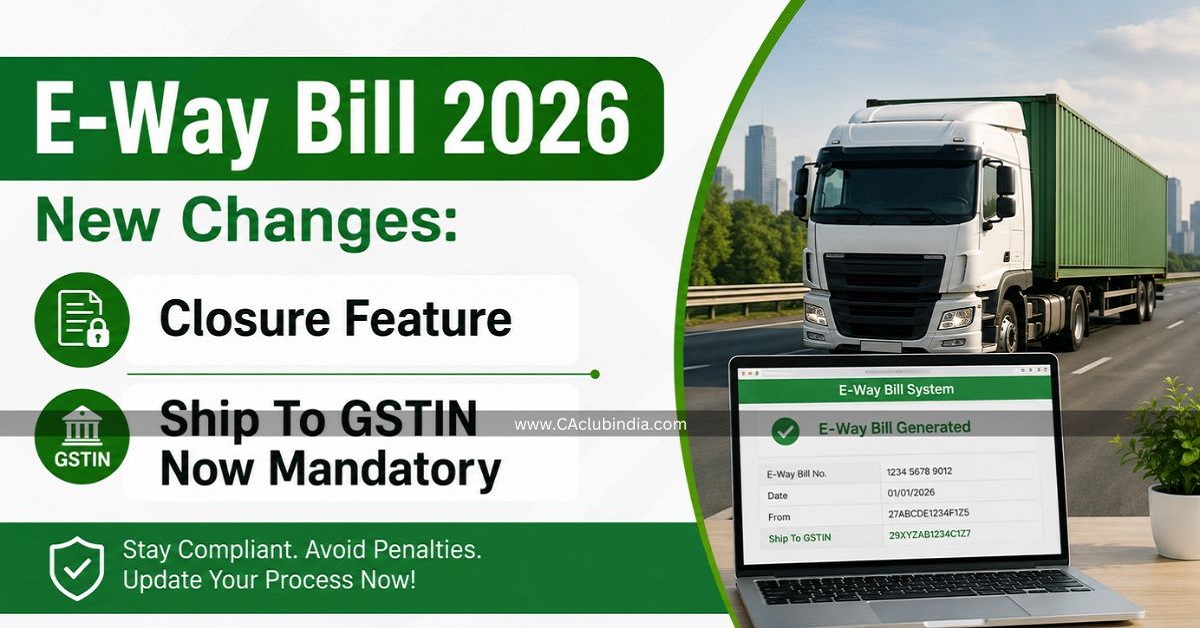
An E-Way Bill is a mandatory electronic document required under GST for transporting goods valued more than Rs 50,000. It must be generated before the movement of goods. From mid-June 2026, the portal will introduce major updates including mandatory "Ship To" GSTIN entry (or URP for unregistered recipients) and a new "E-Way Bill Closure" feature to confirm successful delivery.
Who can generate an E-Way Bill?
Depending on the transaction, the e-way bill can be generated by:
- Supplier
- Recipient
- Transporter
The bill is generated in Form GST EWB-01.
Important Thresholds
Standard limit: Rs 50,000
Some states have higher limits for intrastate movement.
Main Parts of E-Way Bill
- Part A → Invoice & goods details
- Part B → Vehicle/transporter details
E-way bill validity starts only after Part B is entered.
Validity Rules
For normal cargo:
- 1 day validity for every 200 km
- Additional 200 km = extra 1 day
For oversized cargo:
- 1 day for every 20 km.
- Additional 20 km = extra 1 day
Validity Extention
Transporters can extend validity of E-Way Bill from 8 hours before to 8 hours after expiry by updating Part B details and providing a valid reason such as vehicle breakdown, trans-shipment delay, natural calamity, or law-and-order issues. From 1st January 2025, the total extension period cannot exceed 360 days from the original E-Way Bill generation date.
Major Updates For The Year 2026 Under E-Way Bill
The e-way bill portal is introducing two major changes from around mid-June:
Mandatory "Ship To" GSTIN
Businesses are now required to enter the recipient’s GSTIN in the "Ship To" section while generating an e-way bill. If the recipient is unregistered, you can enter URP (Unregistered Person) in the GSTIN Option.
New "E-Way Bill Closure" Feature
A new closure option will be added to mark that goods have been successfully delivered. This is different from cancellation.
Here,
Cancellation means wrong or mistaken e-way bill.
Closure means delivery completed.
Who can close the e-way bill?
- Supplier
- Recipient
- Transporter involved in the transaction
- Authorized person or driver whose mobile number has been provided for closure.
Closure can be performed:
- e-Way Bill-wise, or
- Date-wise
Penalties for Non-Compliance
Transporting goods without a valid e-way bill may lead to:
- Penalty of Rs 10,000 or tax evaded, whichever is higher
- Goods and vehicle may also be detained or seized.
You have reached your daily limit of 2 Free Articles
Subscribe to CCI PRO for unlimited access
Why Upgrade to CCI PRO?
- No Ads
- WhatsApp Community
- Daily E-Newsletter
- Unlimited Articles Access
- Profile Visitors
- Link Social Profiles
- Featured Job Posts
- Pro Badge
- Expert GST Guidance
- Unlimited Forum Replies
- Download Content in PDF
Already a PRO member? Login here for an ad-free experience. 07941056694











 CAclubindia
