
Not Every Road Leads to Export - Understanding the Illusion of "Foreign Destination"
In the GST regime, exports are accorded a special status. They are treated as zero-rated supplies, ensuring that taxes do not form part of the cost of goods in international trade. This principle is not unique to India; it reflects a globally accepted norm that exports must remain tax-neutral to maintain competitiveness in global markets. From a business perspective, therefore, the concept appears straightforward - if goods ultimately move out of India, the transaction should qualify as an export.
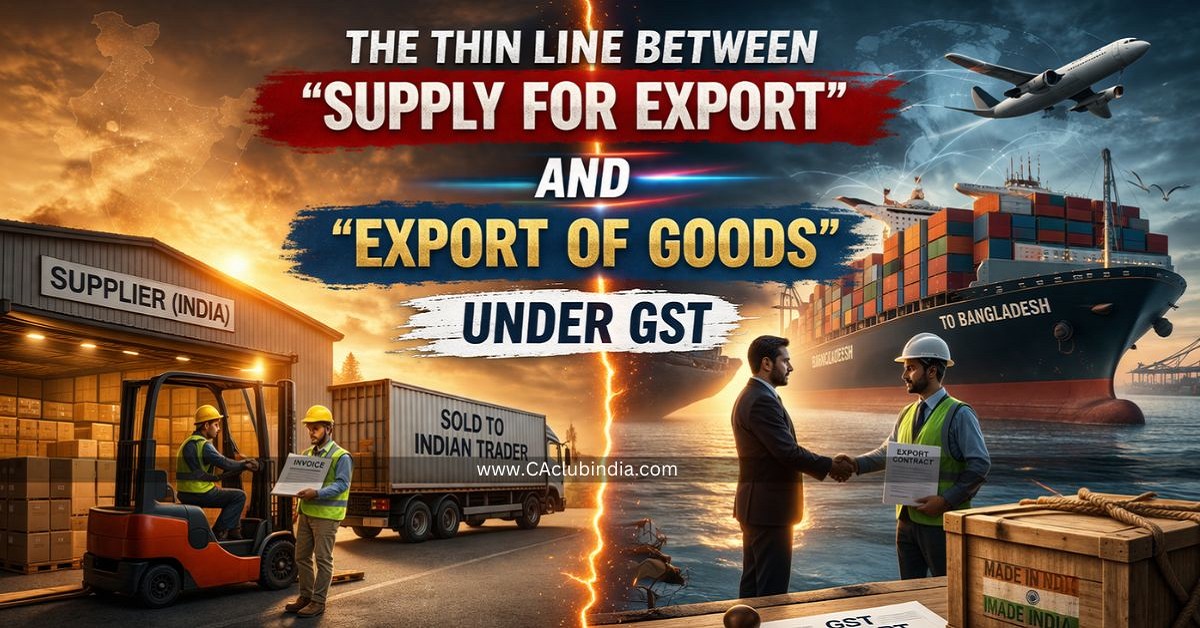
However, real-world commercial arrangements are rarely so simple. Modern supply chains often involve multiple parties, layered contractual arrangements, and intermediary suppliers. Goods may pass through several hands within India before they finally cross the border. It is in such situations that a common misconception arises - that if the final destination is outside India, every supply in that chain should automatically qualify as export.
The Andhra Pradesh High Court, in SEIL Energy India Ltd. vs Principal Commissioner of Central Tax (2026-VIL-03-AP, decided on 31.12.2025) has provided much-needed clarity on this issue. The Court observed that GST law does not merely look at the ultimate destination of goods, but carefully examines the legal character of each transaction and identifies which transaction actually causes the movement outside India.
The guiding principle that emerges is both simple and profound: a supply made with the intention of export is not necessarily a supply in the course of export. This distinction shifts the focus from commercial perception to legal causation, and it is this shift that lies at the heart of the judgment.
One Supply, Two Paths - Where the Real Dispute Began
The controversy in this case arose from what initially appeared to be a routine electricity supply. The petitioner, SEIL Energy India Ltd., was engaged in generating electricity and supplying it to the Bangladesh Power Development Board ( BPDB). However, the manner in which this supply was executed created two distinct transactional pathways.
In one set of transactions, the petitioner directly supplied electricity to BPDB. These transactions presented no difficulty. There was a direct contractual relationship between the Indian supplier and the foreign recipient, and the electricity flowing from India to Bangladesh was directly attributable to this supply. Accordingly, the department accepted these supplies as exports and granted them zero-rating.
The complexity arose in the second set of transactions. Here, the petitioner supplied electricity to Power Trading Corporation India Ltd. ( PTC), an Indian entity. PTC, under a separate agreement, supplied the electricity to BPDB. From a commercial standpoint, the end result remained unchanged - electricity ultimately reached Bangladesh. However, the legal structure of the transaction was fundamentally different.
The petitioner argued that the entire arrangement constituted a single integrated transaction aimed at export, and therefore, even the supply to PTC should be treated as export.The claim was made under Section 16 of the IGST Act, 2017, read with Section 54 of the CGST Act, 2017, which grants a refund of input tax credit in respect of zero-rated supplies. The department, on the other hand, viewed the transactions independently. It held that the supply to PTC was completed within India and did not, in itself, constitute an export. Consequently, it was treated as a domestic supply, and the input tax credit refund was denied to that extent.
This divergence of views transformed a routine refund claim into a deeper legal question : can a supply made within India be treated as an export merely because it ultimately contributes to goods being exported? The answer to this question required the Court to move beyond the surface of the transaction and examine the underlying legal principles.
Beyond the Words - Why a Simple Definition Does Not Tell the Full Story
At first glance, Section 2(5) of the IGST Act, 2017 defines export of goods in simple terms as taking goods out of India. This definition, unlike that of export of services, does not prescribe multiple conditions. Such simplicity may suggest a broad interpretation - that any supply resulting in goods leaving India should qualify as an export.
However, the Court cautioned against such a literal approach. It emphasised that statutory provisions must be interpreted in light of constitutional principles and established judicial precedents. GST law is not a standalone code ; it is built upon the constitutional framework of Article 286 , which restricts taxation on transactions occurring "in the course of export."Although GST is a destination-based consumption tax, the constitutional limitations under Article 286 continue to guide the understanding of what constitutes export.
The meaning of this phrase has been shaped by decades of judicial interpretation. The landmark judgment in State of Travancore-Cochin v. Shanmugha Vilas Cashewnut Factory [(1953) 1 SCC 826] laid the foundation by holding that transactions merely preparatory to export do not qualify as transactions in the course of export. The Court clarified that the expression "in the course of" requires a direct and proximate nexus with the export, not merely a temporal or incidental connection.
This principle was further refined under Section 5 of the Central Sales Tax Act, which introduced the requirement that a sale must "occasion the export." The Constitution Bench in Md. Serajuddin vs State of Orissa [(1975) 2 SCC 47] authoritatively held that in a chain of transactions, only the sale that directly causes the movement of goods out of India qualifies as a sale in the course of export. Earlier transactions, even if undertaken specifically to facilitate export, remain independent and taxable.
An important factor in this analysis was the absence of privity of contract between the supplier and the foreign buyer. Where the supplier's obligation is only towards an intermediary, and not the foreign purchaser, the transaction cannot be said to occasion the export. The Court thus shifted the focus from the flow of goods to the legal relationships governing that flow.
The High Court also examined decisions such as K.G. Khosla & Co. and Indure Ltd., which appeared to adopt a broader approach. However, it clarified that these cases were based on specific factual circumstances where the movement of goods across borders was an inevitable consequence of the contract itself. These decisions do not dilute the principle laid down in Serajuddin, but operate as exceptions in narrowly defined situations.
Where Intention Ends and Law Begins - Applying the Principles to the Case
When these principles were applied to the facts of the present case, the conclusion became clear. The Court found that there were two distinct contracts - one between the petitioner and PTC, and another between PTC and BPDB. The petitioner had no direct contractual relationship with the foreign buyer. Its obligations were confined to supplying electricity to PTC.
The place of delivery, as specified in the agreements, was a substation located in India. At that point, the petitioner's supply to PTC was completed. The subsequent movement of electricity to Bangladesh occurred under a separate contract between PTC and BPDB.
These facts led the Court to conclude that the petitioner's supply did not occasion the export. It was merely a step that enabled another party to carry out the export. In other words, it was a supply for export, but not a supply in the course of export.
This distinction, though subtle, is decisive. It draws a clear line between commercial intention and legal character. For instance, where a manufacturer supplies goods to an Indian trader who subsequently exports them, the manufacturer's supply remains a domestic transaction. Only the trader's supply to a foreign buyer qualifies as an export, even if the goods ultimately leave India. While the petitioner's supply was undoubtedly connected with export, it lacked the direct and proximate nexus required to qualify as export under the law.
A Fine Line with Big Impact - The Difference That Changes Everything
At the heart of this judgment lies a distinction that appears simple on the surface but carries significant legal and financial consequences. The Court draws a clear line between a "supply for export" and an "export of goods," and it is this distinction that ultimately determines the tax treatment of a transaction.
A supply for export is one that is made with the intention of enabling export. It may be an important step in the overall chain and may even be commercially indispensable. However, in legal terms, it remains only a supporting or preparatory transaction. It does not, by itself, result in goods crossing the border.
An export of goods, on the other hand, is the transaction that directly causes the movement of goods outside India. It is the point at which the goods actually leave the country, and it is this transaction that the law recognises as deserving of zero-rated treatment.
The difference between these two concepts is not merely academic or linguistic. It has a direct bearing on tax liability. While export of goods enjoys the benefit of zero-rating and eligibility for refund of input tax credit, a supply for export continues to be treated as a domestic supply and is taxed accordingly. The financial impact of this distinction can be substantial, especially in industries involving large-scale transactions.
By clearly articulating this principle, the Court has removed a layer of ambiguity that often exists in practice. It reinforces the idea that tax benefits under GST are not driven by commercial intention or ultimate outcome, but by the precise legal nature of each transaction.
In doing so, the judgment provides valuable guidance to taxpayers and professionals alike. It reminds us that even a subtle distinction, when viewed through the lens of law, can fundamentally alter the tax consequences of a transaction.
From Theory to Practice - Rethinking How Export Transactions Are Structured
While the judgment lays down an important legal principle, its real significance lies in its impact on day-to-day business decisions. It serves as a practical reminder that, under GST, transactions cannot be viewed solely through the lens of business outcomes; they must be carefully evaluated in terms of their legal structure.
One key takeaway from this ruling is that GST does not adopt a composite view of the supply chain. Instead, it requires each transaction to be examined independently , even if it forms part of a larger export arrangement. Instead, it breaks the chain into individual components and evaluates each on its own merits. This means that even if a transaction is part of a larger export arrangement, it may still be treated as a domestic supply if it does not directly result in goods leaving India.
This makes contract structuring extremely important. Businesses engaged in export-oriented activities must be mindful of how their agreements are drafted and how responsibilities are allocated. If a supplier intends to claim export benefits, it becomes essential to establish a clear and direct nexus with the foreign buyer . Without such a link, the transaction risks being categorised as a domestic supply, regardless of the goods' ultimate destination.
The presence of intermediaries further complicates the position. Where goods are routed through another entity within India, and separate contracts govern each leg of the transaction, the legal connection between the original supplier and the foreign buyer may get diluted. In such cases, the law is likely to treat the initial supply as independent and domestic, leaving only the final leg of the transaction to qualify as export.
Another important lesson from the judgment is the need to move away from relying solely on the end result of a transaction. The mere fact that goods eventually cross the border does not determine the nature of every supply involved in that process. What matters is the role played by each transaction in bringing about that movement.
In essence, the judgment encourages businesses to align their commercial structures with legal requirements. It highlights that tax efficiency in GST is not achieved merely by intention, but by careful planning, precise documentation, and a clear understanding of how the law characterises each transaction.
Cause Over Consequence - The True Test of Export under GST
The decision in SEIL Energy India Ltd. is more than just a resolution of a refund dispute - it is a reaffirmation of a fundamental principle that runs deep in indirect taxation. It reminds us that tax law does not simply look at where a transaction ends, but carefully examines how it reaches there.
In everyday business thinking, outcomes often take centre stage. If goods ultimately reach a foreign destination, it feels natural to treat the entire chain as export-driven. However, the law adopts a more precise approach. It shifts the focus from the final destination to the specific transaction that enables it.
In the context of exports, therefore, the critical question is not whether a supply is connected to export, but whether the transaction actually causes the goods to move out of India . This distinction may appear subtle, but it is decisive in determining tax treatment. A transaction may contribute to export, support export, or even be essential to export, yet still fall short of qualifying as an export under the law.
The Court, through this judgment, has elegantly demonstrated that the movement of goods beyond India is often the result of a series of steps, each playing its own role. But the law does not treat all these steps equally. It identifies and recognises only the step that directly triggers the export.
This approach brings clarity, consistency, and discipline to the interpretation of GST provisions. It ensures that the benefit of zero-rating is granted precisely where it is intended - neither expanded beyond its scope nor denied where it is genuinely due.In the end, the message of the judgment is both simple and profound:
In tax law, it is not the consequence that matters most, but the cause that creates it.
And in the journey from India to the global market, only the transaction that truly sets that journey in motion earns the status of export. This judgment, therefore, serves as a guiding light for structuring export transactions in the era.











 CAclubindia
