
Overview
Turning 60 in India isn't just a birthday - it's an upgrade. One small state-issued card can unlock cheaper hospital bills, priority queues, discounted train tickets, and a genuinely lighter tax outgo. Yet, per RTI data, only around 3 crore of India's 15.4 crore senior citizens actually hold this card - the rest are leaving benefits on the table simply because they never applied.
What is the Senior Citizen Card?
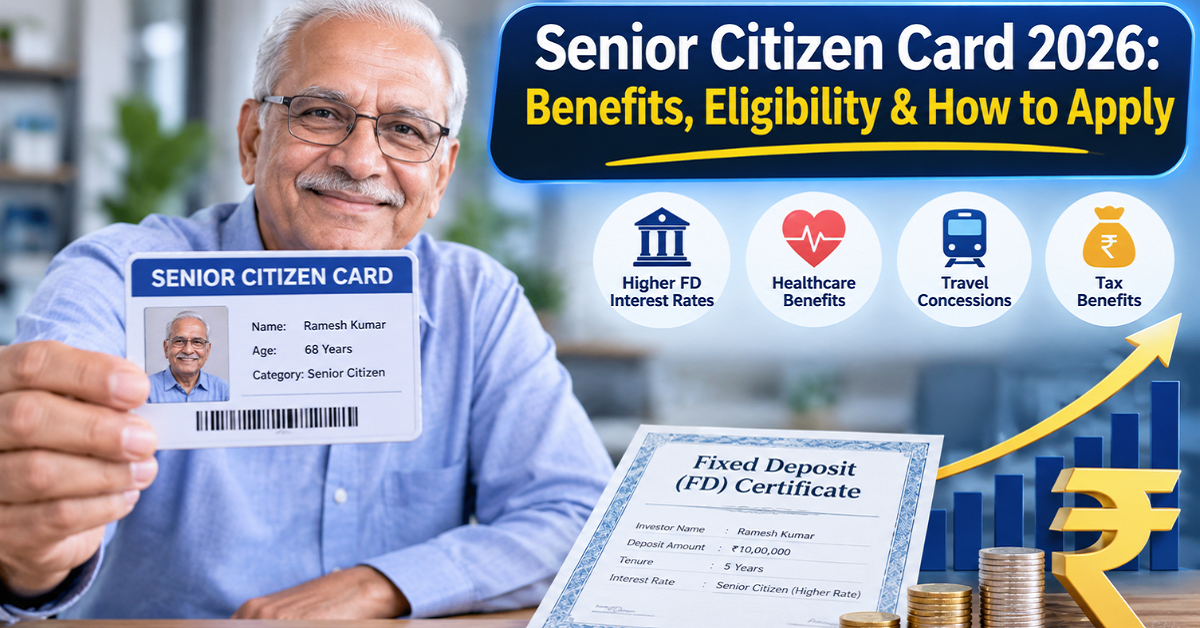
Senior Citizen Card is a state government-issued identity document, similar to Aadhaar, that officially certifies you as a "senior citizen" (60+). It's your single point of proof for most state and central benefits - no separate paperwork needed at each department.
Who Can Apply?
- Age: 60 years or above (age is reckoned as on 31st March of the financial year).
- Citizenship: The applicant must be an Indian citizen.
- Residency proof: Must provide permanent residence in the state where you're applying.
Eligibility is purely age-based. Employed, self-employed, and retired individuals qualify equally.
Click To Know About - Life Certificate for Pensioners 2026: Eligibility, Benefits and Check Who Can Submit?
Documents Required
| Proof Type | Accepted Documents |
| Identity | Aadhaar, Voter ID, Driving Licence, Pension Card |
| Age | Birth Certificate, School Leaving Certificate, Passport |
| Address | Passport, Utility Bill, Rental Agreement, Registered Sale Deed |
How to Apply?
- Visit your state government's official portal - search online using the state name together with “senior citizen card agency,” because the issuing portal differs by state. OR,
- Walk into your nearest Sewa Kendra, fill the physical form, and pay a nominal fee (typically ₹10).
- Submit identity, age, and address proof.
- Card is issued after verification - some states also offer instant digital download.
Pro Tip: If you've recently moved states, update your Aadhaar address first - most state portals reject applications where Aadhaar shows a different state, and eKYC sync can take about a week after the update.
Also Checkout
Key Non-Tax Benefits
- Banking: Higher FD/RD interest rates at most banks.
- Healthcare: Discounted treatment and priority queues at government hospitals; concessions at several private hospitals too.
- Travel: Concessional fares on state-run buses; priority booking assistance.
- Judiciary: Priority hearing dates at High Courts.
- Utilities: Priority installation for BSNL/MTNL connections.
- Investment access: Eligibility gateway for the Senior Citizen Savings Scheme (SCSS).
Note: This card is not the same as Ayushman Bharat/ABHA - for free hospital coverage, seniors still need to enrol separately in AB-PMJAY or their state health scheme. The card mainly gets you priority and concessional rates, not full coverage.
Tax Benefits - Where It Really Pays Off (AY 2026-27)
This is the part most people under estimate. Under the old tax regime, the card-holder status (age 60+/80+) unlocks:
- Higher Basic Exemption Limit: ₹3,00,000 for senior citizens (60–80 years), ₹5,00,000 for super seniors (80+ years) - versus ₹2,50,000 for others.
- Section 80TTB: Deduction on interest from savings accounts, FDs, and post office deposits - recently enhanced by Budget 2026 to ₹1,00,000 (up from ₹50,000), replacing the ₹10,000 Section 80TTA limit available to non-seniors.
- Section 80D: Health insurance premium deduction up to ₹50,000 (vs ₹25,000 for others).
- Section 80DDB: Medical treatment for specified diseases - deduction up to ₹1,00,000 (vs ₹40,000 for others).
- No advance tax: Seniors without business/professional income are fully exempt from advance tax under the proviso to Section 207 - no interest under Sections 234B/234C.
- Section 194P: Full ITR filing exemption - Resident seniors aged 75+ with only pension and interest income from the same specified bank can skip filing altogether by submitting Form 12BBA (Form 121 under the new Income Tax Act, 2025) to the bank.
- Standard deduction of ₹75,000 on pension income - available under both old and new regimes.
Also Read -
Quick reality check: The new tax regime (default) offers a flat ₹4,00,000 exemption for all ages, but with the Section 87A rebate, income up to ₹12,00,000 is effectively tax-free anyway. So the "senior advantage" mainly kicks in under the old regime - via 80TTB, 80D, and 80DDB. Most retired individuals earning FD interest and paying health premiums still come out ahead in the old regime; a proper numbers-based comparison, not a blanket assumption, is the right call every year.
FAQs
Can I get the card if I'm still working?
Yes, eligibility is age-based, not employment-based.
Is the Senior Citizen Card the same as Ayushman Bharat?
No. It gives priority and concessional rates; AB-PMJAY/ABHA gives actual health cover and must be applied for separately.
Do I need to reapply every year?
No, it's typically a one-time issuance, valid as a permanent identity document.
Can I switch between old and new tax regimes every year?
Yes, if you have no business income - pensioners and salaried seniors can choose the more beneficial regime each filing year.











 CAclubindia
