
Overview
Post-retirement, senior citizens typically depend on fixed income streams such as pensions, interest from savings, rental properties, or investment returns. To ease their financial burden, the Income Tax Act offers tailored advantages under the Old Tax Regime, including higher basic exemption limits and targeted deductions.
By contrast, the New Tax Regime applies the same slabs across age groups, offers lower tax rates, and removes most exemptions and deductions. Taxpayers can choose the regime that minimises their total tax liability.
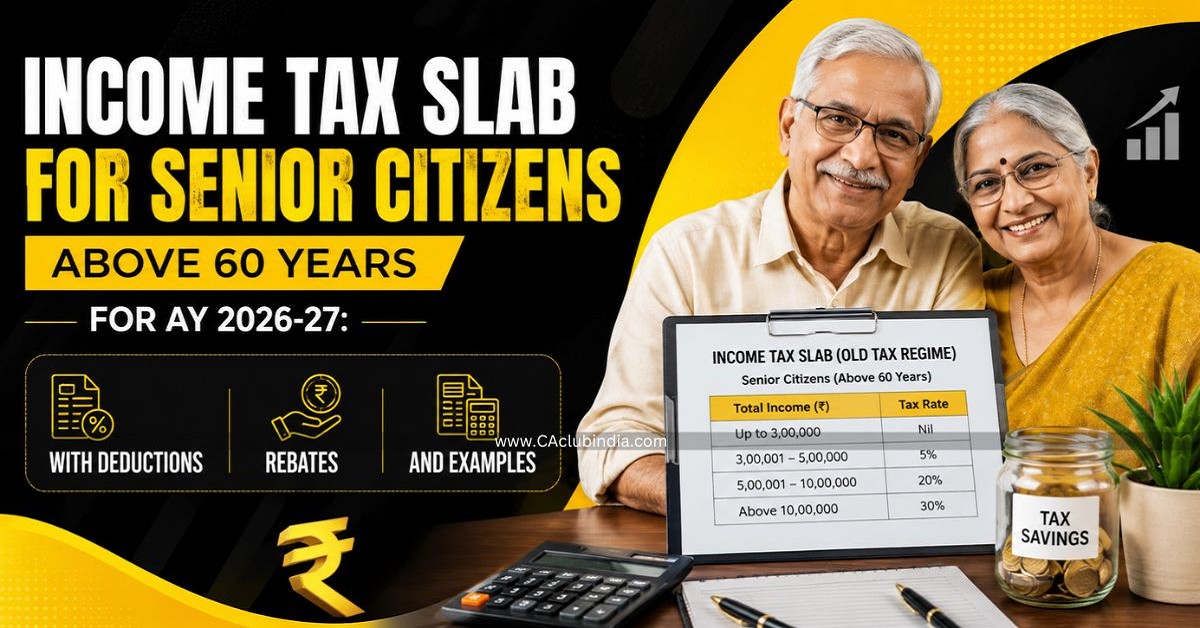
Under the Old Tax Regime, the basic tax-free income thresholds are categorised by age:
- Senior Citizens (Aged 60 to 79): Enjoy a basic exemption limit of Rs 3,00,000.
- Super Senior Citizens (Aged 80 and above): Enjoy an enhanced exemption limit of Rs 5,00,000.
Who is a Senior Citizen?
For income tax purposes:
- Senior Citizen: A resident individual who is 60 years or above but below 80 years at any time during the relevant financial year.
- Super Senior Citizen: A resident individual who is 80 years or above during the relevant financial year.
Note: The age-based tax benefits are available only to resident individuals under the old tax regime.
Eligibility Conditions
A taxpayer qualifies as a senior citizen if:
- They are an individual taxpayer.
- They are residents in India for income tax purposes.
- They have attained the age of 60 years or more but less than 80 years during the financial year.
- They choose either the old or the new tax regime while filing the return, as applicable.
Explore More - Senior Citizen Card 2026: Check Benefits and Who Can Apply?
Income Tax Slabs for Senior Citizens (Old Tax Regime)
For Senior Citizens Age 60 to 79 years
| Taxable Income | Tax Rate |
| Up to Rs 3,00,000 | Nil |
| Rs 3,00,001 – Rs 5,00,000 | 5% |
| Rs 5,00,001 – Rs 10,00,000 | 20% |
| Above Rs 10,00,000 | 30% |
Resident senior citizens enjoy a higher basic exemption limit of Rs 3 lakh under the old regime, while the new regime applies the same slabs to all individuals.
For Super Senior Citizens Above 80 years
| Taxable Income | Tax Rate |
| ₹5,00,000 – ₹10,00,000 | 20% |
| Above ₹10,00,000 | 30% |
Also Read: Senior Citizen After Retirement Must Report These 5 Incomes While Filing ITR for AY 2026-27
Income Tax Slabs Under the New Tax Regime (Applicable to All Individuals)
| Taxable Income | Tax Rate |
| Up to Rs 4,00,000 | Nil |
| Rs 4,00,001 – Rs 8,00,000 | 5% |
| Rs 8,00,001 – Rs 12,00,000 | 10% |
| Rs 12,00,001 – Rs 16,00,000 | 15% |
| Rs 16,00,001 – Rs 20,00,000 | 20% |
| Rs 20,00,001 – Rs 24,00,000 | 25% |
| Above Rs 24,00,000 | 30% |
Unlike the old regime, no separate tax slabs are available for senior citizens under the new regime.
Old vs New Tax Regime for Senior Citizens
| Particulars | Old Regime | New Regime |
| Higher basic exemption for senior citizens | Yes (Rs 3 lakh) | No |
| Separate slabs based on age | Yes | No |
| Most deductions and exemptions | Available | Mostly not available |
| Standard deduction (eligible pensioners) | Available | Available as per applicable provisions |
| Suitable for | Taxpayers claiming deductions | Taxpayers prefer lower tax rates and fewer deductions |
Which Tax Regime is Better for Senior Citizens?
The choice depends on the individual's income and deductions.
The Old Regime may be beneficial if the senior citizen:
- Invests under eligible tax-saving provisions.
- Pays medical insurance premiums eligible for deduction.
- Claims interest-related deductions where applicable.
- Has significant deductions that reduce taxable income.
The new regime may be beneficial if the senior citizen:
- Has limited deductions.
- Prefers a simpler tax structure.
- Earns mainly pension and interest income without major tax-saving investments.
There is no universally better option - the most suitable regime depends on the taxpayer's financial situation.
Tax Calculation Examples
Example 1 – Old Tax Regime
Resident Senior Citizen
Taxable Income: Rs 8,00,000
| Particulars | Amount |
| Up to Rs 3,00,000 | Nil |
| Rs 3,00,001–Rs 5,00,000 @5% | Rs 10,000 |
| Rs 5,00,001–Rs 8,00,000 @20% | Rs 60,000 |
Income Tax = Rs 70,000
Health & Education Cess @4% = Rs 2,800
Total Tax Liability = Rs 72,800
Example 2 – New Tax Regime
Taxable Income: Rs 8,00,000
| Particulars | Amount |
| Up to Rs 4,00,000 | Nil |
| Rs 4,00,001–Rs 8,00,000 @5% | Rs 20,000 |
Tax before rebate = Rs 20,000
If the taxpayer satisfies the conditions for the applicable rebate under the new regime, the rebate can reduce the tax liability to Nil.
Example 3 – Old Regime with Deductions
Gross Total Income: Rs 10,50,000
Eligible deductions: Rs 2,00,000
Taxable Income: Rs 8,50,000
Tax Calculation:
Up to Rs 3,00,000 – Nil
Rs 2,00,000 @5% = Rs 10,000
Rs 3,50,000 @20% = Rs 70,000
Income Tax = Rs 80,000
Health & Education Cess @4% = Rs 3,200
Total Tax = Rs 83,200
This example shows how deductions under the old regime can reduce the taxable income and overall tax liability.
Benefits Available to Senior Citizens
Resident senior citizens may also enjoy several tax-related benefits, including:
- Higher basic exemption limit under the old regime.
- Relief from payment of advance tax in specified situations.
- Higher deduction for eligible medical insurance premiums.
- Deduction on specified interest income, subject to prescribed conditions.
- Certain compliance relaxations under the Income-tax Act.
Thinking of investing - Check out the 5 New Rules of Senior Citizen Saving Scheme from July 2026
Key Rebates & Deductions
- Section 87A Rebate: Under the new tax regime, resident individuals with taxable income up to Rs 12 lakh can claim a rebate of up to Rs 60,000, resulting in no income tax liability. Under the old tax regime, a rebate of up to Rs 12,500 is available for taxable income up to Rs 5 lakh, making the tax payable nil within that limit.
- Standard Deduction: Salaried employees and pensioners are eligible for a standard deduction of Rs 50,000 under the old tax regime, while the deduction has been increased to Rs 75,000 under the new tax regime.
- Advance Tax Relief for Senior Citizens: Resident senior citizens who do not earn income from business or profession are not required to pay advance tax. They can discharge their tax liability when filing their income tax return.
- ITR Exemption: Seniors age above 75 year are exempt u/s 194P from filing ITR if their income is only from pension and interest from the same specified bank.
To determine which tax regime is more beneficial, compare the tax payable under both options after considering your eligible deductions and exemptions. If you share your annual income along with details of eligible deductions or investments (such as Section 80C, Section 80D, home loan interest, or other tax-saving benefits), I can calculate your tax liability under both the old and new regimes and help you identify the more tax-efficient option.
Applicable Returns and Forms
ITR-1 (Sahaj):
This form is applicable to Individual only if -
- Total income from any of the following sources up to ₹50 lakh.
- Income is from Salary/Pension, One House Property, Interest/Dividend/Family Pension, Agricultural Income up to ₹5,000, and LTCG u/s 112A up to ₹1.25 lakh.
ITR-2:
This return is applicable to Individual and HUF if:
- You are not eligible for ITR-1 and have no income under the head Profits or Gains of Business or Profession.
ITR-3:
You can file this return which is applicable to Individual and HUF, only if:
- You have business or professional income and are not eligible for ITR-1, ITR-2, or ITR-4.
ITR-4 (Sugam):
Can use this return if:
- You are a resident individual, HUF, or eligible firm (not LLP).
- Total income is up to ₹50 lakh.
- Income is from Salary/Pension, One House Property, Interest/Dividend/Family Pension, Income from Business/Profession, Agricultural Income up to ₹5,000, and LTCG u/s 112A up to ₹1.25 lakh.
- Business/professional income is taxed under the presumptive taxation scheme (Sections 44AD, 44ADA, or 44AE).
Also Know - Individual Income Tax Return Filing Due Dates for FY 2025-26
Conclusion
Choosing between the old and new tax regimes is a strategic decision for senior citizens. While the Old Tax Regime rewards those with significant investments, health insurance, and rent via higher exemption limits (Rs 3,00,000 for seniors and Rs 5,00,000 for super seniors) and specific deductions, the New Tax Regime offers a simplified, low-rate structure requiring minimal paperwork.
Ultimately, senior citizens should compute their liability under both systems to determine which regime best aligns with their income profile and maximises their disposable income in retirement.
FAQs
1. Is there a separate tax slab for senior citizens under the new tax regime?
No. The new tax regime applies the same tax slabs to all individual taxpayers irrespective of age.
2. Can a senior citizen choose between the old and new tax regimes?
Yes. Eligible taxpayers can choose the tax regime that results in lower tax liability, subject to the applicable provisions.
3. Are senior citizens required to pay advance tax?
Resident senior citizens who do not have income chargeable under the head "Profits and Gains of Business or Profession" are generally not required to pay advance tax.
4. Which regime is usually better for retired pensioners?
Pensioners claiming significant deductions may benefit from the old regime, while those with minimal deductions may find the new regime more advantageous.
5. Do senior citizens get additional deductions for medical expenses?
Eligible resident senior citizens can claim deductions for qualifying medical insurance premiums and specified medical expenses under the applicable provisions of the Income-tax Act.
6. Is the higher exemption limit available to non-resident senior citizens?
No. The enhanced basic exemption limit is available only to resident senior citizens under the old regime.











 CAclubindia
