
Overview
If you have filed your Income Tax Return for Assessment Year (AY) 2026-27 and the tax paid by you is higher than your actual tax liability, you may be eligible for an income tax refund.
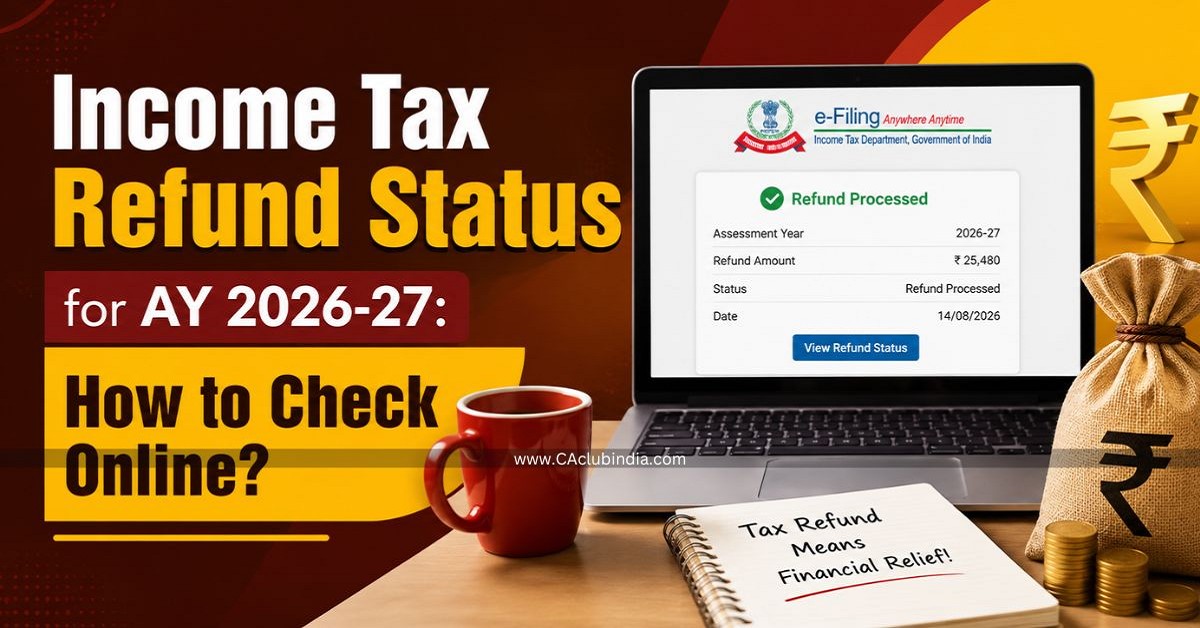
After filing and e-verifying your ITR, taxpayers can track the Income Tax Refund Status for AY 2026-27 through the Income Tax e-Filing portal. The portal also allows taxpayers to view the status of their return and understand whether the refund has been issued, adjusted, or failed.
The Income Tax Department states that refund processing starts after the return is e-verified and generally takes around 4–5 weeks, although the actual time can vary depending on the return and processing.
Waiting for your Income Tax Refund? Check These Important Details:
- How to Check Income Tax Refund Status for AY 2026-27
- What Does "Refund Issued" Mean?
- What Does "Refund Partially Adjusted" Mean?
- What Does "Refund Fully Adjusted" Mean?
- What Does "Refund Failed" Mean?
- What to Do if Income Tax Refund is Not Received?
- How Long Does Income Tax Refund Take?
- Why Can an Income Tax Refund Be Delayed?
- How to Avoid Income Tax Refund Delays
- Can I Check Refund Status Without Logging In?
What is an Income Tax Refund?
An income tax refund arises when the total tax already paid by a taxpayer is more than the final tax liability calculated while processing the Income Tax Return.
Tax may have been paid through:
- Tax Deducted at Source (TDS)
- Tax Collected at Source (TCS)
- Advance Tax
- Self-Assessment Tax
For example, if your final tax liability is ₹50,000 but ₹70,000 has already been paid through TDS and advance tax, you may be eligible for a refund of ₹20,000, subject to processing by the Income Tax Department.
Income Tax Refund Status AY 2026-27 - Important Points
For taxpayers who have filed their return for AY 2026-27, the refund process generally follows these stages:
ITR Filed → ITR E-Verified → Return Processed → Refund Determined → Refund Issued/Credited
It is important to remember that merely filing an ITR claiming a refund does not mean that the refund has been approved. The return must first be processed by the Income Tax Department.
How to Check Income Tax Refund Status for AY 2026-27
You can check your refund status online through the official Income Tax e-Filing portal.
Step 1: Visit the Income Tax e-Filing Portal
- Go to the official Income Tax e-Filing Portal
Step 2: Login to Your Account
- Enter your PAN/User ID and password and log in.
Step 3: Go to Filed Returns
After logging in:
- e-File → Income Tax Returns → View Filed Returns
- The Income Tax Department's official user manual confirms this route for viewing filed returns and refund status.
Step 4: Select AY 2026-27
- Find the Income Tax Return filed for AY 2026-27.
Step 5: Click on "View Details"
- Click View Details against the relevant return.
- You can then view the return's processing lifecycle and refund-related information.
- The portal may show different statuses depending on the stage of processing.
What Does "Refund Issued" Mean?
If the status shows Refund Issued, it generally means the Income Tax Department has processed the refund and initiated the refund payment.
The refund is normally credited to the bank account selected for receiving the refund, provided the account details are valid and properly validated.
What Does "Refund Partially Adjusted" Mean?
Sometimes the refund amount claimed in the ITR may be adjusted against an outstanding tax demand.
In such a case, only the remaining eligible amount may be issued to the taxpayer.
For example:
| Particulars | Amount |
| Refund determined | ₹30,000 |
| Outstanding demand adjusted | ₹10,000 |
| Refund payable | ₹20,000 |
Taxpayers should check the relevant communication or outstanding demand details if the refund is partially adjusted.
What Does "Refund Fully Adjusted" Mean?
If the entire refund is adjusted against an outstanding demand, the taxpayer may see a status indicating that the full refund has been adjusted.
In this situation, the taxpayer should check the outstanding demand section and verify whether the demand is correct.
What Does "Refund Failed" Mean?
A refund can fail to reach your bank account for various reasons.
According to the Income Tax Department, common reasons include:
- Bank account not being pre-validated
- Name mismatch between the bank account and PAN details
- Incorrect IFSC code
- Bank account being closed
- PAN being inoperative due to Aadhaar-linking issues
Therefore, taxpayers should ensure that their bank details are correct before expecting the refund.
What to Do if Income Tax Refund is Not Received?
If you filed your ITR for AY 2026-27 and the refund has not yet been credited, first check the following:
1. Check Whether the ITR is E-Verified
- Refund processing starts only after the return is successfully e-verified.
2. Check the ITR Processing Status
Login to the e-Filing portal and go to:
- e-File → Income Tax Returns → View Filed Returns
- Then select AY 2026-27 and click View Details.
3. Check Your Registered Email
The Income Tax Department may send an email if there is an issue with the return, refund, or processing.
4. Check Your Bank Account
Make sure the bank account selected for the refund is:
- Correct
- Active
- Pre-validated
- Linked appropriately with your PAN details
5. Check for Outstanding Tax Demand
- An outstanding demand can result in adjustment of the refund.
How Long Does Income Tax Refund Take?
The Income Tax Department's current refund-status guidance states that refund processing generally takes around 4–5 weeks after e-verification, although the actual processing period may differ from one taxpayer to another. Therefore, taxpayers should not assume that every refund will be credited within the same number of days.
Factors such as return verification, data validation, discrepancies, outstanding demands and bank-account issues can affect the timeline.
Why Can an Income Tax Refund Be Delayed?
Some common reasons for delay include:
- ITR not e-verified
- Mismatch in TDS information
- Incorrect bank details
- Bank account not pre-validated
- PAN-related issues
- Outstanding tax demand
- Differences between the ITR and information available with the Income Tax Department
- Additional verification or processing requirements
How to Avoid Income Tax Refund Delays
Taxpayers can take a few simple precautions before and after filing their ITR:
- Verify the ITR promptly: Do not leave the return pending for e-verification.
- Check Form 26AS and AIS: Verify TDS, TCS and other reported information before filing.
- Enter correct bank details: Ensure the bank account intended for receiving the refund is correctly added and pre-validated.
- Check PAN-Aadhaar status: An inoperative PAN can create problems with refund processing.
- Review outstanding demands: Check whether any previous tax demand is pending.
- Keep your email and mobile number updated: Important communications from the Income Tax Department may be sent through registered contact details.
Can I Check Refund Status Without Logging In?
The Income Tax Department provides online refund-status facilities through its e-Filing services. For the most detailed view of the refund and ITR lifecycle for AY 2026-27, taxpayers should log in to their e-Filing account and use View Filed Returns.
Have a question about your Income Tax Refund - then Click Here to ask your question.
Conclusion
Checking your Income Tax Refund Status for AY 2026-27 is simple through the Income Tax e-Filing portal. Taxpayers should ensure that their ITR is e-verified, bank account details are correct and pre-validated, and there are no unresolved tax demands or discrepancies.
If your refund is taking longer than expected, don't immediately assume that it has been rejected. First check the ITR processing status, refund status, bank details and any communication from the Income Tax Department.
FAQs
1. When can I check my income tax refund status for AY 2026-27?
You can check the refund status after filing and e-verifying your ITR. The status can be viewed through the Income Tax e-Filing portal.
2. How do I check my ITR refund status?
Login to the Income Tax e-Filing portal and go to:
e-File → Income Tax Returns → View Filed Returns → AY 2026-27 → View Details.
3. How long does an income tax refund take?
The Income Tax Department states that refund processing generally takes around 4–5 weeks after e-verification, though the actual time may vary.
4. Why is my income tax refund showing as failed?
A refund may fail because of issues such as an unvalidated bank account, incorrect IFSC, bank-account closure, name mismatch or PAN-related issues.
5. Can an income tax refund be adjusted against an outstanding demand?
Yes. A refund may be partially or fully adjusted against an outstanding tax demand.
6. What should I do if my refund is delayed?
First check your ITR processing status, registered email, bank-account validation and outstanding demands. If there is a discrepancy, take the appropriate action based on the communication/status displayed on the portal.
You have reached your daily limit of 2 Free Articles
Subscribe to CCI PRO for unlimited access
Why Upgrade to CCI PRO?
- No Ads
- WhatsApp Community
- Daily E-Newsletter
- Unlimited Articles Access
- Profile Visitors
- Link Social Profiles
- Featured Job Posts
- Pro Badge
- Expert GST Guidance
- Unlimited Forum Replies
- Download Content in PDF
Already a PRO member? Login here for an ad-free experience. 011-411-70713











 CAclubindia
