If you have filed your ITR for AY 2026-27 and think that the process is completed, then you are wrong as it is only half the process.
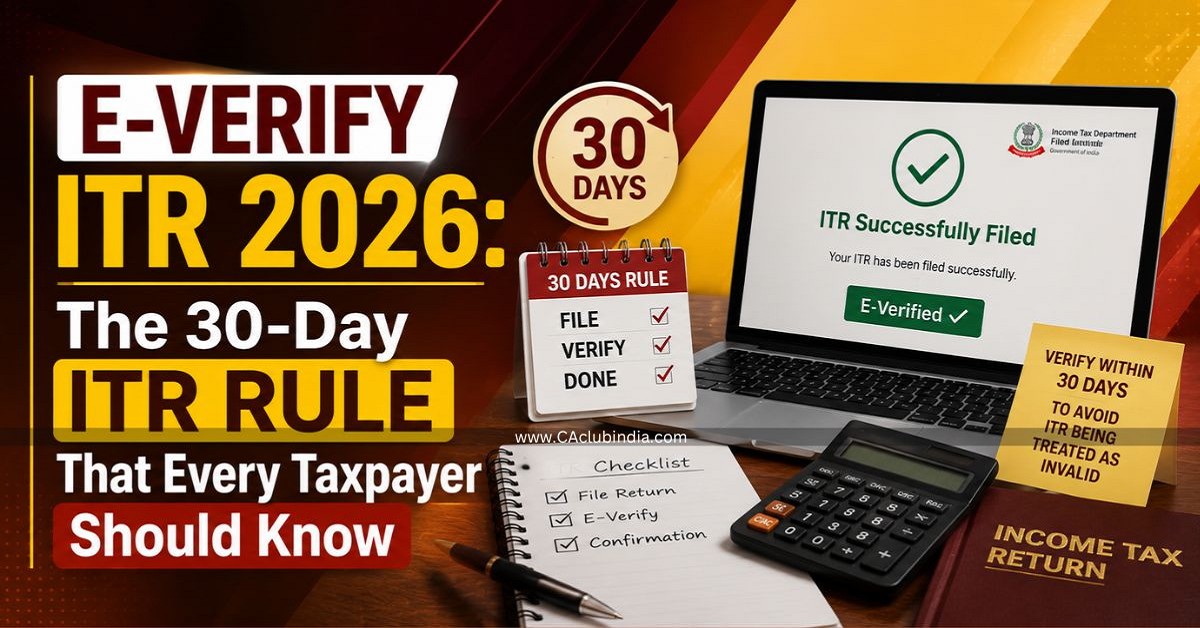
To make your income tax return valid, ITR verification is required. If you do not verify within the prescribed time, the Income Tax Department may treat it as invalid, even if it was filed successfully.
What is ITR Verification?
ITR verification is the final process after filing your income tax return. It confirms that the information submitted in your return is correct and has been approved by the taxpayer.
ITR verification Methods
The Income Tax Department offers multiple verification options.
1. Aadhaar OTP
The most commonly used method is Aadhaar OTP (one‑time password)
OTP is sent to the registered mobile number provided your PAN is linked to Aadhaar.
Verification is completed instantly.
2. Internet Banking EVC
Taxpayers can e-Verify by selecting the Bank Account through which you want to Verify.
3. Digital Signature Certificate (DSC)
Businesses, professionals, and taxpayers can electronically verify their return using a valid Digital Signature Certificate.
4. Demat Account EVC
If your Demat account is linked and validated, you can generate an EVC through CDSL or NSDL for ITR verification.
30-Day Time Limit for ITR Verification
If ITR verification not working with Aadhaar OTP, DSC Internet Banking or Demat Account, then taxpayers can sent signed ITR copy to the Centralized Processing Centre (CPC), Bengaluru by post within 30 Days.
Earlier, taxpayers had 120 days, but now the verification window has been reduced to 30 days.
If ITR is verified within 30 days of filling, the Income Tax Department considers the original filing date as the valid filing date.
Verification After 30 Days
If you verify Income Tax Return after 30 days of ITR filing or submitting, the filing date will be considered when the actual verification was done not the original filing date.
For Example
- ITR Filed: 28 July 2026
- Verified: 4 September 2026
The Income Tax Department will treat 4th September 2026 as the original filing date.
Consequences of Late ITR Verification
- Late filing fee may apply up to ₹5,000 if total income is above ₹5 Lakh and ₹1,000 if total income is up to ₹5 Lakh.
- Delay in refund processing.
Know in Details - Individual Income Tax Return Filing Due Dates for AY 2026-27











 CAclubindia