
The GST e-way bill system has introduced key changes designed to enhance compliance, curb misuse, and improve the tracking of goods in transit. Effective 1 January 2025, the Goods and Services Tax Network (GSTN) rolled out four major updates concerning the validity of supporting documents, e-way bill extensions, and mandatory multi-factor authentication. Businesses, transporters, and tax professionals need to understand these changes to prevent errors, delays, and compliance risks when transporting goods under GST.
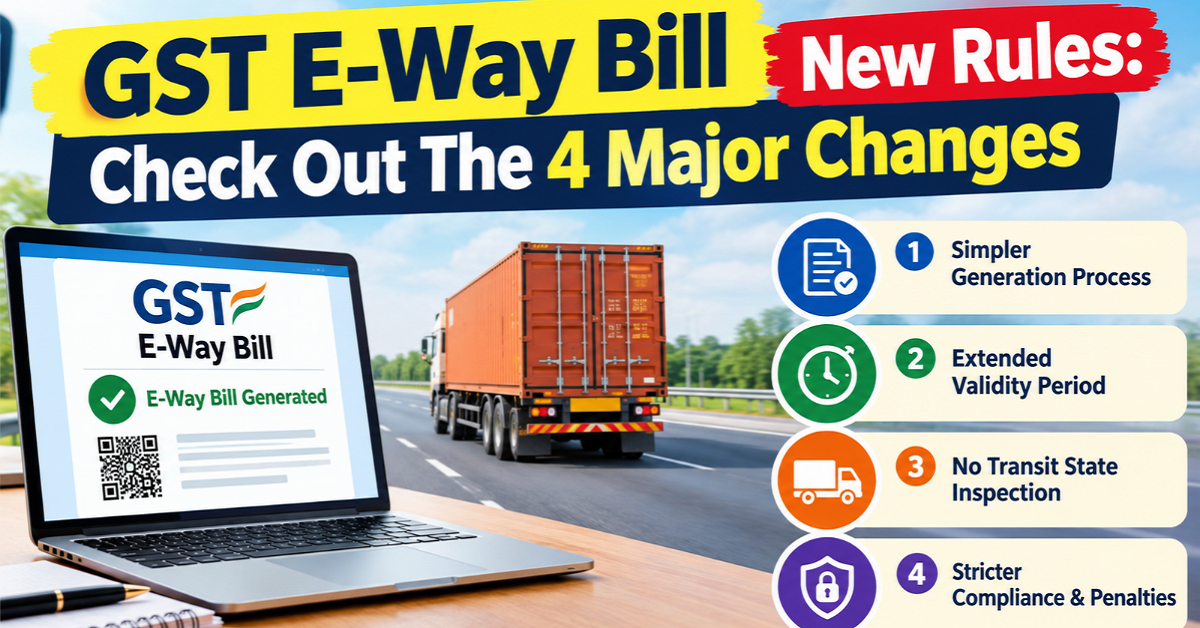
New GST E-Way Bill Rules: A Look at the 4 Key Changes
The Goods and Services Tax Network (GSTN) has rolled out significant updates to the e-way bill system. Starting 1 January 2025, businesses will need to comply with stricter requirements regarding document validity, e-way bill extensions, and multi-factor authentication when generating or extending e-way bills.
What Is An E-Way Bill?
An e-way bill is an electronic document mandated for transporting goods valued above ₹50,000, whether within a state or across state borders. It records details of the goods, consignor, consignee, transporter, and vehicle, enabling tax authorities to monitor the movement of goods.
Four Major Changes in GST E-Way Bill Rules
E-Way Bill Cannot Be Generated for Old Documents
Taxpayers can now generate an e-way bill only when the associated tax invoice, delivery challan, or other supporting document is dated no more than 180 days prior to the e-way bill's generation date.
For example, if an e-way bill is generated on 1 January 2025, the underlying document must be dated on or after 5 July 2024. Documents older than 180 days will not be accepted for e-way bill generation.
Why it matters: Businesses should avoid generating e-way bills long after the invoice or challan date, as delayed documentation can now obstruct the movement of goods.
E-Way Bill Extension Limited To 360 Days
Previously, no specific outer limit existed for extending an e-way bill's validity. Now, an eway bill can be extended only within 360 days from its original date of generation.
For example, an e-way bill generated on 1 January 2025 can be extended only until 25 December 2025; beyond that, no further extension will be permitted.
Why it matters: Transporters and businesses handling long-duration or delayed consignments must plan deliveries and extensions carefully.
Multi-Factor Authentication Is Now Mandatory
GSTN has mandated Multi-Factor Authentication (MFA) for e-way bill and e-invoice users in a phased rollout. Under MFA, users must log in with a username, password, and a onetime password (OTP) sent to their registered mobile number or generated through an approved app.
The rollout was as follows:
| Effective Date | Taxpayers Covered |
| 1 January 2025 | AATO above ₹20 crore |
| 1 February 2025 | AATO above ₹5 crore |
| 1 April 2025 | All other taxpayers and users |
Why it matters: Businesses must ensure that registered mobile numbers are active and accessible. Without OTP verification, users may not be able to generate or access e-way bills.
Stronger Compliance and Documentation Discipline
The new restrictions make timely documentation essential. Businesses must ensure that invoices, delivery challans, and e-way bills align in both date and details, particularly when goods remain in transit for extended periods.
These changes aim to curb the misuse of outdated documents, enhance traceability, and reinforce the integrity of the e-way bill system.
GST Council’s Proposed Rationalisation Of E-Way Bill Provisions
The GST Council has also recommended amendments to Sections 68, 129, and 130 of the CGST Act, 2017 to rationalise e-way bill provisions and reduce unnecessary interception of goods in transit. These recommendations aim to ensure smoother movement of goods while retaining powers to act against genuine tax evasion.
Interception Only on Specific Intelligence
Under the proposed changes, a conveyance carrying goods can be intercepted only based on specific intelligence and with authorisation from an officer not below the rank of Joint Commissioner. This is intended to prevent random or routine checking of vehicles.
No Interception in Transit States
Inspection, detention, or seizure can be taken only where either the supplier or recipient is located or registered in the state where interception occurs. In other words, goods passing through a transit state should not be intercepted merely because they are moving through that state.
Exceptions Where Documents Or E-Way Bill Are Missing
If no e-way bill has been generated, or the conveyance does not carry documents showing the origin or destination of goods, authorities may inspect, detain, or seize the goods irrespective of jurisdiction. This exception is meant to address cases where there is no traceability of the consignment.
No Confiscation for Goods in Transit
The proposed amendment clarifies that the provisions relating to confiscation of goods or conveyances under Section 130 of the CGST Act will not apply to goods or conveyances that are merely in transit.
Key Points for Businesses
- Generate e-way bills only for documents no older than 180 days.
Note that e-way bill extensions cannot exceed 360 days from the original generation date. - Enable and complete MFA when logging in to the e-way bill portal.
- Ensure invoice, challan, transporter, and vehicle details are accurate to avoid compliance issues.
- Train accounts, logistics, and dispatch teams on the revised timelines.
Also Read - Pin To Pin Distance: E-Way Bill
FAQs
Can a vehicle be stopped randomly for e-way bill verification under the proposed changes?
No. As per the GST Council’s recommendation, a conveyance can be intercepted only based on specific intelligence and with authorisation from an officer not below the rank of Joint Commissioner. This is intended to reduce unnecessary checking of goods vehicles.
2. Can authorities in a transit state detain goods simply because the vehicle is passing through?
Generally, no. Inspection, detention, or seizure is proposed to be allowed only where the supplier or recipient is located or registered in the state where interception takes place. However, this restriction will not apply where no e-way bill has been generated or documents showing the origin or destination of goods are unavailable.
3. What happens if goods are moving without an e-way bill or origin/destination documents?
In such cases, authorities may inspect, detain, or seize the goods irrespective of the jurisdiction. The absence of an e-way bill or documents establishing the movement of goods removes the protection available for goods in transit.
4. Can goods in transit be confiscated under Section 130 of the CGST Act?
The GST Council has recommended that confiscation provisions under Section 130 should not apply to goods or conveyances that are merely in transit. This clarification is expected to protect genuine transit consignments from excessive action.
5. Is the 180-day restriction applicable to delivery challans as well?
Yes. The restriction applies to e-way bills generated against supporting documents, including tax invoices and delivery challans. The document must be dated within 180 days from the date of e-way bill generation.
6. If an e-way bill is extended multiple times, can it remain valid indefinitely?
No. Even with multiple extensions, the e-way bill cannot remain valid beyond 360 days from its original date of generation. Once this period ends, no further extension is possible.
7. Does multi-factor authentication apply to transporters and e-way bill executives too?
Yes. The MFA requirement applies to taxpayers and users accessing the e-way bill system, not only to businesses with high turnover. From 1 April 2025, all users were required to complete MFA while logging in.
8. What should a business do if its registered mobile number is not accessible?
The business should update its registered mobile number in the GST portal before attempting to generate or access e-way bills. Since MFA requires OTP verification, an inaccessible mobile number can block e-way bill operations.
9. Are the GST Council’s e-way bill recommendations already enforceable?
No. The recommendations on interception, transit-state restrictions, and confiscation require amendments to the CGST Act. They should be treated as proposed legal reforms, unlike the GSTN system changes that took effect from 1 January 2025.
10. Why is the GST Council rationalising e-way bill provisions?
The objective is to balance compliance enforcement with ease of doing business. The reforms seek to prevent random vehicle checks, protect genuine transit movements, and allow authorities to act only where there is specific intelligence or missing documentation.










 CAclubindia