Revision for Accounting Standards - CA Intermediate (Part 3)


Quick Summary
This article provides a revision of Accounting Standard (AS) 3 on Cash Flow Statements, crucial for CA Intermediate students. It details the mandatory applicability for Level 1 enterprises and encourages its use for other entities. The content clarifies what constitutes cash and cash equivalents, defines cash flows, and outlines the three main classifications: operating, investing, and financing activities.

AS 3 Cash Flow Statements

  • A mandatory for Level 1 enterprises from accounting period commencing on or after April 2001.
  • Not a mandate but encouraged for Level II and Level III Non-corporate entities and Level II corporate Entities.

Exemption from preparing Cash Flow Statements
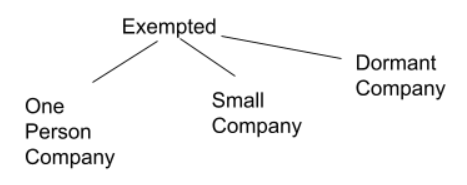
Exemption from preparing Cash Flow Statements

CA Intermediate: AS 3 Cash Flow Statements Explained

Cash and Cash equivalent:

  • Cash-It comprises cash on hand and demand deposits with banks.
  • Cash equivalents-They are short term, highly liquid investments that are readily convertible into known amounts of cash and which are subject to an insignificant risk of changes in value.

What are Cash Flows?

Cash flows are the inflows and outflows of cash and cash equivalents.


Presentation of Cash Flow Statement

Cash Flow depends on the the business and other factors of the enterprises.

Cash Flow is classified into:
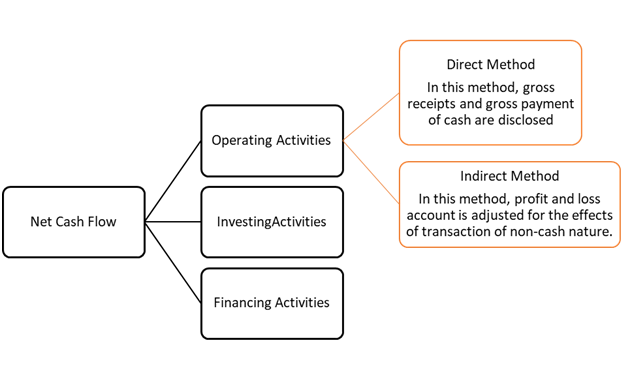
Presentation of Cash  Flow Statement

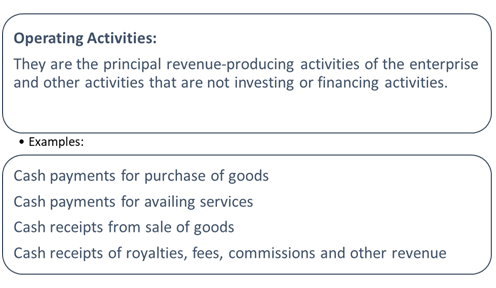
Operating Activities

Operating Activities

Investing Activities
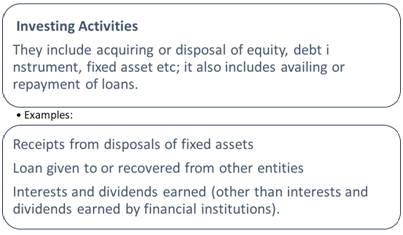
Investing Activities

Financing Activity
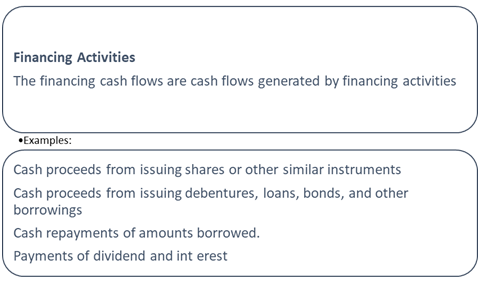
Financing Activity


Disclosure

Para 45 requires enterprise to disclose the amount of significant cash or cash equivalent held by it but not available for use.

Para 47 requires to disclose:

(i) The amount of undrawn facilities that may be available for future operating activities and to settle capital commitments.
(ii) The aggregate cash flow required for maintaining operating activities.

Also Read:

FAQ :

AS 3 Cash Flow Statements are mandatory for Level 1 enterprises from the accounting period commencing on or after April 2001.

Cash comprises cash on hand and demand deposits with banks.

Cash equivalents are short-term, highly liquid investments that can be easily converted into a known amount of cash with minimal risk of value change.

Cash flows are classified into Operating Activities, Investing Activities, and Financing Activities.

Enterprises must disclose significant cash or cash equivalents not available for use, and details on undrawn facilities for future activities and capital commitments, along with aggregate cash flow for maintaining operating activities.


3535 Views 3 Likes Comment   Share Students   Report


About the Author

Practice

I simplify complex income tax, TDS, banking, and investment updates into practical insights for taxpayers, salaried professionals, pensioners, and senior citizens. I regularly write on ITR filing, tax compliance, savings schemes, and the latest financial rule changes in India.

Comments :

Related Articles


Loading


Popular Articles


CCI Pro

CCI Articles

submit article