
Latest Update: UPI MDR charges on selected merchant transactions have been postponed until after Diwali 2026. The new implementation date is yet to be announced.
Introduction
UPI users in India will see an important change in how certain merchant payments are charged. While everyday UPI transfers and payments up to ₹2,000 remain free for consumers, the National Payments Corporation of India (NPCI) has introduced a revised Merchant Discount Rate (MDR) framework for specified person-to-merchant (P2M) transactions above ₹2,000.
Looking for a specific UPI rule? Tap below to jump straight to it.”
Under the new rules, eligible merchants will bear a 0.4% MDR on such payments, subject to a cap of ₹300 per transaction. Certain sectors, including railways, telecom, insurance, fuel, and agricultural inputs, will attract a flat ₹5 charge, while capital-market transactions will attract a lower 0.02% MDR. Importantly, consumers will not be charged separately for using UPI, and person-to-person transfers will continue to remain free.
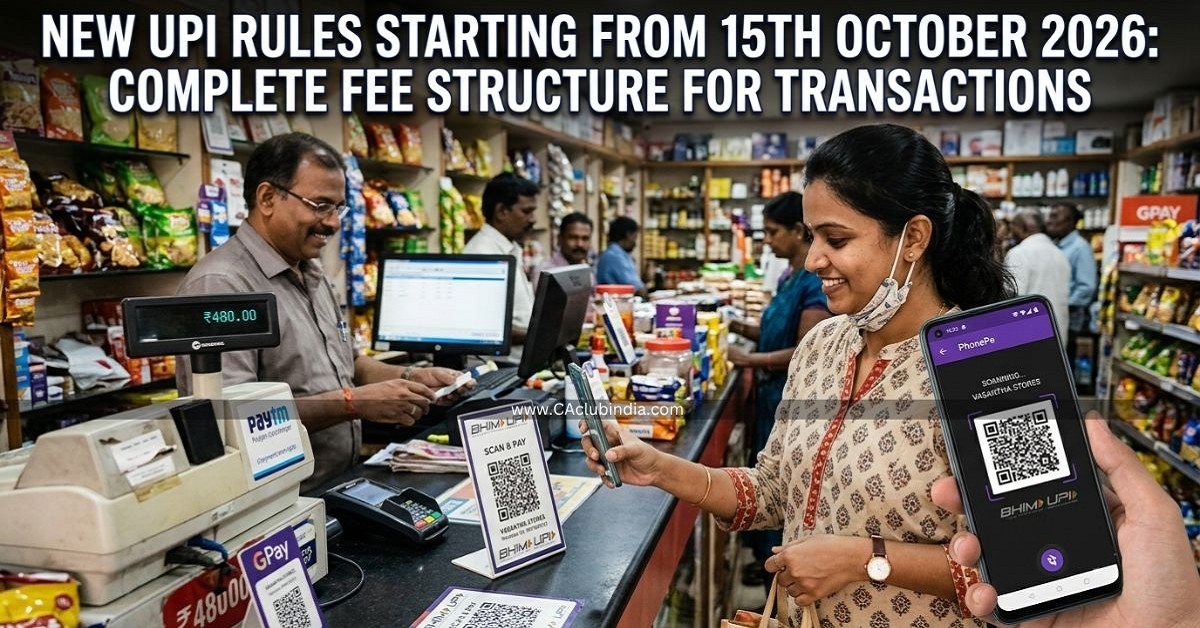
This article explains the new UPI rules effective from 15 October 2026, who will pay the charges, which transactions are affected, and what the changes mean for both consumers and merchants.
What remains free of charge?
Person-to-person (P2P) transfers - whether sending money to friends, family, or between your own accounts; continue to be free, regardless of the amount.
Merchant payments up to ₹2,000 stay free of MDR.
Small merchants enrolled under the P2PM scheme and receiving up to ₹1 lakh per month continue to be exempt from MDR.
What Changes for Merchants?
As per the new rules, eligible Person-to-Merchant (P2M) UPI payments via bank accounts exceeding ₹2,000 will now attract a 0.4% Merchant Discount Rate (MDR).
| Transaction Type | Threshold | Applicable MDR Fee |
| Everyday Merchant Payments (P2M) | Up to ₹2,000 | 0% (Free) |
| Standard Merchant Payments (P2M) | Above ₹2,000 | 0.4% (Capped at ₹300 for payments ₹75,000 and above) |
| Small Merchants (P2PM Category) | Up to ₹1 Lakh/month collections | 0% (Exempt) |
| Essential Services (Railways, Fuel, Telecom, Insurance, Agri Inputs) | Above ₹2,000 | Flat ₹5 per transaction |
| Capital Markets (Stockbroking, Mutual Funds, Securities) | Above ₹2,000 | 0.02% (Capped at ₹300) |
| UPI AutoPay Mandates (Recurring bills, OTT, SIPs) | Any Amount | 0% (Free) |
Who pays?
The MDR is borne by the merchant, not the customer. Merchants falling under this framework are not permitted to pass the charge on to consumers as a separate UPI transaction fee.
For instance, if a customer pays a qualifying merchant ₹10,000 via UPI, the applicable MDR works out to ₹40 (0.4%), which the merchant absorbs - it is not deducted from the customer's ₹10,000 payment.
Practical impact
- Day-to-day UPI activity paying a local store, dividing bills, or sending money is expected to remain largely unaffected, especially for payments of up to ₹2,000.
- Businesses making larger merchant payments in designated categories, however, may face higher costs, potentially influencing how they price goods or which payment methods they favour over time.
- The objective cited is to back investment in UPI infrastructure, innovation, and cybersecurity.
Other Notes
- The MDR is distributed among banks, payment service providers, and UPI app providers to fund infrastructure, cybersecurity, innovation, and customer service.
- A 5% share of MDR collections goes into a dedicated fund aimed at promoting UPI adoption among small merchants.
- The ₹2,000 figure is purely an MDR threshold and does not represent a new transaction limit.
- No Consumer Charges: The MDR is a merchant-paid fee remitted to the payment ecosystem (banks and apps). Banks have been instructed not to pass this cost on to customers.
- Credit Card-Linked UPI: Payments made via RuPay credit cards or pre-sanctioned credit lines linked to UPI follow existing card rules and are exempt from the new 0.4% MDR regime.
- No GST on MDR: No separate Goods and Services Tax is levied on the MDR itself.
Also Read - UPI Transaction Limits 2026
FAQs
Can merchants add a surcharge or recover the MDR from customers?
No. Merchants are strictly prohibited from passing on the MDR to customers. You must pay only the listed price of the product or service. Adding any “UPI charge” or surcharge is a violation. Banks and payment aggregators have been instructed to monitor and prevent this. The government will also conduct daily monitoring starting 15 October 2026.
What about UPI AutoPay, recurring mandates, SIPs, OTT subscriptions, and utility bills?
UPI AutoPay / recurring mandates (pull transactions where you have preauthorised future debits) are explicitly excluded from the new MDR. These remain free of the 0.4% charge regardless of amount.
This covers most recurring utility bills, OTT subscriptions, EMIs collected via AutoPay, and similar mandates.
One-time push payments (QR, payment links, etc.) above ₹2,000 follow the normal rules.
What about loan EMIs, debt collection, or repayments via UPI?
Debt-collection / loan-repayment / EMI transactions above ₹2,000 generally attract a flat ₹5 MDR (merchant-side).
If the EMI is collected through a UPI AutoPay mandate, it remains MDR-free. The borrower/customer does not pay any extra amount.
Do credit-card linked or credit-line UPI payments attract the new 0.4% MDR?
No. Payments funded through RuPay Credit Cards on UPI or pre-sanctioned credit lines fall outside this MDR framework and continue under existing card/credit product rules.
Is GST registration required for small merchants to get zero MDR?
No. Eligibility for the P2PM zero-MDR category is based on the monthly UPI receipt limit (up to ₹1 lakh), not on GST registration status.
How is the MDR calculated - on the full amount or only the amount above ₹2,000?
It is calculated on the full transaction value. Example: On a ₹3,000 payment, MDR = 0.4% of ₹3,000 = ₹12 (not 0.4% of the excess ₹1,000).











 CAclubindia
