
Many SBI customers still believe they must keep ₹3,000 or ₹5,000 in their savings account to avoid charges. But SBI's current rules are different from the older minimum-balance system.
If you have an SBI savings account in 2026, you may be wondering: What minimum balance do I need to maintain? What happens if my balance becomes zero? Will SBI charge me a penalty?
Here is what you need to know.
Table Of Content
- SBI Minimum Balance Rule in 2026
- SBI Savings Account Balance at a Glance
- Do You Need to Maintain ₹3,000 or ₹5,000 in SBI?
- What Happens If Your SBI Account Balance Falls Below ₹3,000?
- Can Your SBI Savings Account Have a Zero Balance?
- Why Do People Still Think SBI Requires ₹3,000 or ₹5,000?
- Minimum Balance and Other Bank Charges Are Different
- What About NRI SBI Savings Accounts?
- Key Points to Remember
- Conclusion
- How to Verify the Latest SBI Rules?
- FAQs
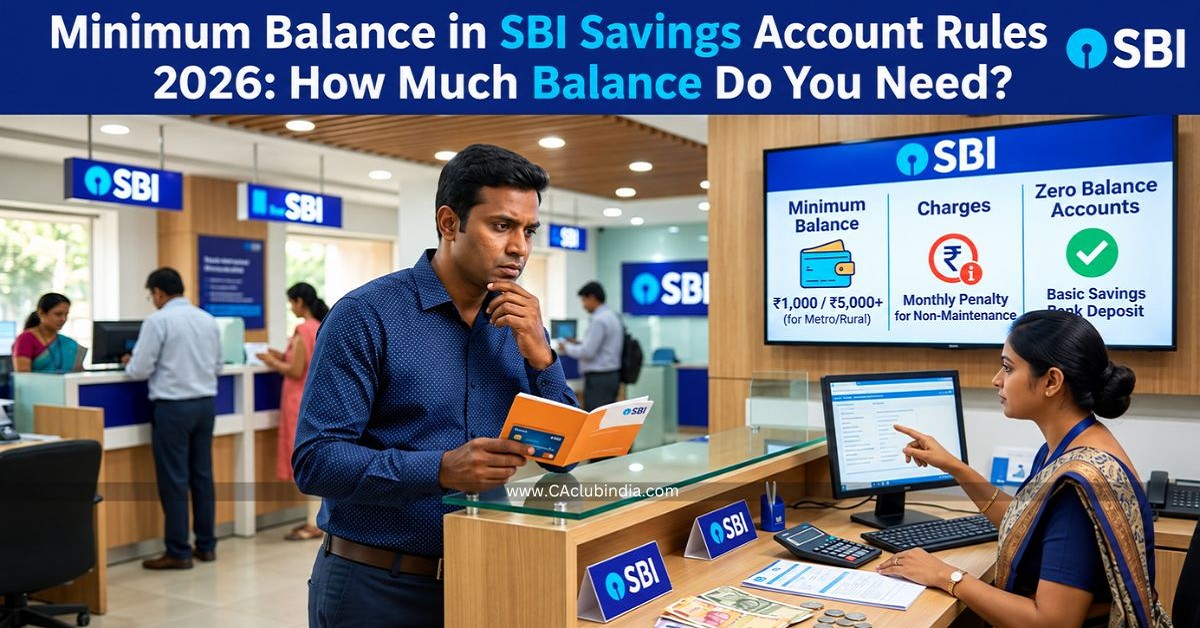
SBI Minimum Balance Rule in 2026
For a regular SBI savings account, SBI does not currently levy a penalty for failing to maintain the prescribed minimum or average monthly balance.
SBI has waived charges for not maintaining the average balance in savings accounts. Therefore, customers with regular domestic savings accounts do not need to keep ₹3,000 or ₹5,000 in their account merely to avoid a minimum-balance penalty. However, different SBI account products can have different terms. Customers should therefore check the specific conditions applicable to their account.
SBI Savings Account Balance at a Glance
| Account category | Minimum-balance penalty |
| Regular SBI Savings Account | No penalty for non-maintenance of minimum balance |
| Basic Savings Bank Deposit Account (BSBD) | No minimum balance requirement |
| PM Jan Dhan Account | No minimum balance requirement |
| Salary Package Account | Generally, no minimum balance requirement |
| NRE/NRO Savings Account | Account-specific conditions may apply |
Important: “No minimum-balance penalty” does not mean that every SBI account has the same terms and charges.
Do You Need to Maintain ₹3,000 or ₹5,000 in SBI?
No, not for the purpose of avoiding a minimum-balance penalty on a regular domestic SBI savings account. The figures of ₹5,000, ₹3,000, ₹2,000 and ₹1,000 that appear on some websites relate to older SBI schedules.
Under those older rules, the minimum monthly average balance varied according to the location of the branch:
| Earlier branch category | Earlier MAB |
| Metro | ₹5,000 |
| Urban | ₹3,000 |
| Semi-urban | ₹2,000 |
| Rural | ₹1,000 |
These figures should not be treated as the current 2026 penalty thresholds for ordinary SBI savings accounts. SBI's older service-charge document contains these figures, whereas its later policy information confirms that charges for non-maintenance of average balance in savings accounts were waived.
What Happens If Your SBI Account Balance Falls Below ₹3,000?
Suppose your SBI savings account has only ₹2,000, ₹500 or even a very low balance.
For a regular domestic savings account, SBI does not impose a minimum-balance penalty merely because the balance falls below the older ₹3,000 or ₹5,000 thresholds.
This is why customers should not rely on old articles that continue to quote the previous minimum-balance figures. However, other banking charges may still apply depending on the service you use.
Can Your SBI Savings Account Have a Zero Balance?
A regular savings account may have a very low balance without triggering a minimum-balance penalty.
However, customers should distinguish between:
- No minimum-balance penalty
- No minimum balance requirement
- A zero-balance account specifically designed by SBI
These are not necessarily the same thing.
For example, BSBD and PMJDY accounts have specific zero/minimum-balance provisions. For other account variants, the applicable account terms should be checked before assuming that the account can remain inactive or at zero indefinitely.
Why Do People Still Think SBI Requires ₹3,000 or ₹5,000?
The confusion largely comes from older SBI rules.
Earlier SBI service-charge schedules specified different Monthly Average Balance requirements depending on whether the account was maintained at a metro, urban, semi-urban or rural branch. The schedule also contained penalties for shortfalls.
Those older figures continue to appear in search results and older personal-finance articles. This can make it appear that SBI still requires every savings customer to maintain ₹3,000 or ₹5,000.
That is not the current position for a regular domestic SBI savings account.
Minimum Balance and Other Bank Charges Are Different
Customers should also understand that removing a minimum-balance penalty does not eliminate every possible SBI banking charge.
For example, charges may apply to particular banking services, transactions beyond prescribed free limits or specific account-related facilities.
Therefore, a customer should not interpret the rule as:
- “SBI savings accounts have no charges at all.”
The more accurate interpretation is:
- SBI does not currently charge a penalty for non-maintenance of minimum/average balance in regular savings accounts.
What About NRI SBI Savings Accounts?
NRI accounts can have separate terms and balance requirements.
Therefore, an NRE or NRO account holder should not automatically apply the rules applicable to a regular domestic savings account.
Before maintaining a low balance, NRI customers should check the applicable SBI NRI account terms and service-charge schedule.
Key Points to Remember
- SBI has waived the penalty for non-maintenance of average balance in savings accounts.
- The old ₹5,000/₹3,000/₹2,000/₹1,000 figures should not be treated as the current minimum-balance penalty thresholds for regular domestic savings accounts.
- A regular SBI savings customer does not need to maintain ₹3,000 or ₹5,000 solely to avoid a minimum-balance penalty.
- Different SBI account products can have different terms.
- BSBD and PMJDY accounts have specific zero/minimum-balance provisions.
- NRE/NRO account holders should check the rules applicable to their particular account.
- Other SBI service charges can still apply even when there is no minimum-balance penalty.
Conclusion
If you have a regular SBI domestic savings account, you generally do not need to maintain ₹3,000 or ₹5,000 solely to avoid a minimum-balance penalty.
However, the rules can differ for specific account types, particularly NRI and specialised accounts. It is therefore important to check the latest SBI terms applicable to your account.
How to Verify the Latest SBI Rules?
Note: SBI’s account terms and service charges may change from time to time. Before relying on any minimum-balance information, readers should verify the latest applicable rules on the official SBI website.
Check the Personal Banking → Service Charges/Fees section and, where applicable, the specific terms and conditions for your particular savings account.
Also Read
FAQs
1. What is the minimum balance required in an SBI savings account in 2026?
For a regular domestic SBI savings account, there is no penalty for non-maintenance of the earlier prescribed minimum/average balance.
2. Do I need to keep ₹5,000 in my SBI account?
No, not for avoiding a minimum-balance penalty on a regular domestic SBI savings account. The ₹5,000 figure comes from an older SBI service-charge structure.
3. Is ₹3,000 the minimum balance in SBI?
No. ₹3,000 was an older minimum average balance applicable to certain urban-branch savings accounts. It should not be presented as the current 2026 penalty threshold for regular SBI savings accounts.
4. Will SBI charge me if my savings account balance is below ₹1,000?
For a regular domestic SBI savings account, there is no minimum-balance penalty simply because the balance falls below ₹1,000.
5. Does SBI charge for other banking services?
Yes. The absence of a minimum-balance penalty does not mean that all SBI services are free. Applicable charges can depend on the particular service, transaction or account type.
6. Do SBI NRE and NRO accounts have the same rules?
Not necessarily. NRI accounts can have separate requirements and charges. NRE/NRO customers should check the terms applicable to their particular account.










 CAclubindia