
Revision for Accounting Standards - CA Intermediate (Part 1)


Quick Summary
This article covers Accounting Standard (AS) 1 concerning the disclosure of accounting policies. It explains the purpose of these disclosures, which is to enhance the understanding and comparability of financial statements. The content also defines accounting policies, outlines key factors to consider when selecting them (like prudence, substance over form, and materiality), and details the conditions under which an entity can change its accounting policies for a more appropriate financial presentation.

AS 1: Disclosure of Accounting Policies

(Issued in November 1979, Came into existence from accounting periods commencing on or after April 1 ,1991.)

Purpose of Disclosure of Accounting Policies

  1. To Promote Better Understanding of Financial Statement, by disclosing significant accounting policies in an orderly manner.
  2. To facilitate meaningful comparison between financial statements of different enterprises for the same accounting period.
  3. Disclosure of changes in Accounting Policies which helps the users to compare the same enterprise’s financial statements for different accounting periods.

Accounting Policies: CA Intermediate Revision Guide

What are Fundamental Accounting Assumptions?
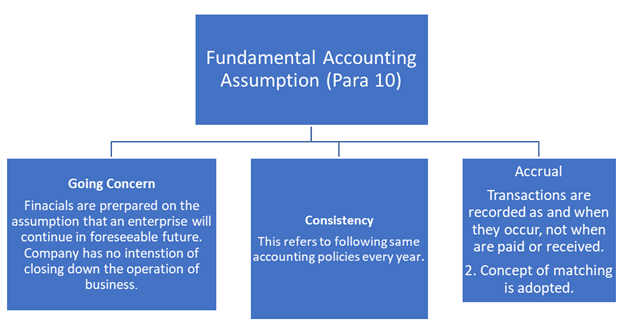
Fundamental Accounting Assumptions

What are Accounting Policies?

Accounting Policies refer to rules and methods to adopt such principles in financial accounts for a true and fair presentation.

For example: FIFO or weighted Average method is used for valuation of Inventory. SLM or WDV method is used for depreciation.

Factors to be considered while selecting an Accounting Policy

  1. Prudence: A loss is to be recognized in the view of uncertainty of events. Profits are to be recorded only when it is realized.
  2. Substance over form: Transactions should be recorded with financial reality not merely their legal form.
  3. Materiality: Financial Statements should disclose all the material items/ facts which influence the decisions of the shareholders.
 

Change in Accounting policy

When can an entity Change Accounting Policy?

Entity can change the accounting Policies if the following Conditions are satisfied.

  1. Adoption of different accounting policies is required by law/ statute.
  2. In Compliance with other Accounting Standards
  3. Change in Accounting Policy will result in more appropriate presentation of Financial Statements.
 

Effects of Change in Accounting Policy
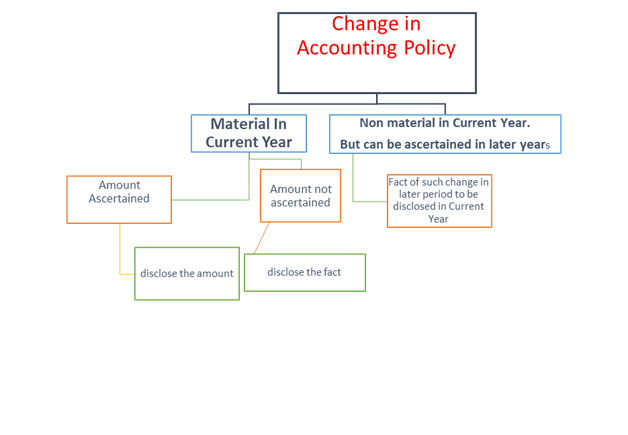
Change in Accounting Policy

FAQ :

The main purpose is to promote a better understanding of financial statements and to facilitate meaningful comparison between the financial statements of different enterprises.

Accounting policies refer to the rules and methods adopted in financial accounts to ensure a true and fair presentation of financial information.

Key factors include Prudence (recognising losses but not profits until realised), Substance over form (recording transactions based on their financial reality), and Materiality (disclosing all facts that influence decisions).

An entity can change its accounting policies if required by law or statute, in compliance with other accounting standards, or if the change results in a more appropriate presentation of financial statements.

AS 1 is the standard for the Disclosure of Accounting Policies, issued in November 1979 and effective from accounting periods starting on or after April 1, 1991.


7477 Views 4 Likes Comment   Share Students   Report


About the Author

Practice

I simplify complex income tax, TDS, banking, and investment updates into practical insights for taxpayers, salaried professionals, pensioners, and senior citizens. I regularly write on ITR filing, tax compliance, savings schemes, and the latest financial rule changes in India.

Comments :

Related Articles


Loading


Popular Articles


CCI Pro

CCI Articles

submit article