
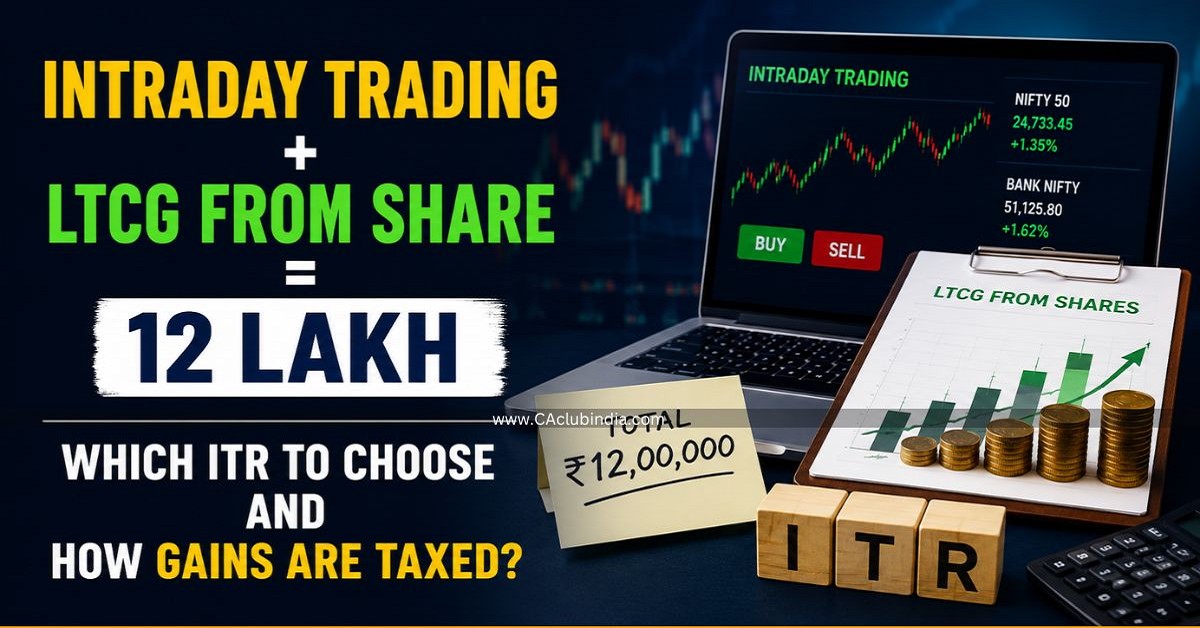
Say your year in the market looked like this: ₹5.5 lakh from intraday trading and ₹6.5 lakh in long-term capital gains (LTCG) from delivery-based shares - a combined ₹12 lakh. On paper it looks like one number, but the tax law treats these as two completely different animals. One is business income, the other is capital gains, and mixing up the ITR form or the tax treatment is one of the most common - and expensive - mistakes active traders make. Here is exactly which ITR to file and how much tax this combination actually attracts for AY 2026-27.
How intraday profit and LTCG are classified?
The two incomes fall under entirely different heads of income:
- Intraday equity trading (₹5.5 lakh): Buying and selling the same stock within a single trading session, without taking actual delivery, is classified as speculative business income under Section 43(5) of the Income Tax Act. It is taxed under "Profits and Gains from Business or Profession," not as capital gains.
- LTCG from shares (₹6.5 lakh): Profit from delivery-based shares held for more than 12 months, on which Securities Transaction Tax (STT) has been paid, is taxed as long-term capital gains under Section 112A, a completely separate head of income with its own flat tax rate.
This distinction is the single most important thing to get right, because it decides which ITR form you're even allowed to file.
Also Read - Long-Term Capital Gain Tax: Exemptions Available in AY 2026-27
Which ITR form applies?
The moment you have any business income - and speculative income from intraday trading counts as business income - ITR-1 and ITR-2 are both ruled out, regardless of how small or large the amount is. You are required to file ITR-3.
Inside ITR-3, the two incomes go into two separate schedules:
- The ₹5.5 lakh intraday profit is reported in Schedule BP (Business or Profession), under the speculative business sub-head, along with the trading account details required for AY 2026-27.
- The ₹6.5 lakh LTCG is reported in the Capital Gains schedule within the same ITR-3 - the identical schedule that an investor using ITR-2 would use, just embedded inside the more comprehensive ITR-3 form.
Common mistake: Traders often assume that because their capital gains are larger than their trading income, ITR-2 should work. It doesn't. Even ₹1 of speculative business profit is enough to require ITR-3 for the entire return, LTCG included.
How the ₹5.5 lakh intraday profit is taxed?
Speculative business income has no special or flat tax rate. It is added to your total income and taxed at your normal slab rate, exactly like salary or any other business profit. There's no benefit of a lower fixed rate here, unlike LTCG - the more you earn from intraday trading, the higher the slab you can move into.
A few other points specific to intraday income:
- No standard deduction applies to it (standard deduction is only for salary and pension income).
- Presumptive taxation under Section 44AD is not available for speculative business, so profit has to be computed on an actual basis with proper books of account where applicable.
- Section 87A rebate can apply to this portion if your total normal-rate income (after adjusting for any other income) stays within the eligible limit - more on this in the worked example below.
How the ₹6.5 lakh LTCG is taxed?
LTCG on listed shares is governed by Section 112A. For FY 2025-26 (AY 2026-27):
- The first ₹1.25 lakh of LTCG under Section 112A in a financial year is exempt.
- The balance is taxed at a flat 12.5%, with no indexation benefit.
- Eligibility requires the shares to be held for more than 12 months and STT to be paid on the transaction.
- Section 87A rebate does not apply to Section 112A gains - this holds true under both the old and new tax regimes. Even if your total income would otherwise be fully covered by the rebate, LTCG under 112A still gets taxed.
On ₹6.5 lakh of LTCG: ₹6,50,000 − ₹1,25,000 exemption = ₹5,25,000 taxable, taxed at 12.5%.
Set-off rules: what can't be mixed
Important: Intraday (speculative) profit and LTCG sit in watertight compartments for set-off purposes.
- A loss from intraday trading can be set off only against speculative business profit - not against LTCG, salary, or any other head. If not fully absorbed, it can be carried forward for 4 assessment years, but only against future speculative profit, and only if the return is filed on or before the due date.
- A long-term capital loss can be set off only against capital gains (long-term against long-term; under specific conditions, against short-term too) - never against speculative or business profit.
- In this example both figures are profits, so set-off doesn't come into play, but it's worth knowing before you assume a bad year in one column can offset a good year in the other.
Do you need a tax audit?
This is where profit and turnover get confused most often. Tax audit applicability under Section 44AB is driven by trading turnover, not by the profit figure. For intraday trading, turnover is computed as the absolute sum of all positive and negative differences across trades - it is not the total value of shares bought and sold. A trader can show a modest ₹5.5 lakh profit while still running a turnover that crosses the audit threshold, or vice versa. Since speculative business is not eligible for the Section 44AD presumptive scheme, turnover-based audit thresholds under Section 44AB apply directly. Get your turnover computed properly and checked against the current threshold before assuming audit is or isn't required - this is one detail worth getting a CA to verify rather than guessing.
Also Checkout
- 30-Day ITR Rule That Every Taxpayer Should Know
- Individual Income Tax Return Filing Due Dates for AY 2026-27
- Penalty For Late Filing Of Income Tax Return For AY 2026-27
- Income Tax Audit Last Date For The AY 2026-27
FAQs
Which ITR form applies if I have both intraday trading income and LTCG from shares?
ITR-3. Any speculative business income, including intraday trading, rules out ITR-1 and ITR-2. LTCG is reported in the Capital Gains schedule within ITR-3 itself.
How is intraday trading profit taxed?
As speculative business income, added to total income and taxed at your normal slab rate - there is no flat or special rate for it.
How is LTCG on shares taxed for AY 2026-27?
Under Section 112A, the first Rs 1.25 lakh of LTCG on listed shares (held over 12 months, STT paid) is exempt each year, and the balance is taxed at a flat 12.5%, with no indexation.
Can intraday trading loss be set off against LTCG, or LTCG loss against intraday profit?
No. Speculative loss can only be set off against speculative profit, and capital loss only against capital gains. The two heads cannot offset each other.
Is a tax audit compulsory for someone with Rs 5.5 lakh intraday profit?
Not automatically. Audit applicability depends on computed trading turnover crossing the prescribed threshold under Section 44AB, not on the profit amount itself - this needs to be checked separately.











 CAclubindia

