
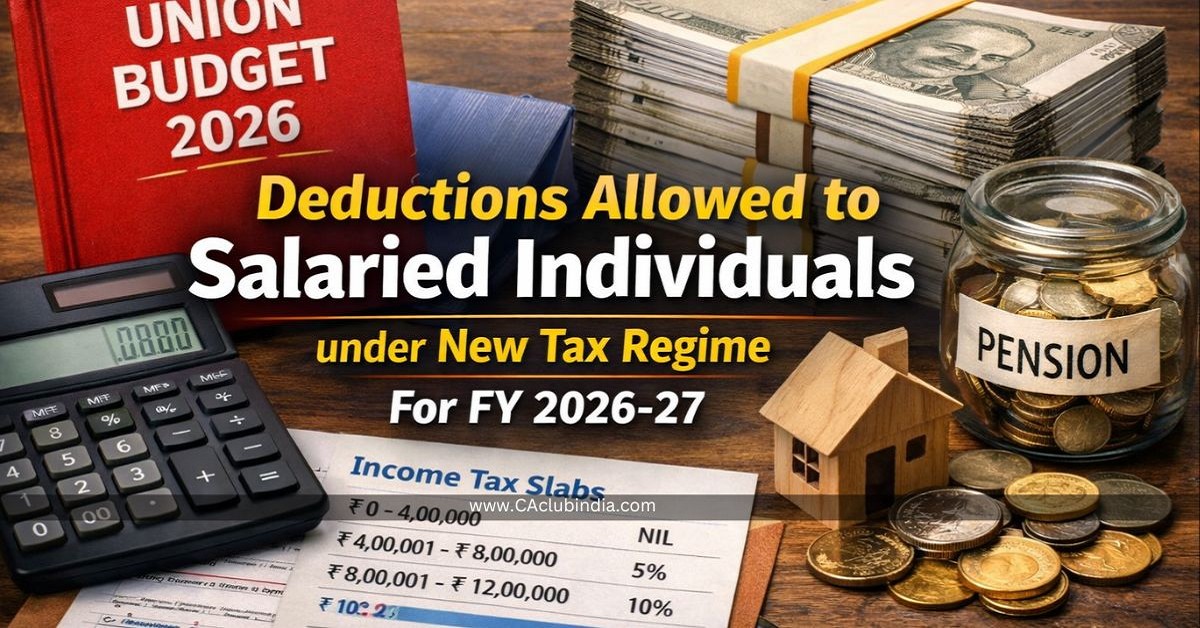
According to the Union Budget 2026 announcements, no changes have been made to the deductions available to salaried individuals under the New Tax Regime for the financial year 2026-27 (assessment year 2027–28).
The following deductions and exemptions are allowed under the New Tax Regime for the financial year 2026–27.
Standard Deduction
Salaried individuals and pensioners are eligible for a flat Standard Deduction of ₹75,000, which is deducted directly from gross salary prior to computing taxable income.
Employer’s NPS Contribution [Section 80CCD(2)]
A deduction is available for the contribution made by your employer to your National Pension System (NPS) account. The deduction is limited to 14% of your salary (Basic + Dearness Allowance). This provision applies to both private-sector and government employees. Please note that this deduction is separate from your own contribution, which is not eligible for deduction under the New Tax Regime.
Deduction for Family Pension [Section 57(iia)]
A deduction is available on family pension, limited to ₹25,000 or one-third of the pension, whichever is less.
Agniveer Corpus Fund [Section 80CCH]
Contributions to the Agniveer Corpus Fund (Agnipath scheme) by either the individual or the Central Government are fully deductible.
Specific Exemptions & Allowances
Although most allowances are taxable, the following exemptions continue to apply under Section 10(14), subject to the condition that they are utilized for official purposes:
- Conveyance Allowance: For travel undertaken in the course of employment.
- Daily Allowance: For ordinary daily expenses incurred during tours or transfers.
- Transport Allowance: Available specifically to specially-abled employees, up to ₹3,200 per month.
Additionally, interest earned and maturity proceeds from the Public Provident Fund (PPF) and Sukanya Samriddhi Yojana (SSY) remain tax-free.
Tax-Free Income Threshold (with Rebate)
One of the most significant advantages for FY 2026–27 is the rebate available under Section 87A. Resident individuals with a taxable income of up to ₹12 lakh are eligible for a rebate of up to ₹60,000, effectively resulting in zero tax liability. When combined with the ₹75,000 standard deduction, this brings the effective tax free threshold for salaried individuals to a gross salary of ₹12.75 lakh.
Summary Table: FY 2026-27 Slabs (New Regime)
| Income Slab (₹) | Tax Rate |
| 0 – 4,00,000 | Nil |
| 4,00,001 – 8,00,000 | 5% |
| 8,00,001 – 12,00,000 | 10% |
| 12,00,001 – 16,00,000 | 15% |
| 16,00,001 – 20,00,000 | 20% |
| 20,00,001 – 24,00,000 | 25% |
| Above 24,00,000 | 30% |
What salaried individuals can claim?
| Item | Allowed under new regime? | Remarks |
| Standard deduction | Yes | ₹75,000 on salary income |
| Employer NPS (80CCD(2)) | Yes | Up to 10–14% of salary as per employer type |
| Employee NPS (80CCD(1)/(1B)) | No | Not allowed |
| HRA exemption | No | HRA must be taxed as per regime-wise rules |
| 80C, 80D, 80E, LTA, etc. | No | Not allowed under new regime |











 CAclubindia