
Overview
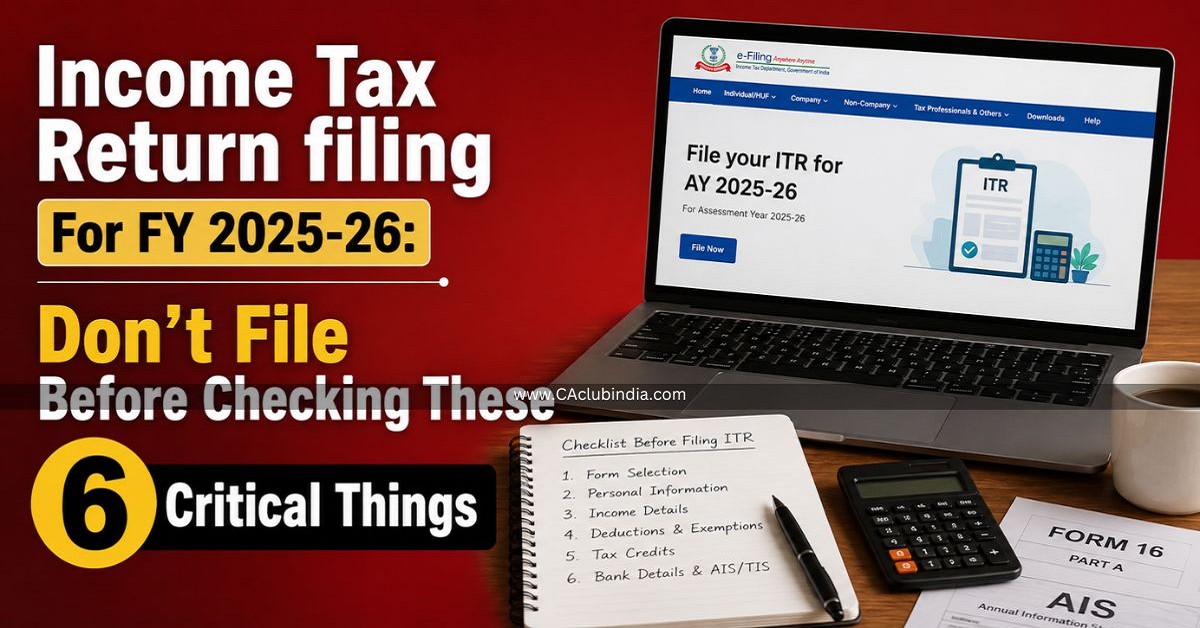
Income Tax Return Filing for FY 2025-26 has already begun with the online forms ITR-1 and ITR-4. Filing your ITR early may seem like a smart move but without checking specific records may create serious problems later.
The IT Department now cross-checks information from banks, employers, registrars, investment platforms, credit card companies and other reporting entities through systems like AIS, TIS and Form 26AS. Even a small mismatch may trigger notices, defective return warnings and future consequences.
So, before submitting your return, every taxpayer should complete these below mentioned six critical checks to avoid future complications.
Check AIS/TIS and wait until 31 May
The most important step is reviewing your AIS (Annual Information Statement) and TIS (Taxpayer Information Summary). Many banks and other reporting entities submit high-value transactions to the department through SFT (Statement of Financial Transactions) by 31 May, so filings your return before that date may miss those later-reported entries and may create mismatches.
Transactions Commonly Reported in AIS/TIS
Savings Account Cash Deposits
- Deposits above ₹10 lakh (with PAN)
- Deposits above ₹5 lakh (without PAN)
Current Account Transactions
- Cash deposits and withdrawals above ₹50 lakh
Fixed Deposits (FDs)
- FDs exceeding ₹10 lakh are reportable
- Auto-renewals usually are not treated as new deposits
- Breaking and recreating an FD may become reportable
Insurance Premium
- With PAN ₹5 lakh
- Without PAN ₹2.5 lakh
Property Transactions
- Property transactions of ₹45 lakh or more are reported by registrars
Stamp Paper
- If done with having PAN ₹2 lakh and without PAN ₹1 lakh.
Credit Card Payments
- Cash payments above ₹1 lakh and ₹10 lakh through online are reportable.
Purchase of Share, Bonds and Debenture
- ₹10 lakh or more
Match TDS, Form 16 and 26AS Properly before filing
Many taxpayers make mistake while filing ITR using only Form 16. However, the IT Department primarily relies on Form 26AS for tax credit verification.
Employers normally issue Form 16 by end-May or by 15 June but you should not file until you have reconciled Form 16 and Form 26AS.
If Form 16 shows higher TDS but 26AS shows lower TDS, the department will rely mainly on 26AS for tax credit. For this issue you must get the employer or bank (for Form 16A issued TDS interest) to correct reporting so that 26AS reflects actual TDS before filing. If unresolved, you may need legal recourse.
Choose Correct Tax Regime
You must decide whether to opt for the new tax regime or retain the old regime as selecting the wrong tax regime may increase your tax liability unnecessarily.
- For Salaried Pensioners Filing ITR-1: The tax regime choice can be changed year-to-year
- For Business or Presumptive Taxation Cases Filing ITR-4: Rules are stricter. Previous regime choices matter as if you want to switch you need to fill form 10IEA.
Aggregate and Report all Bank accounts Correctly
Now disclosing bank balance are mandatory especially important for taxpayers filing ITR-3 and ITR-4.
- For ITR-4 filers under presumptive taxation and ITR-3 must report bank balances of all the Indian Bank Accounts for 1 April to 31 March period.
- You must check credit-side receipts like salary, rent, pension, interest, FD interest, loans received, UPI/NEFT/IMPS receipts, etc. as they are treated as income or require explanations and documentary support. Loans from friends over ₹50,000 may be taxable as income from other sources if not properly documented. Gifts from relatives are exempt but gifts from non-relatives above thresholds and cash gifts above prescribed limits may become taxable.
Note : Bank Balance does not include credit card balance and FD balance as you need to report them separately.
Explore More: Income Tax Bank Balance Disclosure Rules in ITR-4
Watch debits vs declared income:
If your declared income is low but your debits (i.e., spending or transfers) are very large, the tax department will expect documentary explanation and may raise a notice.
Reconcile High-Value Non-Cash Transactions and Investments
Purchases of bonds, debentures, shares over ₹10 lakh are reportable, share market turnover (including derivatives/FO trading) and unlisted shares must be disclosed - even if transactions produce a loss, they must be shown in return.
Other Mandatory ITR Filing Conditions
You must report if you have:
- Business sales: ₹10 lakh or above
- Foreign spent: ₹2 lakh or more
- Electricity Bill Paid: ₹1 Lakh or more
- TDS/TCS: ₹25,000 (for non senior) and ₹50,000 (for senior)
- Foreign income or assets
- Loss to be carried forward for business or capital loss.
Also Read - Short Term Capital Gains Tax Deductions
Provide New and Expanded Details on Returns
Contact Information: You may now provide secondary:
- Mobile number
- Email ID
- Address
Two House Properties Allowed: ITR-1 and ITR-4 now allow reporting of:
- Two house properties
- instead of only one earlier.
Transaction Reference Details: For Section 80G you may require:
- UPI reference number
- IMPS/NEFT/RTGS details
- Cheque number
- IFSC code
Political Donations: You may need:
- Political party name
- PAN of done
Conclusion
Income Tax Return filing for FY 2025–26 should not be treated as a routine formality. You must wait until 31 May (or until AIS/TIS and late bank SFTs reflect correctly) and then reconcile to your declared income. A properly verified return can save you from unnecessary notices, penalties, revisions and stress in the future.









 CAclubindia
