
Overview
An Income Tax Demand Notice issued under Section 143(1) is an "intimation" sent by the Centralised Processing Centre (CPC) after your ITR is processed. It is triggered when a discrepancy in the return results in additional tax due, a refund, or no change at all. This notice is typically system-generated and does not amount to a scrutiny assessment. However, you must respond within the specified timeframe to avoid accruing interest or facing recovery proceedings.
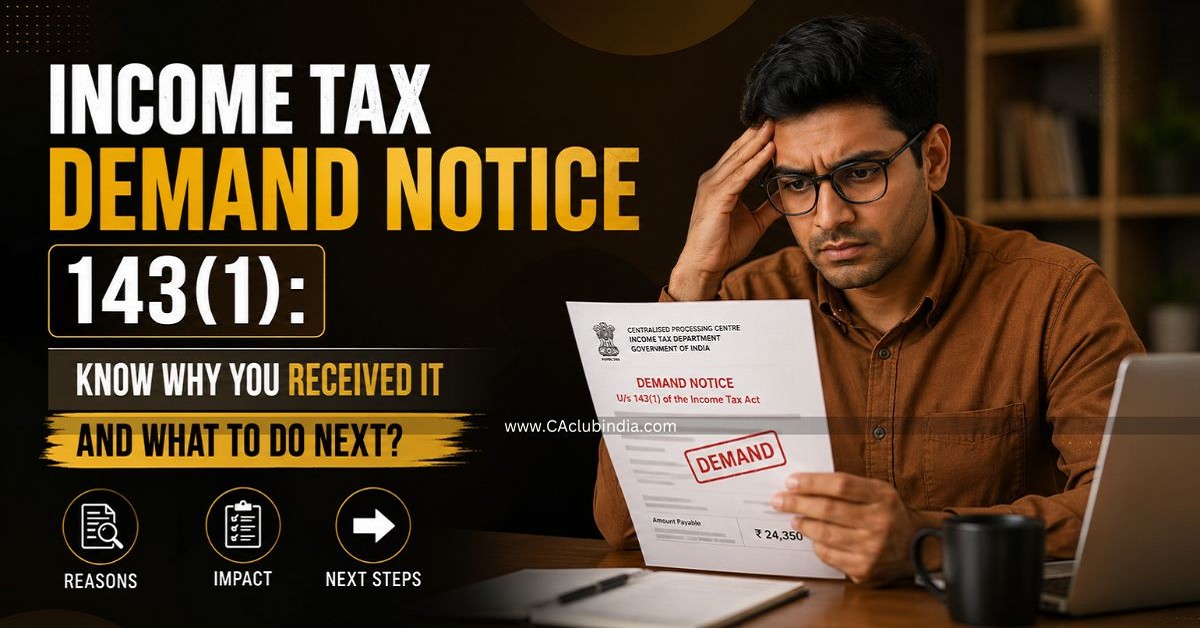
What a Section 143(1) Intimation Actually Means?
Once you've filed and verified your Income Tax Return, the Centralised Processing Centre (CPC) processes it by performing preliminary checks and cross-verifying your reported figures against data available in Form 26AS, AIS/TIS, and other sources.
The result of this automated review is communicated to you as an "Intimation under Section 143(1)." This intimation can reflect one of three outcomes: no tax payable or refund due (i.e., a nil adjustment), a refund payable to you, or a tax demand along with applicable interest.
When the Intimation Becomes a "Demand Notice"
If the CPC's computation reveals that your tax liability exceeds the amount you had already paid while filing your return, the intimation will show a "tax payable" figure. This constitutes a demand. In most cases, this amount also includes interest levied under Sections 234A, 234B, and/or 234C, as applicable.
At this point, the intimation effectively functions as a formal demand notice. You are required to settle the outstanding amount within the prescribed timeline, typically 30 days from the date of service of the notice, unless a shorter period is explicitly mentioned.
Common Reasons You Received This Notice
Typical triggers that are easy to explain in your content include:
- A mismatch between the income reported in your ITR and the income reflected in Form 26AS, AIS, or TIS. This could occur if you omitted interest from fixed deposits, salary from a second employer, or proceeds from the sale of securities.
- Incorrect claim of TDS, advance tax, or self-assessment tax. This may arise from wrong challan details, missed credits, or duplicate claims of TDS.
- Disallowance of deductions or exemptions, either fully or partially, due to section-wise limits, missing schedules, or apparent ineligibility. Examples include claiming Section 80C above the permitted limit, errors in HRA calculation, or home loan interest not supported by the relevant schedule.
- Arithmetical or clerical errors in the return itself, such as incorrect tax slab computation or mistakes in summing up total income.
- System driven adjustments related to fees or interest, including late filing fees under Section 234F or minor rounding differences.
Step by Step: What To Do Next?
1. Verify Authenticity
Confirm that the notice has been issued from a valid Income Tax Department email ID or SMS and is also reflected in your e-filing account under the "View Notices/Orders" section.
Ensure that your PAN, assessment year, DIN or document number, and date are consistent with what appears on the portal.
2. Compare With Your Records
Download the intimation PDF and keep your filed ITR, Form 26AS, AIS/TIS, and challan receipts available for side by side comparison.
Identify exactly which line item differs, whether it relates to an income head, deduction section, TDS credit, or interest and fee calculation.
If You Agree With the Demand
Log in to the e-filing portal and navigate to "Pending Actions" followed by "Response to outstanding demand." Choose to "Agree" or "Partially agree" as applicable.
Pay the agreed amount using Challan ITNS 280 or the e-pay tax facility. Ensure you select the correct assessment year and the appropriate minor head, such as "400 – Tax on regular assessment" if applicable. After making the payment, map the challan in the portal to close the demand.
Practical content angle: You can include a brief walkthrough of the portal screens, highlighting key fields to watch such as assessment year, minor head, PAN, and bank selection. Emphasise the impact of selecting wrong heads on future mismatches.
If You Disagree With the Demand
On the same "Response to outstanding demand" screen, select "Disagree" or "Partially disagree" and provide reason codes, such as TDS not considered, challan not matched, or deduction wrongly disallowed. Attach supporting documents where the option is enabled.
In many cases, you should also file an online rectification request under Section 154 by going to "Services" and then "Rectification." Point out the specific mistake in CPC processing and reference the intimation number.
For content: You can create a carousel showing each typical objection reason with a mini case, for example, "CPC ignored this TDS – how to fix."
Timelines and Consequences of Inaction
A demand raised under Section 143(1) should generally be paid or disputed within 30 days from the date of service. If you fail to act within this period, interest may continue to accrue and recovery measures could be initiated.
Ignoring the notice may lead to adjustment of future refunds against the outstanding demand, issuance of reminder notices, or further proceedings under other provisions if the department treats it as non-compliance.
When to Seek Professional Help
Complex AIS mismatches, such as those involving multiple brokers, speculative versus non-speculative income, or futures and options turnover issues, warrant a detailed review by a chartered accountant or tax professional. Similarly, high value demands also merit expert assistance.
Cases involving incorrect residential status, foreign income, or carry forward losses from previous years that have been adjusted by the CPC should also be handled with professional support to avoid compounding errors.
How to Avoid Such Notices in Future?
Always reconcile salary, interest, capital gains, and other sources of income with Form 26AS and AIS/TIS before filing your return.
Validate deductions and exemptions with actual supporting documents, use the correct ITR form, and let the portal or tax software compute your tax liability to minimise arithmetic errors.
File your return on time, pay the correct advance tax and self-assessment tax, and double-check challan details to ensure all credits are properly captured by the CPC.
You have reached your daily limit of 2 Free Articles
Subscribe to CCI PRO for unlimited access
Why Upgrade to CCI PRO?
- No Ads
- WhatsApp Community
- Daily E-Newsletter
- Unlimited Articles Access
- Profile Visitors
- Link Social Profiles
- Featured Job Posts
- Pro Badge
- Expert GST Guidance
- Unlimited Forum Replies
- Download Content in PDF
Already a PRO member? Login here for an ad-free experience. 07941056694










 CAclubindia
