 efiletax
Why Prices Rise Despite Unsold Flats and Should You Really Buy a House?
India's housing market in 2025-26 is behaving in a way that confuses almost every middle-class buyer.
On one side:
- lakhs of unsold flats
- falling sales volumes
- affordability crisis
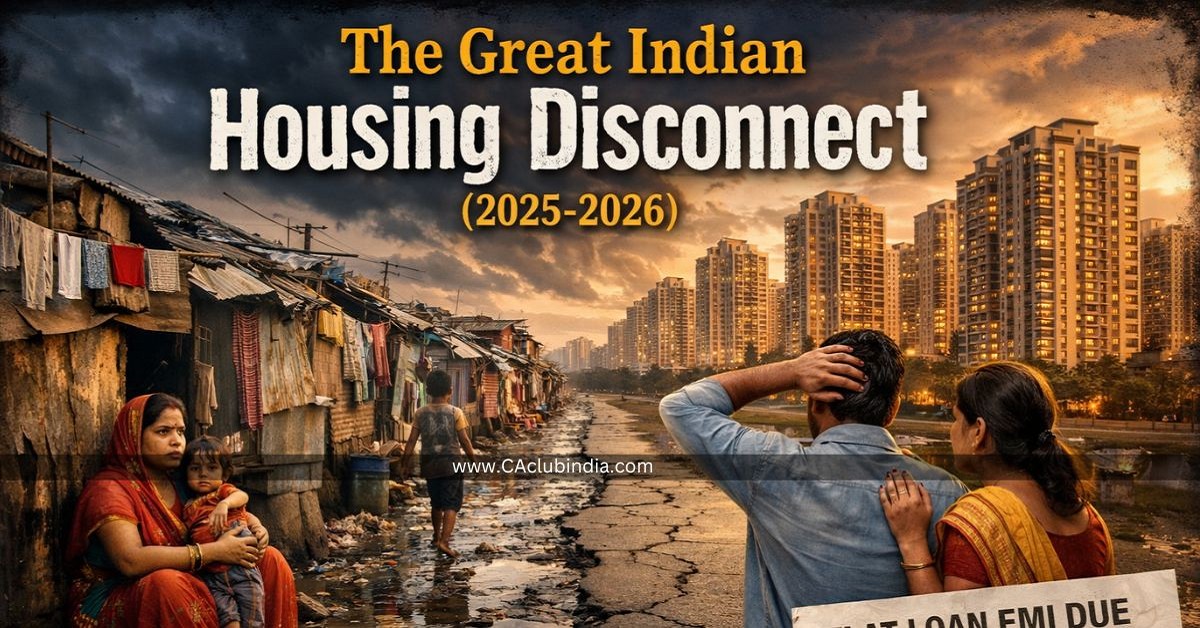
On the other side:
- prices still increasing
- luxury launches dominating
- rents staying low compared to property value
This is not a normal supply-demand market anymore. It has become a financial-structure-driven market.
Let's understand what is actually happening.
1. The Big Reality - India Does NOT Have a Housing Shortage
India has an affordable housing shortage, not a total housing shortage.
At the end of 2025:
Unsold homes in top 7 cities ≈ 5.77 lakh units
| City | Unsold Flats |
|---|---|
| Mumbai Metropolitan Region | ~1.79 lakh |
| Hyderabad | ~96,000 |
| Delhi-NCR | ~90,000 |
| Pune | ~83,000 |
| Bengaluru | ~64,800 |
| Chennai | ~33,400 |
| Kolkata | ~29,000 |
Sales actually declined during the year - but launches continued.
So why didn't prices fall?
Because the Indian housing market is not controlled by buyers. It is controlled by balance sheets.
2. The Premiumization Shift - Middle Class Priced Out
In 2022: Affordable homes (< Rs 50L) formed ~63% of sales
In 2025: Affordable homes dropped to nearly ~20%
Meanwhile:
- Homes above Rs 1 crore now dominate the market
- HNIs and NRIs drive purchases
- First-time buyers reduced sharply
Developers moved to premium projects because affordable housing gives low margin and high legal complexity.
Result: Demand exists where supply is low, and supply exists where demand is low.
That's the disconnect.
3. Why Prices Never Fall (Even When Flats Don't Sell)
A) Developers Cannot Reduce Prices
If builder drops price:
- Existing buyers revolt
- Bank collateral value collapses
- Loans become risky
- Project financing stops
So builders do indirect discounts:
- free car parking
- interiors
- stamp duty offers
- subvention schemes
But official price stays same.
B) Land Is Treated as Wealth Storage
In India land is not valued based on productivity.
It is valued based on money supply.
That's why:
Rs 5 lakh land → Rs 50 lakh land
Not because usefulness increased. But because liquidity increased.
Property price inflation is actually currency inflation in disguise .
C) Investors Set Prices - Not End Users
In many cities 30-50% buyers are:
- investors
- NRIs
- capital protection buyers
They don't care about rental return. They care about asset preservation.
So prices detach from income levels.
D) Developer Debt Locks Prices
Builders borrow at 14-18% interest from private funds.
Selling cheaper = booked loss = financing risk
So they prefer holding inventory instead of selling cheap.
4. Rent vs Property Price - The Harsh Math
Example: Rs 80 lakh flat
Average rent: Rs 30,000/month
Annual rent: Rs 3.6 lakh
Gross yield:
≈ 4.5%
After expenses:
- maintenance
- vacancy
- repairs
- property tax
Net yield:
≈ 2.5%–3%
Compare with Financial Assets
| Investment | Avg Return |
|---|---|
| Residential property | ~3% yield |
| Property appreciation | ~5-8% |
| Index fund | ~12-15% |
| Inflation | ~6% |
Financially, equity beats real estate.
Real estate is not a return asset - it is a capital parking asset.
5. The 12% Entry Tax Shock
Buying Rs 80L flat costs nearly Rs 90L.
| Cost | Approx |
|---|---|
| Stamp duty | 5–7% |
| Registration | ~1% |
| GST | 5% |
| Other charges | 1–2% |
India taxes entry heavily and ownership lightly. So the property starts with a loss on day one.
6. New Tax Regime Changed Everything
Earlier people bought houses for tax saving.
Now:
- No interest deduction for self-occupied house
- Principal benefit ineffective for many taxpayers
Result:
Home buying shifted from financial decision → lifestyle decision
7. Will Real Estate Crash in India?
A US-style crash is unlikely.
Because:
- Supply tightly controlled
- Developers hold inventory
- Banks restructure loans
- Cultural ownership demand strong
- Land supply limited
Instead of crash, India experiences: Long stagnation + slow inflation
Prices may stay flat for years but rarely fall sharply.
8. The Truth About Indian Real Estate
Real estate in India is not an investment.
It is:
- inflation hedge
- stability asset
- lifestyle purchase
You earn from:
- city expansion
- infrastructure growth
- migration
Not from rent.
9. When Buying a House Makes Sense
Buy only if:
- You will live > 10 years
- EMI < 25% income
- You accept low returns
- You want stability
Avoid if:
- You expect passive income
- You compare with equity returns
- You plan to sell in 5 years
- You're buying only due to social pressure
Final Thought
For the Indian middle class in 2026:
A house is no longer a wealth-creation tool. It is a consumption choice. The biggest financial mistake today is buying a house believing it will make you rich.
The biggest emotional mistake is never buying one when you want stability. The smart decision lies between those two extremes.









 CAclubindia
