
Overview
Explore the Income Tax and GST systems through the colourful analogy of Maharashtra’s Dahi Handi. This Arjuna-Krishna dialogue explains how taxpayers form different layers of the tax pyramid from businesses and salaried individuals to capital gains, other income, GST compliance, ITC, returns and reconciliation. It highlights key tax thresholds, due dates, compliance requirements and practical examples, while showing why accurate documentation and timely compliance are essential to keeping the entire tax pyramid strong.
Arjuna (Fictional Character): Krishna, the whole of Maharashtra is echoing with "Govinda Ala Re"! Every Govinda in the pyramid knows his layer and his weight. Does such a pyramid stand in the world of taxation also?
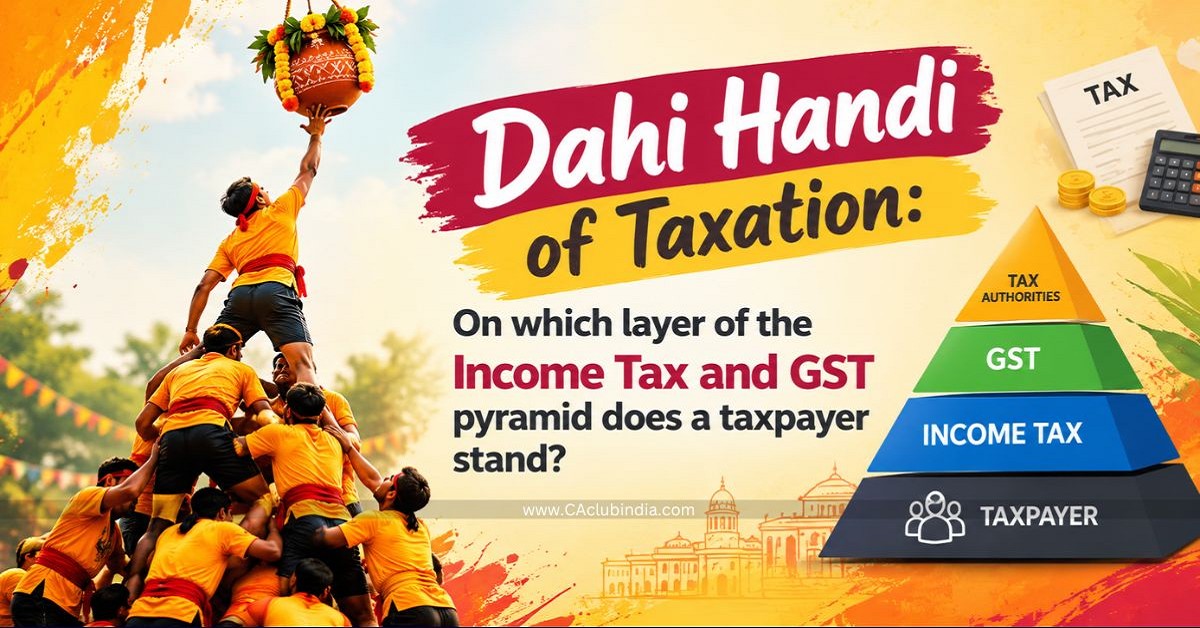
Krishna (Fictional Character): Arjuna, taxation is exactly a Dahi Handi. The Government ties the handi of revenue high in the sky. Below it stands a human pyramid of taxpayers, the strongest shoulders at the base, lighter ones above, and the smallest, most agile Govinda at the very top, who finally breaks the pot. Income Tax and GST are the two ropes that hold this handi in place. And just as the makhan chor of Gokul never ate the butter alone but shared it with every child in the street, tax collected from a few is spent for all.
Arjuna (Fictional Character): Krishna, if the Income Tax pyramid is climbed layer by layer, who stands on which tier and what is the duty of each?
Krishna (Fictional Character): Arjuna, five layers form this pyramid, and every layer carries a different weight:
First, the businessmen at the base. The strongest shoulders belong to traders, manufacturers, companies and professionals, because they carry the maximum weight of the nation’s collection. A small trader with turnover up to Rs 2 crore may declare presumptive income at 8 percent, or 6 percent on digital receipts, under Section 44AD, and this limit rises to Rs 3 crore where cash receipts do not exceed 5 percent of turnover. A professional may declare 50 percent under Section 44ADA up to Rs 50 lakh, extended to Rs 75 lakh on the same cash condition. Beyond these limits a tax audit under Section 44AB is triggered at Rs 1 crore of turnover, or Rs 10 crore where both cash receipts and cash payments stay within 5 percent. For audit cases the audit report is due by 30th September 2026 and the return by 31st October 2026.
Second, salaried employees. A salaried person receives a standard deduction of Rs 75,000 under the new regime and Rs 50,000 under the old regime. Under the new regime the rebate under Section 87A goes up to Rs 60,000 where total income does not exceed Rs 12,00,000, which makes a salary of roughly Rs 12,75,000 effectively tax free after the standard deduction. Yet this layer never stands on its own strength, if the employer deducts TDS and fails to deposit it, the credit never appears in Form 26AS and the refund remains stuck.
Third, house property and capital gains. Here the calendar decides the tax, not merely the amount. Rental income gets a flat 30 percent standard deduction, and interest on a self-occupied house loan is deductible up to Rs 2,00,000 under the old regime. In capital gains the clock is the master - listed shares held beyond 12 months become long-term and are taxed at 12.5 percent above the annual exemption of Rs 1,25,000, while a shorter holding attracts 20 percent. Immovable property becomes long term only after 24 months. One day short of the line, and the tax nearly doubles.
Fourth, income from other sources. This layer carries the least weight but is watched the most closely. Savings bank interest, fixed deposit interest, dividend and gifts are taxed here. A gift received from a person who is not a relative becomes fully taxable under Section 56(2)(x) once the aggregate value in a year crosses Rs 50,000. Every one of these figures already sits inside the Annual Information Statement and Form 26AS before the return is even opened.
Top, the Income Tax Return. The topmost Govinda is the lightest, yet the entire pyramid below is built only for him. Filing by itself is not the end of the act - e-verification must be completed within 30 days, otherwise, the return is treated as never filed at all. Where something has genuinely been left out, an updated return under Section 139(8A) still remains available.
For example, Mr. A of Nagpur runs a trading firm with turnover of Rs 1.80 crore and receives 97 percent of it through banking channels. He declares 6 percent presumptive income and escapes audit altogether. Mr. B has exactly the same turnover but accepts 40 percent in cash then he must maintain full books and face audit. Same handi, very different weight on the shoulder.
Arjuna (Fictional Character): Krishna, and how does the GST pyramid stand, from the base right up to the handi?
Krishna (Fictional Character): Arjuna, GST builds its pyramid in exactly the same five layers, and each one rests on the one below:
First, supply, the foundation stone. Nothing is taxed under GST unless it is first a supply. Registration becomes compulsory once aggregate turnover crosses Rs 40 lakh for goods or Rs 20 lakh for services, and Rs 20 lakh and Rs 10 lakh respectively in special category States. A small dealer may stay simple under the composition scheme with turnover up to Rs 1.5 crore for goods and Rs 50 lakh for services. If classification, HSN code, place of supply or the rate of tax is wrong at this stage, every layer standing above inherits that same mistake.
Second, Input Tax Credit. Credit under Section 16 is allowed only when four conditions are satisfied together a valid tax invoice is held, the goods or services are actually received, the supplier has paid the tax and filed his return, and the credit appears in GSTR-2B. The invoice value must also be paid to the supplier within 180 days. The last date for taking credit of an invoice of a financial year is 30th November of the following year. Arjuna, this is the shakiest layer of the whole pyramid, because the foot rests on another man’s shoulder. Just as a salaried employee suffers when the employer does not deposit TDS, a buyer suffers when the supplier does not deposit GST.
Third, the periodic returns. GSTR-1 is due by the 11th and GSTR-3B by the 20th of the following month. Late filing attracts Rs 50 per day, Rs 20 per day for a nil return, together with interest at 18 percent per annum.
Fourth, reconciliation. Books must match GSTR-2B, GSTR-1 must match GSTR-3B, and the e-way bill must match the invoice. Where GSTR-1 and GSTR-3B differ, an intimation in DRC-01B arrives; where credit claimed exceeds GSTR-2B, DRC-01C follows. The Invoice Management System now requires every invoice to be accepted, rejected or kept pending before the credit flows. This layer teaches one hard truth; the department already holds the figures. A return today is not a declaration; it is a confirmation.
Top, the Annual Return. The annual return in GSTR-9 is mandatory where turnover exceeds Rs 2 crore, and the reconciliation statement in GSTR-9C where turnover exceeds Rs 5 crore. For the financial year 2025-26 the due date is 31st December 2026. Broken correctly, the handi seals the year with honour; broken carelessly, the curd spills over everyone standing below.
Arjuna (Fictional Character): Krishna, what should the common taxpayer learn from this Dahi Handi?
Krishna (Fictional Character): Arjuna, three lessons. First, no Govinda selects his own layer the source of income decides where a taxpayer stands, and the duty of every layer is different. Second, the pyramid holds only when each layer holds; one wrong invoice at the base becomes a notice at the top. Third, in a real Dahi Handi there are helmets, mats and harnesses, and the taxpayer has them too documentation is the helmet, reconciliation is the mat, timely advance tax and timely deposit of TDS and GST form the harness, and a professional advisor is the trainer standing beside the pyramid. A slip need not be fatal when the safety net is ready, because an updated return under Section 139(8A), a revised return where time still permits, and a voluntary payment in DRC-03 under GST can break the fall. What breaks bones is climbing without any protection at all.











 CAclubindia
