
The Silent Danger Behind Artificial Turnover and Fake ITC
The Goods and Services Tax regime was conceptualised as a technology-driven system built on seamless Input Tax Credit and invoice-based transparency. The success of this framework depends largely on the genuineness of transactions reflected in GST returns, invoices and e-way bill systems. However, the same mechanism that facilitates legitimate business also becomes vulnerable when transactions are structured merely on paper to create artificial turnover or to rotate Input Tax Credit without corresponding commercial substance.
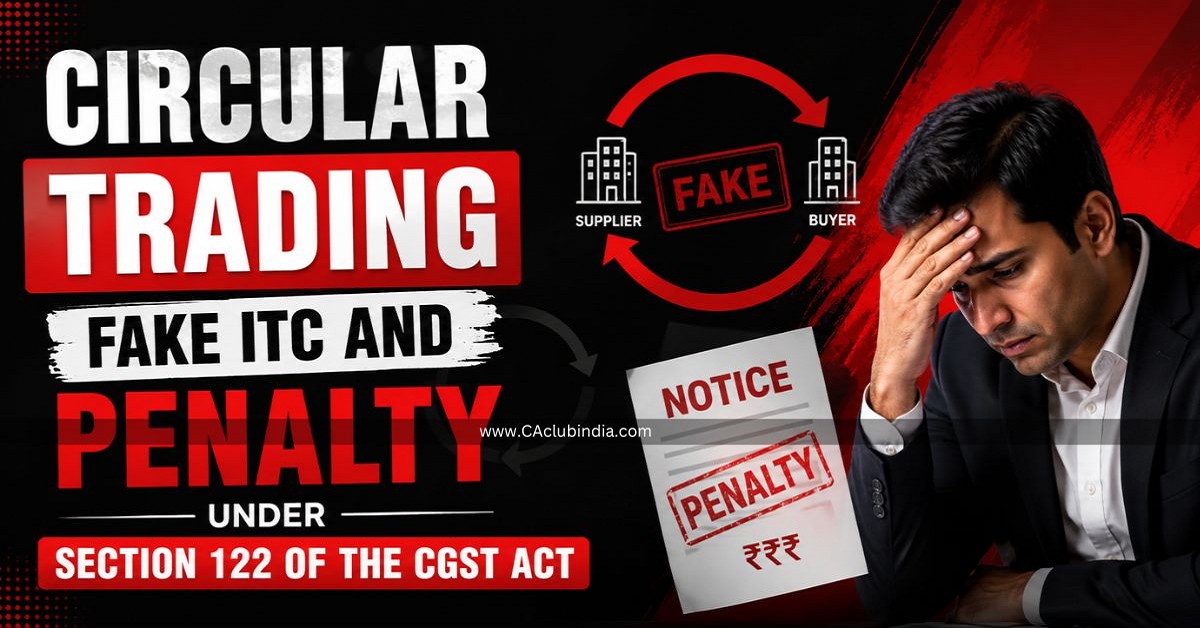
Over the last few years, one of the most aggressively investigated areas under GST has been alleged fake invoicing and alleged circular trading arrangements. In simple commercial terms, alleged circular trading is a chain of paper transactions in which invoices are repeatedly issued among interconnected entities, with no actual movement of goods or only a negligible genuine supply. The same goods — or sometimes no goods at all — are shown as sold and resold through multiple entities, so that turnover figures continue to increase at every stage. On paper, every entity appears to be conducting substantial business operations, although the underlying commercial activity may be absent or grossly disproportionate to the reported turnover.
The present judgment arises precisely from such an allegation of artificial commercial circulation, where, according to the Department, the reported turnover far exceeded the underlying economic reality.
It is in this larger enforcement and constitutional context that the decision of the Madras High Court in TVL. Sam Enterprises & Ors. v. Commercial Tax Officer reported in 2026-VIL-486-MAD dated 18.02.2026 assumes considerable significance. The judgment not only examines the scope of penalties under Sections 122(1)(ii) and 122(1)(vii) of the CGST Act but also revisits an equally important constitutional issue — the extent to which the writ jurisdiction should interfere where disputed factual findings and statutory appellate remedies coexist.
When Invoice Chains Become Investigation Trails
The batch of writ petitions before the Madras High Court arose from proceedings initiated against several dealers in the medical equipment business. The Department alleged that the petitioners engaged in extensive alleged circular trading without the actual movement of goods and availed or passed on ineligible Input Tax Credit through fake invoicing arrangements. According to the Department, many of the transactions lacked genuine commercial substance and were designed primarily to artificially inflate turnover figures.
The authorities further observed that a substantial portion of the turnover of the concerned entities appeared to be circular in nature and unsupported by corresponding genuine movement of goods. The Department specifically alleged that the transactions were structured not merely to avail of or pass on alleged fake ITC, but also to project inflated turnover figures before banks and financial institutions. In modern commercial practice, GST turnover has increasingly become an important indicator for evaluating working capital exposure, vendor credibility, creditworthiness and market standing. Artificial inflation of turnover may therefore create an illusion of commercial strength even where the underlying business activity remains
The present case, therefore, demonstrates that alleged circular trading investigations under GST are no longer confined to tax computations. Increasingly, authorities examine invoice trails, e-way bills, transportation records, banking transactions, stock patterns and dealings among interconnected parties to determine whether the reported turnover reflects genuine economic activity or merely a paper-based circular movement intended to generate artificial ITC and inflate commercial visibility.
The Doctrine of Proportionality Enters GST Litigation
One of the principal arguments advanced by the petitioners was that the penalties imposed were disproportionate. It was contended that even assuming statutory violations existed, the penalty ought to have been limited to ₹10,000 rather than to amounts equivalent to the alleged fake Input Tax Credit. The petitioners consequently attempted to import the constitutional doctrine of proportionality into GST penalty jurisprudence
To support this argument, reliance was placed on decisions such as Coimbatore District Central Cooperative Bank v. Employees Association [(2007) 4 SCC 669], Charanjit Lamba v. Commanding Officer, Army Southern Command [(2010) 11 SCC 314] and S.R. Tewari v. Union of India [(2013) 6 SCC 602]. These judgments broadly recognise that punishment should ordinarily be proportionate to the gravity of misconduct and that courts may interfere where punishment appears outrageously disproportionate or arbitrary.
However, the Madras High Court distinguished these authorities, observing that they arose under entirely different statutory frameworks governing labour and disciplinary jurisprudence. The Court noted that the GST penalty provisions are governed by specific legislative language and, therefore, the proportionality principles applicable in-service law cannot automatically override the express language of Section 122 of the CGST Act.
The Real Force of the Phrase "Whichever is Higher"
Perhaps the most significant legal aspect of the judgment lies in the Court’s interpretation of Section 122(1) of the CGST Act, 2017. The provision prescribes a penalty of ₹10,000 or an amount equivalent to the tax evaded or the Input Tax Credit wrongly availed, whichever is higher .This seemingly modest statutory expression ultimately became the decisive axis around which the entire controversy revolved.
The High Court observed that the expression “whichever is higher” demonstrates legislative intent to link the penalty directly to the magnitude of tax evasion or wrongful availment of ITC wherever the ingredients of the provision are attracted. The Court therefore held that the statutory language itself considerably limits adjudicatory discretion in quantifying the penalty.
This interpretation is important because it highlights the distinction between two categories of penalty provisions. In the first, the statute merely prescribes a maximum limit and leaves substantial discretion with the authority. In the second, the legislature itself provides a quantified formula linked to the disputed tax or ITC. Section 122 falls substantially within the latter category. Consequently, the Court declined to accept the argument that the penalty could automatically be reduced to ₹10,000 merely by invoking proportionality principles.
Dharamendra Textile - Relied Upon or Merely Referred To?
An academically interesting aspect of the judgment is its discussion of Union of India v. Dharamendra Textile Processors [ (2008) 13 SCC 369: 2008-VIL-01-SC-CE-LB] and Union of India v. Rajasthan Spinning and Weaving Mills [(2009) 13 SCC 448 : 2009-VIL-02-SC-CE] . The Department relied on these judgments to contend that, once the statutory conditions for a penalty are met, the adjudicating authority has limited discretion in quantifying the penalty.
However, a careful reading of the judgment indicates that these decisions were primarily cited while recording the submissions advanced on behalf of the Revenue. The High Court did not independently build the entire ratio of the case upon these authorities. Instead, the Court proceeded primarily on the plain statutory language of Section 122 and the factual findings recorded in the impugned orders.
This distinction is important because judicial discussions frequently cite several precedents, but not every referred judgment necessarily forms part of the operative ratio. In the present case, the Court's more decisive reasoning appears to rest on the statutory wording itself and the limited scope of writ interference where disputed factual issues exist.
The Constitutional Boundary Between Writ Jurisdiction and Appellate Remedy
Another significant aspect of the judgment concerns judicial discipline in tax administration. The petitioners had invoked the writ jurisdiction against adjudication orders that involved extensive factual findings on alleged circular trading, alleged fake invoicing and alleged wrongful ITC availing. The High Court was therefore required to determine whether such disputes should properly be examined in writ proceedings.
The Court reiterated that the GST enactments provide a comprehensive hierarchy of remedies under Sections 107, 112 and 117 of the CGST Act. In this context, the Court referred to L. Chandrakumar v. Union of India [(1997) 3 SCC 261], emphasising that disputed factual controversies are ordinarily expected to be examined within the statutory appellate framework itself.
The judgment therefore reinforces an important constitutional principle. Writ courts exercising jurisdiction under Article 226 are not intended to serve as substitute appellate authorities in matters involving detailed factual adjudication. Particularly in GST disputes concerning alleged fake ITC, alleged circular trading, and invoice genuineness, the High Court therefore reaffirmed the self-imposed constitutional restraint ordinarily exercised by writ courts in matters involving detailed factual adjudication.
When Access to Justice Meets Statutory Pre-Deposit
Although the writ petitions were dismissed, the judgment contains an important balancing feature that reflects judicial sensitivity to practical realities. The Court recognised that insisting on pre-deposit of 10% of enormous penalty amounts under Section 107 could render the appellate remedy practically illusory for the assessees.
Accordingly, while relegating the petitioners to the statutory appellate mechanism, the High Court dispensed with the requirement to pre-deposit 10% of the penalty amounts. This aspect of the judgment assumes particular significance because statutory pre-deposit conditions under GST are ordinarily regarded as mandatory, and courts generally exercise restraint when interfering with such legislative requirements.
The Court's approach, therefore, reflects a careful constitutional balance. On the one hand, the Court refused to permit direct writ interference in a matter involving disputed factual findings. On the other hand, it ensured that the statutory appellate remedy remained genuinely accessible and was not defeated by procedural conditions that effectively defeat substantive appellate access.
A Judgment That Reflects the Changing Nature of GST Litigation
The decision in TVL. Sam Enterprises & Ors. reflects the evolving philosophy of GST enforcement in India. Earlier, indirect tax disputes frequently revolved around classification, valuation, or the interpretation of exemption notifications. Increasingly, however, GST litigation now involves forensic examination of commercial behaviour, invoice chains, transaction authenticity and the underlying economic substance of transactions. The present case illustrates how GST enforcement has gradually moved beyond mere return scrutiny into a broader examination of commercial credibility and behavioural compliance.
The judgment also demonstrates that proceedings under Section 122 can carry extraordinarily serious consequences where allegations of fake invoicing or circular trading arise. Taxpayers and professionals must therefore recognise that aggressive invoice structuring or artificial inflation of turnover may expose entities not merely to tax demands but also to substantial penalties linked directly with disputed Input Tax Credit. At the same time, the ruling reiterates that constitutional courts ordinarily remain reluctant to bypass the statutory appellate framework in matters involving detailed factual adjudication.
Viewed holistically, the judgment reflects the changing philosophy of GST enforcement in India. The focus is gradually shifting from mere arithmetical tax determination to the examination of commercial substance, transaction authenticity, and behavioural compliance. Simultaneously, the ruling demonstrates that constitutional courts continue to preserve procedural fairness even while refusing to dilute statutory discipline. The decision therefore stands as an important reminder that under GST, aggressive invoice engineering may invite not only fiscal consequences but also close constitutional scrutiny within the framework of statutory remedies.









 CAclubindia
