
As practicing professionals, we often hear this question from clients, friends, or even family members whose income falls below the taxable threshold: “My tax liability is zero, so why bother going through the hassle of filing an Income Tax Return?”
It sounds logical on the surface. If you don't owe the government any tax, filing paperwork feels like an unnecessary chore. But in practice, looking at an ITR purely as a tax-paying document is a major misconception.
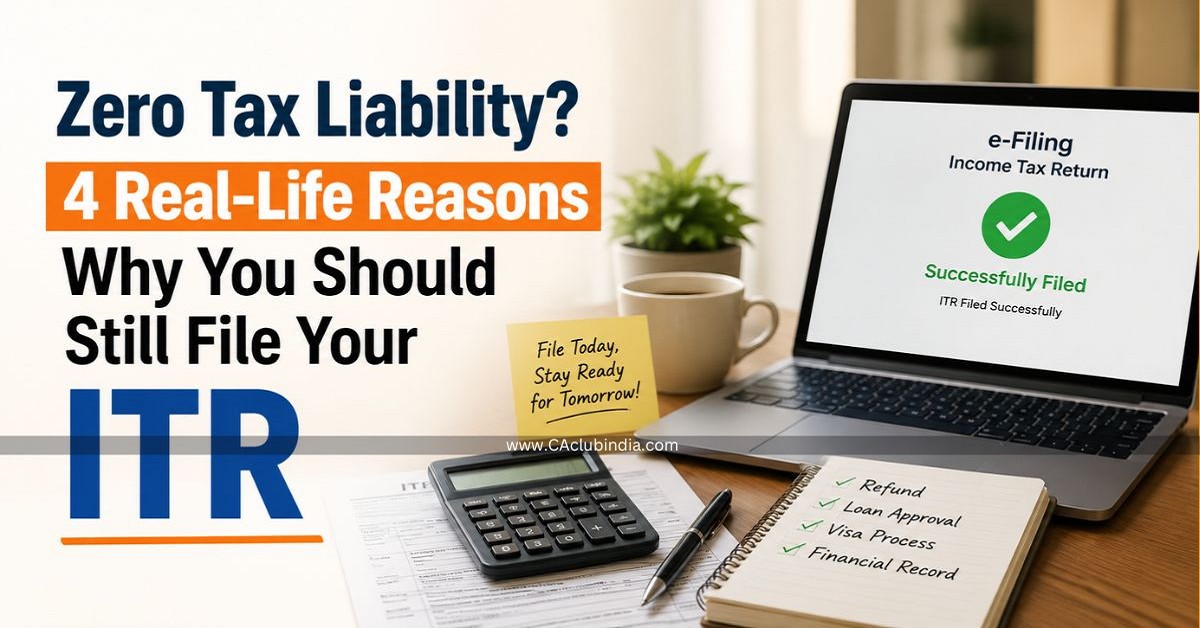
An ITR is actually your financial resume. Skipping it when your tax is zero can cost you heavily down the line. To make this clearer, let's help understand with some illustrative or hypothetical examples through four real-world scenarios we frequently encounter in practice that prove why filing on time matters, no matter what your tax liability looks like.
1. The Freelancer Who Missed a ₹60,000 Refund (Rahul's Story)
Rahul works as a freelance content creator. Over the financial year, several clients deducted TDS totaling ₹60,000 from his payments. However, because his total income was well below the taxable limit, his actual tax liability came out to ₹0.
Assuming he didn't need to file since he owed no tax, Rahul skipped filing his ITR. The result? He completely missed claiming his legitimate ₹60,000 refund.
The Takeaway: Zero tax liability \neq zero refund. If TDS has been deducted, filing the return is the only way to get your hard-earned money back into your bank account.
2. The Home Loan That Got Stuck (Amit's Story)
Amit had a modest income with little to no tax liability, so he never bothered filing ITRs for a few years. Fast forward three years later: he finalized a property and wanted to apply for a ₹50 lakh home loan.
When he approached the bank, the loan officer asked for his past income-tax returns to verify his financial stability. Suddenly, Amit realized that the ITR he didn’t think he needed yesterday was the exact document he couldn't do without today. It turned a straightforward loan approval into an unnecessary scramble.
3. The Last-Minute Visa Nightmare (Rohan's Story)
Rohan planned a dream trip abroad. He had his passport ready, sufficient bank balance, and flight tickets booked. Everything looked sorted until he hit the visa documentation stage.
The consulate requested past ITRs as part of his financial proof. Because Rohan hadn't been filing, he had to scramble to arrange alternative documents and write explanatory letters. What should have been a smooth process turned into a stressful, last-minute headache simply because of an unfiled return.
4. The ₹3 Lakh Capital Loss That Went Down the Drain (Neeraj's Story)
Neeraj sold some investments and booked a ₹3 lakh Long-Term Capital Loss. Since he had no taxable profits, he thought: "No profit, no tax. Why file?"
Here is what many taxpayers miss: under the Income Tax Act, if an eligible capital loss is reported correctly within the prescribed due date, it can be carried forward to set off against future capital gains. Two years later, Neeraj made a ₹3 lakh Long-Term Capital Gain. But because he hadn't filed his return for the loss year, he lost the legal right to carry it forward—costing him a massive tax benefit.
The Bottom Line
An ITR does much more than calculate what you owe the government. It helps you:
- Claim eligible refunds
- Support loan and credit applications
- Smooth out visa documentation
- Preserve and carry forward eligible losses
₹0 tax doesn’t mean ₹0 value in filing your ITR. Don't let a skipped filing today turn into an expensive regret tomorrow.
You have reached your daily limit of 2 Free Articles
Subscribe to CCI PRO for unlimited access
Why Upgrade to CCI PRO?
- No Ads
- WhatsApp Community
- Daily E-Newsletter
- Unlimited Articles Access
- Profile Visitors
- Link Social Profiles
- Featured Job Posts
- Pro Badge
- Expert GST Guidance
- Unlimited Forum Replies
- Download Content in PDF
Already a PRO member? Login here for an ad-free experience. 011-411-70713











 CAclubindia
