
Introduction
When I was doing my CA Articleship in the year 1990, I clearly remember the then Railway minister Late Sri George Fernandes laying the first foundation of the construction of the Udupi-Mangalore line in the first phase of construction of the Konkan railway through the SPV known as KRCL (Konkan Railway Corporation Limited) which was a small step in connecting the west coast of India with the rest of the railway network of India which was considered a missing link of approximately 700 Kms, The Project was later executed by SriE Sridharan in the most professional way and the record profits of KRCL for the FY Ending 2018-2019 of Rs 91.73 Crores with a loss later in the two years following the onslaught of Covid 19 Pandemic which derailed both the Passenger and Commercial Movements not specifically only to India But also globally and reasons beyond the control of Human beings, now that we have reached the Pre covid levels of Passenger & Goods movement we are sure FY 2022-2023 will be a financial Positive for KRCL, indicating that this infrastructure project is a colossal hit amongst both the passengers and goods movement. So in this article, I have taken the live example of the proposed new airport coming up in Noida Known as YIAPL.
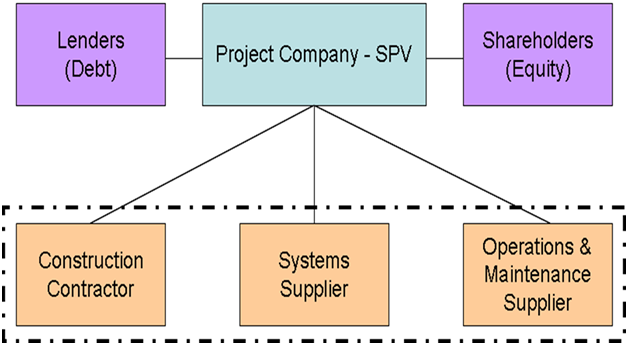
Let me try to explain how a Mega infrastructure Project is planned and later executed and then see the cost& benefits to the end-user as well as its contribution to the economy of the country. It can be road construction, power generation, and distribution, gas distribution, and construction of SEZ, to name a few.
The Noida International Airport at Jewar is spread across an area of 5,000 acres and is being developed by Zurich International Airport AG at an estimated cost of Rs 29,560 crore. The Swiss Airport company had won the bid in November 2019 following which a concessionaire agreement had been signed with the state government for 40 Years. Noida International Airport Limited, a joint venture, was incorporated as a government organization in which UP government has 35%, Noida Authority 35%, Greater Noida Industrial Authority 12.5%,and Yamuna Expressway Industrial Authority has 12.5% shareholding.
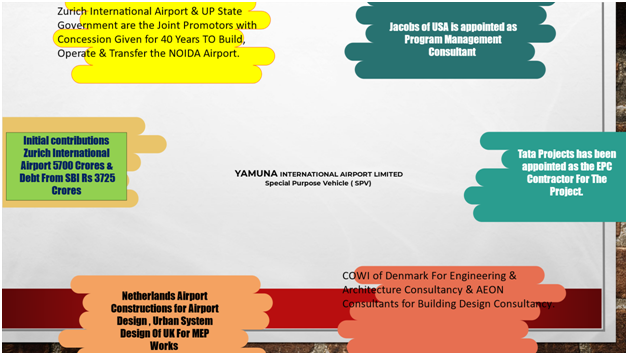
Jewar Airport is located about 72 km from the existing IGI Airport in New Delhi, 40 km from Noida, and about 40 km from the multi-modal logistics hub at Dadri.A second airport near the national capital New Delhi was planned and eventually,Zurich International Airport AG and the Uttar Pradesh State government formed a joint agreement to develop the proposed newairport to come up at Jewar known as Yamuna International airport Limited (YIAPL), the agreement is to Build, Operate and Transfer (BOT) the airport built under PPP model, and the concession period agreedinitially was for 40 years with 4 phases of development and possible positive revenue generation of almost Rs 49,000 crores, can be much higher based on user development charges, rental chargesin the terminal complexes and commercial operations, Cargo revenue,Landing/Housing/Parking Charges, AERO bridge &CUTE Charges,Fuel Throughput Charges, Ground &Cargo Handling chargesetc. the Zurich International AirportAG consortium had bagged the award of constructing the airport after they gave the maximum bid of Rs 410 per passenger against the nearest competitors of the bid which was in the range of Rs 240-Rs 360 plus on a sharing basis.once the Zurich airport AG bagged the award in 2019, they immediately opened a SPV special purpose vehicle known as Yamuna International Airport limited (YIAPL) To take charge of responsibility of construction of the airport and they in turn appointed Jacobs of USA as Project Management Consultant to the project, the duty of Project management consultant is quite huge and they have to do a lot of groundwork which included preparation of DPR – Detailed Project Report which entails review of each activity with the associated costs, monitoring of Pre Construction Period, OngoingConstruction Period and Post-construction period, liasoning with the various governmental authorities, MEP Contractors, HVAC contractors, Architects, Design consultants and the main project contractor which in this case is Tata Projects who have bagged the project to construct the Phase 1 of the EPC project With assistance from COWI of Denmarkfor engineering and architecture consultancy, AEON Consultants for Building design, Netherlands Airport construction for Airport design and finally Urban system design of UK for MEP related works.
As per the agreement, the first phase of the project, costing Rs 5,730 crore as per the development plan, will have to be completed within 1095 days from the appointed date which will be September 29, 2024.In stage 1, there will be a two-runways airport of 1334 hectares for which the agreement has been signed. In the following stage, the third runway on a 1,365-hectare area will come up for which land acquisition is under process. A fourth runway in an area of 1,318 hectares and a fifth runway have been proposed in the second stage.While the deal size has not been disclosed, sources pegged it at over Rs 6,000 croreTata Projects, the infrastructure, and construction arm of the Tata group will construct the terminal, runway, airside infrastructure, roads, utilities, landside facilities, and other ancillary buildings at the Noida International Airport (YIAPL)

Usually, the main project management consultants charge a fee anywhere from 2 % to 5 % of the total project cost as their fees and they have a huge task cut out of certifying the PPC (Progressive payment certificates)for the certifying different stages and total progress of the contractso that the contractor can move forward with the project, the PPC has too Commercial value because they can be used by the contractor to discount the bills and maintain a healthy cash flow to finish the construction on time without any hiccups and cost overruns. Normally thebankers of the projects get an assignment in their favor so that all receipts of the contractors come into their account with little scope of diversion of funds. The contractors based on their activity of the project geta good banking facility by way of fund-based facilities and non-fund-based facilities. In such PPP projects Once the project is over the revenue generated by the project has to come into this same account because of the earlier lending facilities for the mega projects, its like they have a first charge on all the revenues of the project which in this case is State Bank Of India (SBI). Normally infrastructure projects require a huge financial commitment and bankers have an uphill task to finance such mega projectsonly banks with adequate capital adequacy can finance such projectsand SBI has Committed to lending Rs 3,750 crores to this project.The Jewar airport will be developed in four phases over the next 30 years. As per initial calculations, phase 1 will witness approximate traffic of 12 million passengers per annum, which is expected to increase to 70 million passengers per annum by the end of phase 4. The cost of the Jewar airport from the first phase is set to increase from Rs 4,588 crore to Rs 29,560 crore.
In conclusion, any project to succeed in India should have a steady demand and I do foresee steady growth in the footfalls in the airport because of the huge population base in the state of Uttar Pradesh which has almost population of nearly 23 crores, initially, skeptics had doubts about the viability of Bangalore International Airport Limited (BIAL) but it has proved all the skeptics wrong by posting a healthy footfall and revenue and has turned out to be a money-spinner, so infra projects though consume a lot of time, energy, financial resources tend to be a money-spinnerin the long run with a Profit Reported of Rs 287 crores for the FY Ending 2019-2020.











 CAclubindia
