What is a Tax Audit?
A tax audit under Section 44AB of the Income Tax Act, 1961 is an examination of a taxpayer's books of account by a Chartered Accountant to verify that income has been correctly computed, deductions/exemptions accurately claimed, and the accounts fully comply with tax laws.
The CA doesn't just "check the books", the audit outputs a formal report ( Form 3CA/3CB along with Form 3CD ) that must be submitted on the Income Tax e-filing portal before filing the Income Tax Return (ITR).
- Form 3CA: Applicable when the taxpayer's accounts are already required to be audited under another law (e.g., a company audited under the Companies Act, 2013).
- Form 3CB: Applicable when the taxpayer is not required to undergo an audit under any other law (e.g., sole proprietorships or partnership firms).
- Form 3CD: The detailed 44-clause statement of particulars attached to either Form 3CA or Form 3CB.
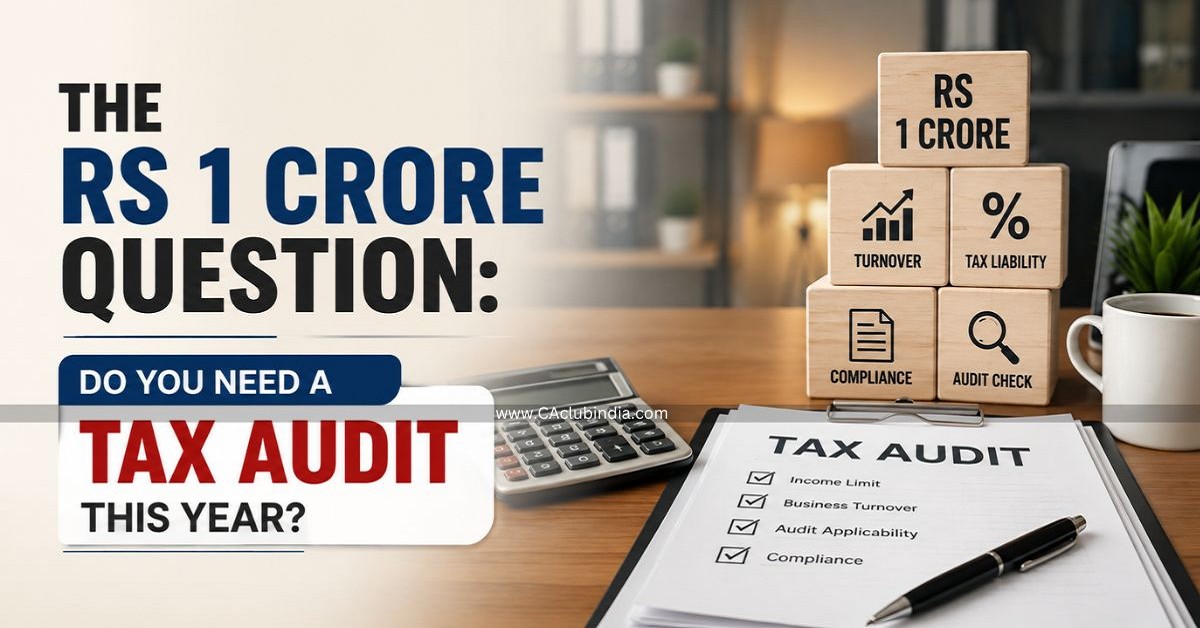
Who It Applies To (FY 2025-26 / AY 2026-27)
- Standard Business Limit (> Rs 1 Crore): Mandatory for any business with total sales, turnover, or gross receipts exceeding Rs 1 Crore. (Note: Under Section 44AD, small businesses with turnover up to Rs 2 Crore - or up to Rs 3 Crore if cash receipts are less than or equal to 5% - can declare presumptive profit without an audit).
- Digital Business Relaxation (> Rs 10 Crore): The threshold rises to Rs 10 Crore if both cash receipts and cash payments do not exceed 5% of total receipts and payments, respectively.
- Professionals (> Rs 50 Lakhs / Rs 75 Lakhs): Mandatory for doctors, lawyers, CAs, consultants, and other specified professionals whose gross receipts exceed Rs 50 Lakhs (this limit is enhanced to Rs 75 Lakhs if cash receipts do not exceed 5% of total receipts).
- Presumptive Taxation Opt-Out (Businesses): Required under Section 44AD if a business declares profits below the presumptive rate (6%/8%) or exits the scheme within the 5-year lock-in period (Section 44AD(4)), provided total taxable income exceeds the basic exemption limit.
- Presumptive Taxation Opt-Out (Professionals & Specialized Cases): Required under Sections 44ADA, 44AE, 44BB, or 44BBB if you declare income lower than the prescribed rates and your total taxable income exceeds the basic exemption limit.
- Statutory Due Date: The tax audit due date for FY 2025 - 26 is 30 September 2026 (or 31 October 2026 if transfer pricing provisions under Section 92E apply).
Why It's Important
- Compliance Check: Confirms the return being filed is backed by properly audited, verifiable accounts.
- Accuracy: Helps catch accounting errors, wrong claims, or inconsistencies before filing - significantly reducing the chances of receiving a tax notice or scrutiny later.
- Credibility: Audited accounts carry substantial weight with banks, financial institutions, investors, and regulators.
- Penalty Avoidance: Skipping a mandatory tax audit triggers a penalty under Section 271B - equal to 0.5% of total turnover/gross receipts, capped at Rs 1,50,000 (unless reasonable cause like severe illness or natural disaster can be proven).
Most Important Clauses of Form 3CD
Form 3CD is the core substance of the tax audit report - a comprehensive statement comprising 44 clauses. A few critical clauses include:
- Clause 8: Disclosure of the nature of business or profession (and any change during the previous year).
- Clause 8a: Discloses whether the assessee has opted for concessional tax regimes under Sections 115BAC / 115BAA / 115BAB / 115BA / 115BAD / 115BAE .
- Clause 13: Method of accounting followed, changes in method, and adjustments required under Income Computation and Disclosure Standards (ICDS I to X).
- Clause 17: Details of land/building transferred for consideration below the stamp duty value (governed by Sections 43CA and 50C).
- Clause 21: Amounts debited to the P&L account that are inadmissible (e.g., personal expenses, fines/penalties, non-deduction of TDS under Section 40(a)(ia)/40(a)(i), cash payments exceeding limits under Section 40A(3)).
- Clause 26: Sums allowable strictly on actual payment under Section 43B (e.g., GST, bonus, employer's contribution to PF/ESI, bank/NBFC loan interest, leave encashment).
- Crucial Distinction: Employee's contribution to PF/ESI is governed by Section 36(1)(va) and disallowed under Clause 21(b) if paid past the due date specified under the respective PF/ESI Act. It is NOT governed by Section 43B - a common mistake clarified by the Supreme Court in Checkmate Services.
- Clause 31: Particulars of loans/deposits/specified sums accepted or repaid, specifically monitoring cash compliance under Sections 269SS and 269ST.
- Clause 34: Detailed TDS/TCS compliance verification - checking whether tax was deducted/collected and deposited correctly within statutory timelines.
- Clause 40: Discloses accounting and financial ratios (e.g., Gross Profit/Turnover, Net Profit/Turnover, Material Consumed/Finished Goods Produced).
- Clause 41: Details of statutory demands raised or refunds issued during the year under tax laws other than Income Tax (e.g., GST, Excise, Customs, VAT).
- Clause 44: Breakdown of total expenditure incurred during the year between GST-registered and unregistered entities.
Important Clauses Explained Through a Practical Case Study
Case Scenario: Meet Rohan, who runs a small manufacturing unit, "Rohan Fabricators," with an annual turnover of Rs 3.5 Crore (FY 2025 - 26). Since his cash transactions exceed 5% of total receipts, he falls under the standard Rs 1 Crore threshold and requires a tax audit. Here is what his CA's audit report flags, clause by clause:
Clause 21 - Inadmissible Expenses
Rohan paid a contractor Rs 80,000 for repair work but failed to deduct TDS under Section 194C.
- If the payee is a Resident: Under Section 40(a)(ia) , 30% of Rs 80,000 ( Rs 24,000 ) gets disallowed and added back to his taxable income. The remaining Rs 56,000 remains allowable.
- If the payee is a Non-Resident: Under Section 40(a)(i) , a 100% disallowance applies, making the entire Rs 80,000 inadmissible.
Clause 26 - Section 43B (Payment Basis)
Rohan's books show Rs 1.2 Lakh of GST collected from customers for March 2026, which was deposited in May 2026 (after the financial year ended, but before the ITR filing due date). Under Section 43B, this GST expenditure is allowed as a deduction for FY 2025 - 26 because it was deposited before the statutory ITR filing due date under Section 139(1).
Clause 31 - Cash Loans & Deposits (Sections 269SS / 269T)
Rohan took a Rs 2.5 Lakh cash loan from a supplier to manage a short-term cash flow crunch. Accepting a cash loan of Rs 20,000 or more violates Section 269SS. This violation attracts an independent penalty under Section 271D equal to 100% of the loan amount (Rs 2.5 Lakh). The auditor is required to report this under Clause 31 regardless of whether Rohan was aware of the restriction.
Clause 34 - TDS / TCS Compliance
Rohan paid Rs 6 Lakh in professional fees (Section 194J) to a design consultant during the year, but deducted TDS on only Rs 4 Lakh (missing two invoices). The short-deduction details are disclosed under Clause 34. Consequently, 30% of the defaulted Rs 2 Lakh expense (Rs 60,000) becomes disallowed under Section 40(a)(ia) (routed through Clause 21), along with applicable interest under Section 201(1A) for late/short deduction.
Clause 44 - GST Expenditure Breakup
Of Rohan's total Rs 2 Crore in expenses, Rs 15 Lakh went to vendors who are not GST-registered. Clause 44 requires disclosing this exact breakup (registered vs. unregistered entities), allowing tax authorities to cross-verify Income Tax disclosures against GST returns.
The Takeaway
None of Rohan's issues were deliberate tax evasion, they were operational oversights common in growing businesses. That is precisely why a tax audit is valuable: it identifies statutory gaps before the return is filed, preventing far more costly consequences under a scrutiny assessment later on.











 CAclubindia