
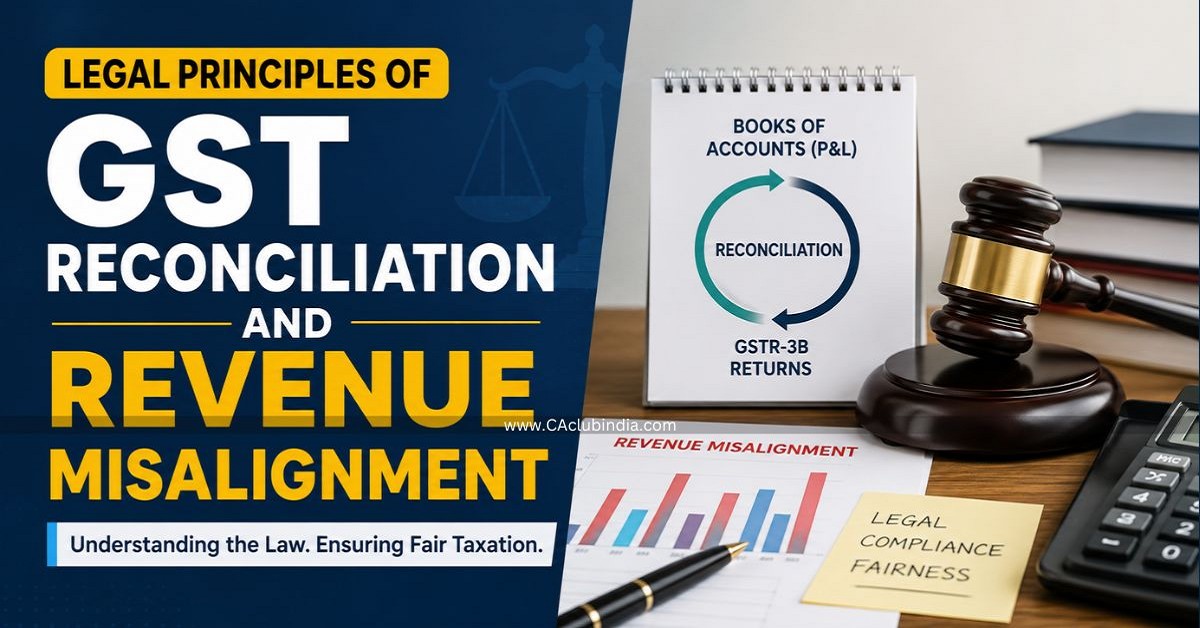
Income appearing in a Profit & Loss (P&L) Account is based on accounting rules, whereas GST output tax liability is triggered by the statutory 'time of supply'. Because of this fundamental difference, raising an output tax demand solely based on data discrepancies between a taxpayer's P&L Account and their GSTR-3B returns is contrary to law. To address these natural differences, the GST framework permits proper reconciliation under provisions such as Section 44 of the Karnataka GST Act. When assessing "Other Income" discrepancies, a direct comparison is inherently erroneous without making several critical adjustments. For a meaningful and legally sound comparison, the following factors must be accounted for:
- Exclusions of Non-GST Revenue: Non-taxable and non-GST income appearing in the P&L Account must be explicitly excluded.
- Timing Differences: Output tax liabilities that were discharged in an earlier year but accounted for as income in the current year must be excluded. Conversely, tax liabilities not discharged in an earlier year but accounted for as current-year income must be included.
- Subsequent Adjustments: The comparison must exclude liabilities that were discharged or reversed in a subsequent tax period, such as those permitted under Section 34 of the Karnataka GST Act and duly reported in Table 14 of GSTR-9 Part V.
- Netting Practices: Taxpayers are permitted by Circular 26/26/2017-GST to report 'net values' and make offline adjustments for 'negative values' in GSTR-3B, which naturally creates variances with gross financial statement figures.
- Furthermore, the P&L data extracted by authorities often does not even match the reconciled figures already submitted by the taxpayer in their annual GSTR-9 (Tables 4N and 13).
In a closely related scenario, authorities sometimes erroneously demand output tax based on expenditure appearing in the P&L Account. This is a direct contradiction in taxation tenets because expenditure relates to inward supplies, whereas output tax is strictly applicable to outward supplies. Without demonstrating actual outward supplies, demanding output tax on expenditures lacks legal authority.
The Larger Context of Output Tax Liability Disputes: Disputes over P&L "Other Income" are symptomatic of a broader issue where authorities routinely issue Show Cause Notices (SCNs) based purely on linear data mismatches, whether between financial statements, GSTR-1, GSTR-7 (TDS), E-Way Bill portals, and GSTR-3B.
Within this larger context of output tax disputes, the sources highlight several key legal principles:
- Burden of Proof: The burden of proof remains entirely on the Revenue to demonstrate the actual incidence of output tax. A mere data mismatch does not ipse dixit (in itself) establish an undischarged tax liability.
- Absence of Taxing Ingredients: SCNs relying on data differences routinely fail to identify the essential statutory ingredients required to attract a tax levy. To lawfully demand output tax, the authority must establish the category of supply (goods or services), taxability, HSN codes, time of supply, and place of supply. Without these elements, demands are improperly founded on guesswork, estimation, and conjecture.
- Self-Assessment Principles: GST is a self-assessment-based regime where the taxpayer is entitled to evaluate their outward supplies and discharge tax accordingly. Demanding output tax solely on mismatched data often ignores the taxpayer's valid self-assessment and bypasses proper audit or enquiry procedures.
- Jurisdictional Errors: In these data-driven disputes, authorities sometimes arbitrarily demand CGST-SGST without verifying the nature of the supply, which is violative of Section 77 of the Karnataka GST Act and Section 19 of the Integrated GST Act.
I welcome any query or contrary opinion.
You have reached your daily limit of 2 Free Articles
Subscribe to CCI PRO for unlimited access
Why Upgrade to CCI PRO?
- No Ads
- WhatsApp Community
- Daily E-Newsletter
- Unlimited Articles Access
- Profile Visitors
- Link Social Profiles
- Featured Job Posts
- Pro Badge
- Expert GST Guidance
- Unlimited Forum Replies
- Download Content in PDF
Already a PRO member? Login here for an ad-free experience. 07941056694








 CAclubindia
