
Financial discipline around cheque payments is tightening in India. While cheque dishonour continues to be governed by Section 138 of the Negotiable Instruments Act, 1881, recent regulatory push and procedural reforms coming into effect around 2026 make enforcement faster, stricter, and harder to ignore.
The objective is simple: remove delay tactics, ensure faster recovery, and discourage casual cheque issuance without sufficient balance.
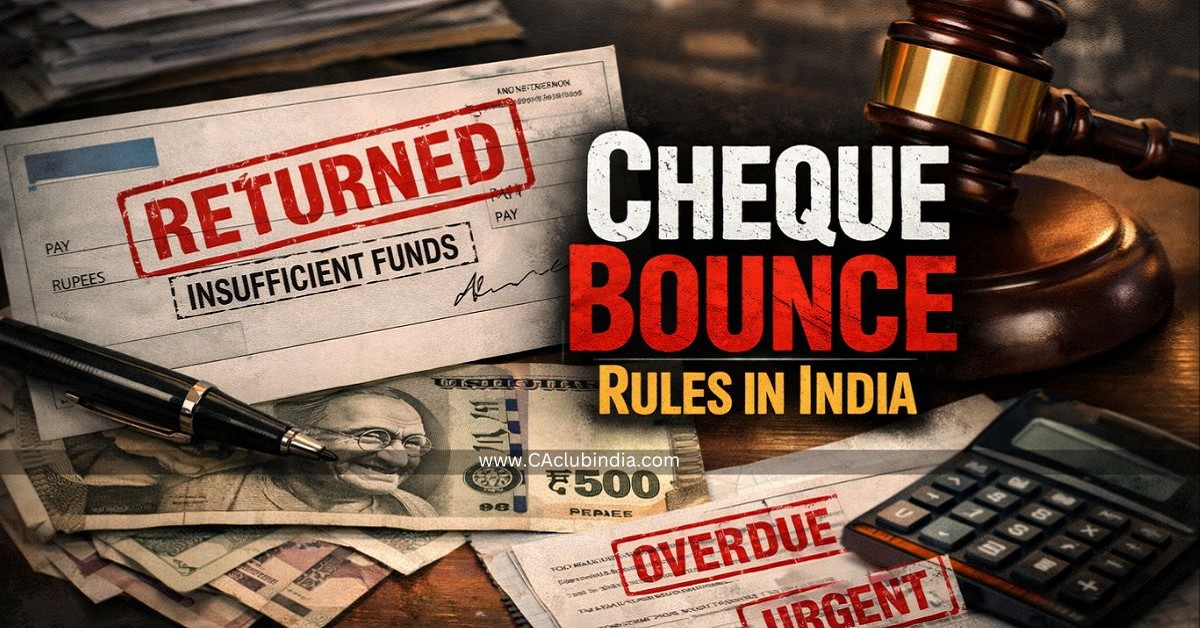
1. Cheque Bounce Remains a Criminal Offence
A bounced cheque is not just a banking mistake, it is a punishable offence when issued knowingly without sufficient funds.
Key consequences:
- Fine up to 2 times the cheque amount
- Imprisonment up to 2 years for wilful default
- Criminal record on conviction
This means issuing a cheque is legally treated as a promise of payment, not merely a payment method.
2. Interim Compensation During Trial
Earlier, cases dragged on for years while the receiver waited endlessly.
Now courts can order the issuer to pay up to 20% of the cheque amount during the trial itself under interim compensation provisions.
Impact: You may have to pay before the case is decided.
This discourages delaying tactics and protects genuine creditors from financial hardship.
3. Faster Case Disposal - Target 6 Months
Cheque bounce cases were among the most delayed matters in Indian courts. The new system pushes them into fast-track handling.
New approach:
- Digital filing is allowed in many jurisdictions
- Electronic summons permitted
- Courts aim for disposal within 6 months
Ignoring notices is no longer a working strategy.
4. Digital Evidence is Now Valid
Earlier offenders escaped liability by denying receipt of notice.
Now the following are accepted as proof:
- SMS alerts
- Email notices
- Bank notifications
- Messaging app communication (where verifiable)
This makes legal service easier and prevents evasion.
5. RBI Banking Restrictions on Repeat Bounces
Banks are now empowered to act against habitual defaulters.
Possible actions:
- Cheque book facility suspension
- Account freeze in serious cases
- Reporting affecting credit profile
- Bank penalty charges per bounce
Cheque misuse now directly impacts banking credibility.
6. 3-Hour Cheque Clearing System (Major 2026 Shift)
India is moving toward near-real-time cheque processing.
New reality:
- Cheques processed within ~3 hours
- No "float time" buffer
- Funds must be available immediately
- No delay window to arrange money
Practical meaning: You cannot issue a cheque expecting time to deposit money later.
What This Means for Individuals & Businesses
For Issuers
- Never issue a cheque without ready funds
- Treat a cheque like an instant payment
- Avoid casual post-dated cheques
For Receivers
- Faster recovery process
- Stronger legal protection
- Better proof of acceptance
- Less litigation delay
Final Takeaway
The 2026 framework transforms cheques from a flexible credit instrument into a strict financial commitment.
Earlier mindset: "Deposit karne tak manage kar lenge"
Now reality: Cheque = Immediate legal liability
Businesses and individuals should shift toward disciplined payment practices or adopt digital modes where possible.











 CAclubindia
