
Same loan, same borrower, same day of origination and a 4.5x difference in the provision, before anything has even gone wrong
The Problem Both Models Were Built to Fix
Before the post-financial-crisis reforms, both Indian and US accounting ran on an "incurred loss" model: a lender recognised a credit loss only once there was objective evidence that a loss event had already occurred - a missed payment, a covenant breach, a bankruptcy filing. Regulators called this "too little, too late." Losses that were entirely foreseeable at origination sat unrecognised until the borrower had vis
Ind AS 109 (mirroring IFRS 9) and US GAAP's CECL under ASC 326 both replace incurred loss with an expected loss model - forward-looking, not evidence-of-default-dependent. That much is identical in spirit. Where they diverge is in exactly how much of the expected loss gets booked, and when. That divergence is not a footnote-level difference. It changes the day-one P&L charge on every loan, receivable, and debt instrument a lender originates.
1. Ind AS 109 - The Three-Stage Model
Ind AS 109 does not ask "how much will this asset eventually lose" and stop there. It first asks whether credit risk has moved, relative to origination, and only escalates the measurement once it has.
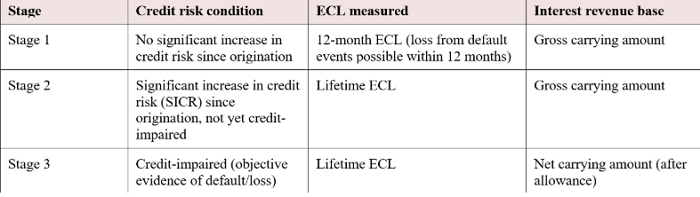
The mechanism that does the real work is Significant Increase in Credit Risk (SICR) - a relative test, not an absolute one. An asset doesn't need to look bad in isolation; it needs to have gotten meaningfully worse than it was expected to be at origination. A retail loan whose original lifetime PD was priced at 3% and has now drifted to 6% has doubled in risk and may trigger Stage 2, even though a 6% PD would not, on its own, look alarming. This is precisely why Ind AS 109 ECL is one of the most model-dependent, judgement-heavy numbers in a financial institution's books - the SICR threshold, the definition of "origination," and the macro scenarios used to forecast PD are all management estimates, not observable facts.
2. CECL - One Measurement, No Staging
ASC 326 dispenses with staging altogether. There is a single measurement objective: the full lifetime expected credit loss, recognised in the allowance the moment the asset is originated or purchased, irrespective of how healthy the borrower looks. A brand-new, investment-grade, zero-delinquency loan still gets a lifetime ECL allowance on day one - because CECL's premise is that some losses are always expected over the life of any credit exposure, and deferring recognition until credit quality visibly deteriorates is exactly the flaw the FASB set out to eliminate.
This is the headline difference the entire comparison turns on: Ind AS 109 defers the lifetime number until risk has demonstrably worsened; CECL books the lifetime number immediately and simply revises it every period as conditions change. Both frameworks use reasonable and supportable forecasts before reverting to historical loss experience for the remaining life of the asset - the forecasting mechanic itself is not the point of difference. The point of difference is the window CECL applies it over: the full remaining life, from the first day, for every asset in scope, without a staging gate to hold the number down.
3. The Same Loan, Two Provisions
Take a ₹1,000 crore, five-year loan book originated on the same day, priced identically, to identical borrowers. The 12-month PD used at origination is 1%; the cumulative PD over the full five-year life, given how default risk compounds over a longer horizon, is 4.5%. Loss given default is 40% under both frameworks.
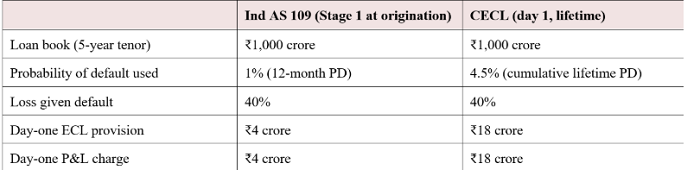
A ₹1,000 crore book that would show a ₹4 crore provision on an Ind AS balance sheet shows ₹18 crore on a CECL balance sheet, on the same day, for the same underlying credit risk. Nothing about the borrower has changed between the two columns - only the measurement window has. This is often called the "day-one loss" phenomenon under CECL, and it was one of the most contested elements of the standard during US adoption: a lender's earnings take an immediate hit for originating new, entirely healthy business.
4. Where This Actually Bites: The Group Consolidation
Picture the three-country group from the earlier piece in this series - an Ind AS parent with a lending or trade-receivable-heavy subsidiary in the US reporting locally under CECL. The subsidiary's own statutory books are correct on their own terms: CECL requires the lifetime number, and that's what the local auditor signs off on.
The problem is that the group's consolidated financial statements are prepared under Ind AS 109, and Ind AS 109 does not recognise "CECL's number" as an acceptable proxy for its own staged measurement. The conversion here is not a reclassification entry - it is a genuine re-computation. The group finance team has to take the same loan or receivable population and re-run it through the Ind AS 109 staging logic: classify each exposure into Stage 1, 2, or 3 based on SICR since origination, and apply 12-month or lifetime ECL accordingly. For a healthy, freshly originated book, this typically means the group consolidated number will be materially lower than the subsidiary's own CECL-based statutory number - the opposite direction from most GAAP-conversion adjustments, which tend to be modest reclassifications rather than a different loss quantum entirely.
- The GAAP-conversion memo for a lending subsidiary needs its own PD/LGD model output re-run against Ind AS 109 staging definitions - the CECL model's lifetime PD curve can usually be reused, but the staging trigger (SICR) has to be built and evidenced separately, because CECL has no equivalent concept to translate from.
- Macro-economic scenario weighting (base/upside/downside case probability weights) is a judgement made independently under each framework - a group cannot assume the US subsidiary's CECL scenario weights were built with Ind AS 109's forward-looking requirements in mind, and should not import them uncritically.
- The reconciliation from local GAAP net income to Ind AS consolidated net income should show the ECL conversion as a distinct, named adjustment line - not buried inside a general "other GAAP differences" catch-all - given how large and how directionally counter-intuitive it can be.
5. The Audit Angle
Both ECL and CECL allowances sit squarely inside SA 540 (Auditing Accounting Estimates) territory - they are among the most judgement-dependent numbers on a lender's balance sheet, built on PD/LGD models, SICR thresholds, and macro-economic scenario assumptions that are inherently unverifiable in the way a cash balance is verifiable. For a group auditor working across an Ind AS parent and a CECL-reporting subsidiary, the incremental risk is not just "is the CECL number right for US GAAP purposes" - it's whether the re-computed Ind AS 109 staged number, prepared specifically for consolidation, has been subjected to the same rigour as the primary statutory estimate, given that it is often built later, by a smaller team, under greater time pressure, and reviewed less independently than the number that actually gets audited locally.
The Takeaway
Ind AS 109 and CECL are not two routes to the same destination on different timelines - they are two different definitions of how much of the future belongs in today's balance sheet. Ind AS 109 waits for risk to visibly worsen before demanding the full lifetime number; CECL assumes the lifetime number was always the right answer and books it from day one. Neither is more "conservative" in the abstract - CECL is far more conservative on a freshly originated, healthy book, while Ind AS 109 can be slower to recognise deterioration that hasn't yet crossed the SICR threshold. For any group straddling both frameworks, the number that finally lands in the consolidated balance sheet is neither number in isolation - it's whatever survives a proper re-computation, not a translation.











 CAclubindia
