
Overview
Can every amount spent by a business be claimed as a tax deduction? Through an engaging dialogue between Arjuna and Krishna, this article explains the fundamental distinction between business expenditure and tax-deductible expenses under the Income Tax Act. It discusses the conditions an expense must satisfy to qualify for deduction, lists commonly allowable business expenses, highlights expenses that are specifically disallowed, and explains the impact of cash payment restrictions, TDS defaults, PF/ESIC compliance, and personal-use adjustments. The article also outlines the consequences of incorrect claims and provides practical guidance for business taxpayers to ensure accurate and compliant return filing.
Arjuna (Fictional Character): Krishna, August is the month of filing returns of businesses. Can a businessman claim every amount spent during the year as a business expense?
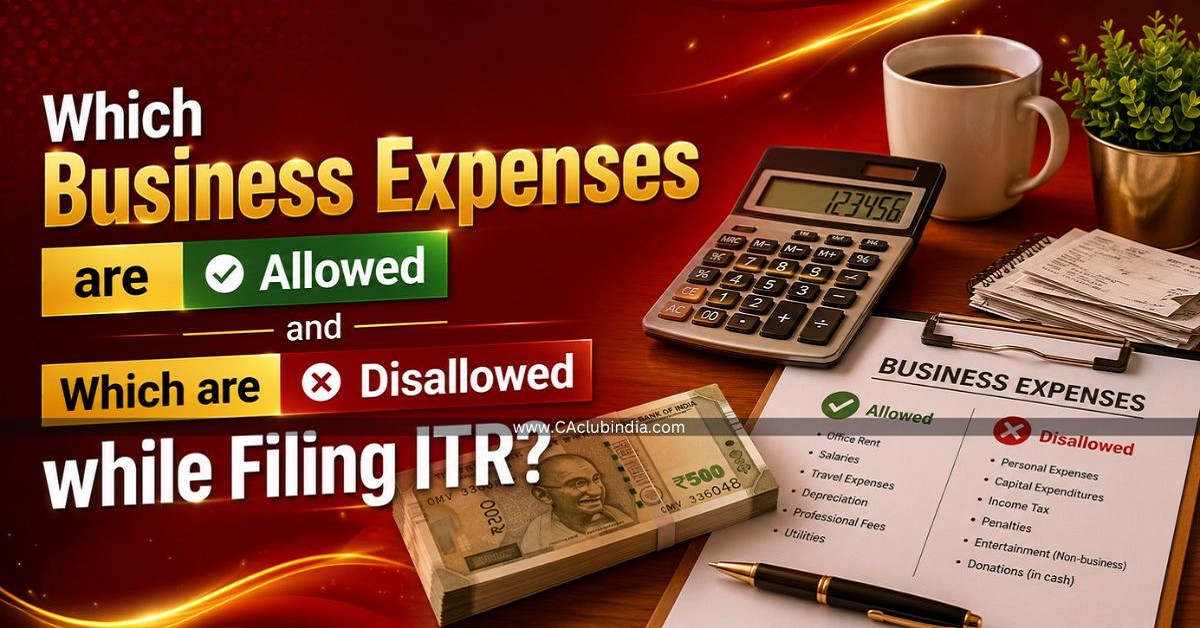
Krishna (Fictional Character): Arjuna, this is the biggest misunderstanding among business taxpayers. Money spent and expense allowed under Income Tax are two different things. The law permits deduction only for those expenses which pass certain tests. If an expense fails even one test, it is disallowed, the profit increases, and the taxpayer pays tax along with interest and penalty.
Arjuna (Fictional Character): Krishna, what are these tests which an expense must pass?
Krishna (Fictional Character): Arjuna, an expense is allowed only when it satisfies all of the following:
- It is incurred wholly and exclusively for the business, and not for personal or family needs.
- It is revenue in nature and not capital in nature, and relates to that particular year.
- It is supported by proper bills, vouchers and entries in the books of account.
- The mode of payment and TDS compliance required by law have been followed.
Arjuna (Fictional Character): Krishna, which expenses can a business taxpayer safely claim?
Krishna (Fictional Character): Arjuna, the following are normally allowable if genuine and properly recorded:
- Purchases and direct costs: Raw material and traded goods, inward freight, packing, loading and unloading charges.
- Employee costs: Salary, wages, bonus and staff welfare, subject to TDS and timely deposit of PF and ESIC.
- Rent and utilities: Rent of shop, office, godown or factory, with electricity, water and maintenance charges.
- Communication: Telephone, mobile and internet charges to the extent used for business.
- Repairs and insurance: Routine repairs of premises, machinery, vehicles and office equipment, and insurance of stock and business assets.
- Interest and bank charges: Interest on loans taken for business, bank charges, processing fees and commission.
- Depreciation: On building, plant and machinery, vehicles, computers and furniture used in the business.
- Selling and marketing: Advertisement, publicity, website and social media promotion, commission and brokerage.
- Professional fees: Audit fees and fees paid to consultants and advocates for business matters.
- Travel and conveyance: Travelling, conveyance and hotel expenses for business tours and meeting customers or suppliers.
- Office expenses: Printing, stationery, postage, courier and software subscriptions.
- Bad debts and business taxes: Amounts written off which were earlier offered as income, and GST where credit is not available, professional tax, municipal tax and license fees.
Arjuna (Fictional Character): Krishna, now tell me which expenses cannot be claimed?
Krishna (Fictional Character): Arjuna, the following are not allowed, howsoever they may be recorded in the books:
- Personal and household expenses: Groceries, children’s school fees, family functions, personal travel and personal insurance routed through business books.
- Income tax itself: Income tax paid, and interest or penalty on income tax, is never a business expense.
- Fines and penalties: Traffic challans, pollution fines and penalties levied by any authority for breach of law.
- Capital expenditure: Purchase of machinery, vehicle, computer or major addition to building. Only depreciation is allowed, not the full cost.
- Cash payments above ₹10,000: Any expense paid in cash to a single person in a single day exceeding ₹10,000 is disallowed in full, however genuine it may be. For payments made to transporters for plying, hiring or leasing of goods carriages, this limit is ₹35,000.
- TDS defaults: Where TDS was required on a payment to a resident but was not deducted or not deposited in time, 30% of that expense is disallowed. In the case of payments to a non-resident, the entire expense is disallowed. The disallowed amount can be claimed in the year in which the TDS is finally deposited.
- PF and ESIC dues: The employees’ share deducted from salary must be deposited within the due date prescribed under the respective law, failing which it is disallowed. The employer’s own contribution is allowed if deposited on or before the due date of filing the return.
- Donations and charity: Donations to temples and trusts are not business expenses. They may be claimed separately but not as a business expense, subject to conditions and the tax regime chosen.
- Expenses without proof: Expenses recorded without bills or vouchers, and purchases from bogus parties, are disallowed and also invite penalty.
Arjuna (Fictional Character): Krishna, in a small business, many expenses are partly business and partly personal. What should be done?
Krishna (Fictional Character): Arjuna, the answer is proportion, not silence. Mr. A uses the same car for delivering goods and for dropping his children to school. He cannot claim the entire fuel, insurance, repairs and depreciation, but only the reasonable business portion, treating the balance as drawings. Similarly, Mr. B works from two rooms of his residential house and can claim only the proportionate electricity and maintenance of those rooms. The basis of division should be reasonable, consistent every year, and capable of being explained to the department.
Arjuna (Fictional Character): Krishna, what will happen if expenses are claimed wrongly?
Krishna (Fictional Character): Arjuna, the consequence is heavier than the tax saved. The expense is disallowed, profit increases, tax becomes payable with interest, and penalty for under-reporting or misreporting may follow. Further, the department today matches the return with GST returns, bank details, TDS records and the Annual Information Statement, so mismatches are picked up by the system itself and may lead to scrutiny or reassessment.
Arjuna (Fictional Character): Krishna, what should the taxpayers learn from this?
Krishna (Fictional Character): Arjuna, in business the pen of the accountant is as powerful as the cash counter. An expense claimed honestly with proper proof reduces tax lawfully, while an expense claimed carelessly invites notice, interest and penalty. Before filing the return, every businessman should ask three questions about each expense: Is it truly for the business? Is there a bill to prove it? Has the related compliance been followed? If all three answers are yes, then only taxpayer shall claim such expenses. If even one is no, leave it out, because tax saved wrongly today is always paid back tomorrow with interest and penalty.











 CAclubindia
