 CA Ruby Bansal
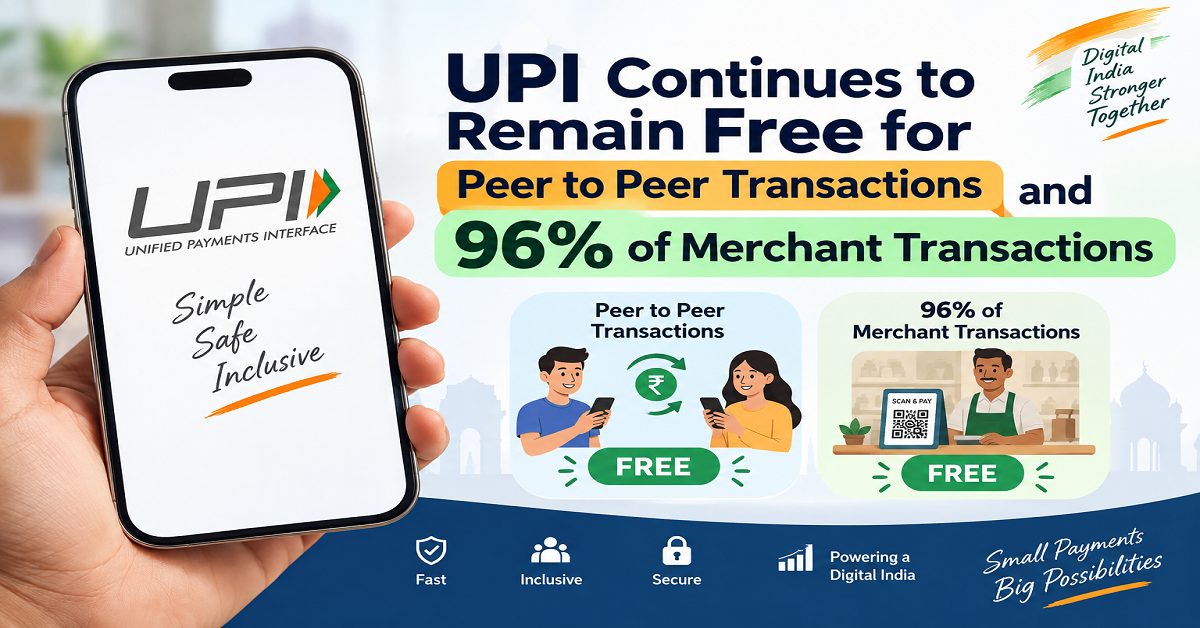
If you send money to a friend, pay your vegetable vendor, or split a dinner bill on UPI, nothing changes for you. The government confirmed on 15 September 2026 that person-to-person UPI transfers stay free no matter the amount, and so do 96% of merchant payments. The new charge, a Merchant Discount Rate (MDR), touches only a narrow slice of larger business transactions, and it's the merchant's payment provider that absorbs it, not the customer.
Here's the breakdown, because "96% unaffected" hides some numbers worth knowing if you run a business or process payments for one.
What stays free, full stop
All person-to-person UPI transfers remain free regardless of amount. No transaction fee, no platform fee, nothing. This category alone makes up 70% of the total value moving through UPI.
Person-to-merchant payments up to ₹2,000 also stay free. So does anything routed through the zero-MDR framework for small merchants, which is where street vendors and neighbourhood shops live.
Speaking of which: small merchants accepting payments through UPI QR codes under the Person-to-Person-Merchant category get zero MDR on everything, as long as they take in up to ₹1 lakh a month. That's the government's way of keeping the local kirana owner and the roadside cart out of this entirely.
Where the 0.4% actually kicks in
MDR applies only to person-to-merchant transactions above ₹2,000, and the rate is 0.4%. On a ₹75,000 transaction, the charge caps at ₹300, and it stays capped at ₹300 for anything higher. The MDR gets split between banks, payment service providers and UPI app providers, the entities actually running the rails.
Three sectors get a different, flatter treatment because they run on thin margins:
Railways, telecom, insurance, fuel and agricultural inputs pay a flat ₹5 per transaction on anything above ₹2,000, not a percentage. For a business processing thousands of small-ticket payments, a flat fee is far more predictable than a percentage cut.
Capital market transactions, meaning mutual funds, securities, and payments to stockbrokers and dealers, attract 0.02%, capped at ₹300. This is deliberately low so it doesn't discourage retail investors from using UPI to fund their trading or SIP accounts.
Who's actually paying this
Not you. MDR sits within the merchant payment ecosystem, and banks have been directed to make sure merchants don't quietly pass it on to customers at the counter. UPI app providers are barred from adding platform fees or any hidden charges of their own.
If you've noticed your bank's daily UPI limit, that's a separate thing entirely. Those limits, generally ₹1 lakh to ₹5 lakh depending on the transaction type, exist for fraud and risk control. They were never a backdoor charging mechanism, and this framework doesn't touch them.
Why now, and where the money goes
The framework comes under the Payment and Settlement Systems Act, 2007, after the UPI Steering Committee worked through the rates and safeguards. The logic is straightforward: UPI processes an enormous volume of transactions for free, and someone has to fund the infrastructure, especially the push into rural and semi-urban areas where acceptance is still thin.
A part of the collection goes right back to the merchants least able to absorb costs. Five percent of total MDR collections will feed a dedicated fund to get more small merchants onto UPI and keep them using it. The idea traces back to the Standing Committee on Finance's 32nd Report, which had flagged the need for UPI to have a workable revenue model if it's going to keep expanding.
For most CAs and their clients, the practical takeaway is simple: if a business bills a customer more than ₹2,000 through UPI and isn't in the exempt list, budget for the 0.4% (or the flat ₹5, if it falls under railways, telecom, insurance, fuel or agri-inputs). Everyone else keeps using UPI exactly as before.
You have reached your daily limit of 2 Free Articles
Subscribe to CCI PRO for unlimited access
Why Upgrade to CCI PRO?
- No Ads
- WhatsApp Community
- Daily E-Newsletter
- Unlimited Articles Access
- Profile Visitors
- Link Social Profiles
- Featured Job Posts
- Pro Badge
- Expert GST Guidance
- Unlimited Forum Replies
- Download Content in PDF
Already a PRO member? Login here for an ad-free experience. 011-411-70713











 CAclubindia
