DiA Corporate Consulting
Since GST was rolled out, most small business owners have gotten reasonably comfortable with the basics of filing. But comfort often breeds small, repeated errors — the kind that do not get noticed until a notice from the department arrives, or a client suddenly cannot claim the credit they expected. Having worked with small businesses, exporters, and professional service firms in and around Bengaluru on their GST compliance, this guide covers the mistakes seen most often, what the current penalty rules actually are, and a simple monthly routine that prevents most of these problems before they start.
Why This Matters More Than It Used To
GST compliance has become progressively more automated and less forgiving of manual error. The GST portal now cross-checks GSTR-1, GSTR-3B, and GSTR-2B against each other automatically, which means mismatches that used to go unnoticed for months now trigger system-generated notices within weeks. On the payment side, a portal update effective from the January 2026 tax period changed how interest on late payment is calculated — it now factors in the lowest cash balance held in the Electronic Cash Ledger during the delay period, rather than simply charging interest on the full liability. This is explained in more detail in the interest section below.
1. Mismatched Invoices Between GSTR-1 and GSTR-3B
This is by far the most common issue. GSTR-1 reports outward supplies invoice by invoice, while GSTR-3B is a summary return used to actually pay the tax. When the two do not reconcile — often because of a late invoice entry, a duplicate entry, or a simple data entry error — it triggers an automated mismatch flag from the GST portal, and in persistent cases, a formal notice under Section 61 for scrutiny of returns.
The fix is procedural, not technical: reconcile GSTR-1 and GSTR-3B every month before filing, not just when preparing the annual return. A short reconciliation checklist run before the 20th of each month catches almost all of these errors before they become departmental correspondence.

2. Claiming Input Tax Credit (ITC) Without Checking GSTR-2B
Many businesses still claim ITC based on their own purchase records rather than cross-checking against GSTR-2B, the auto-populated statement that reflects what suppliers have actually reported on their end. If a supplier has not filed their return, or has filed it late, that credit may simply not appear in your 2B for that period — and claiming it anyway, based on your own invoice, can lead to a demand for reversal along with interest at a steeper rate later.
Always reconcile ITC claims against GSTR-2B before filing, not against your purchase register alone. This single habit change prevents the majority of ITC-related notices.
3. Wrong Classification of Goods or Services (HSN/SAC Codes)
Using an incorrect HSN or SAC code seems like a minor clerical detail, but it directly determines which tax rate applies. An incorrect code is one of the more common findings during a GST audit or scrutiny, particularly for businesses dealing in multiple product categories, bundled services, or composite supplies. Codes are worth reviewing periodically, and especially whenever the GST Council issues a rate change notification for your sector.
4. Missing the Composition Scheme Deadline or Eligibility Limits
Small businesses registered under the Composition Scheme sometimes cross the prescribed turnover threshold mid-year without realising it, and continue filing composition returns (CMP-08 and GSTR-4) instead of switching to the regular scheme. This surfaces most often during an audit and typically results in a demand for the tax difference plus penalty. If turnover is anywhere close to the threshold, it is worth tracking monthly rather than reviewing only at year-end.
5. Ignoring GST on Reverse Charge Mechanism (RCM) Transactions
Payments to unregistered vendors, certain notified categories of services, and specified import transactions attract GST under reverse charge, where the recipient of the supply — not the supplier — is liable to pay the tax directly to the government. This is frequently missed by businesses that assume GST is always the supplier's responsibility. It also has a cash-flow implication that catches people off guard: RCM liability must be paid in cash and cannot be offset against available Input Tax Credit.
6. Underestimating Late Fees and Interest on Delayed Filing
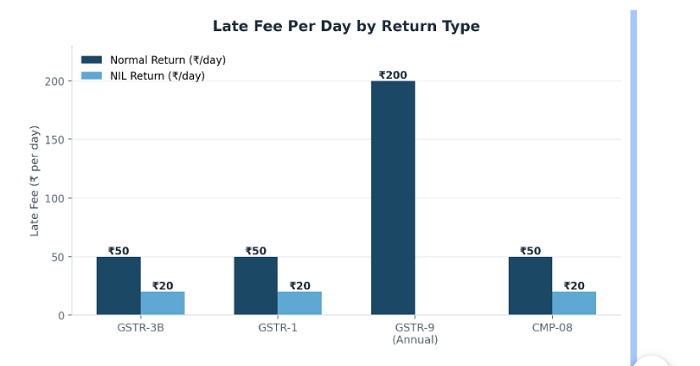
This is the area with the most confusion, and also the one with the most concrete rules, so it is worth laying out precisely.
|
Return |
Normal Filing (per day) |
NIL Return (per day) |
Maximum Cap |
|
GSTR-3B |
₹50 (₹25 CGST + ₹25 SGST) |
₹20 (₹10 + ₹10) |
Turnover-based, up to ₹10,000 |
|
GSTR-1 |
₹50 (₹25 CGST + ₹25 SGST) |
₹20 (₹10 + ₹10) |
Turnover-based, up to ₹10,000 |
|
GSTR-9 (Annual) |
₹200 (₹100 + ₹100) |
— |
0.5% of turnover in the state |
|
CMP-08 |
₹50 (₹25 + ₹25) |
₹20 (₹10 + ₹10) |
₹10,000 |
Late fees are charged under Section 47 of the CGST Act and apply per return, per day of delay — they do not compound across months, but three months of missed filing means three separate late-fee calculations running in parallel. Late fees must also be paid in cash; they cannot be settled using available Input Tax Credit.
Interest is separate from the late fee and is governed by Section 50 of the CGST Act. The standard formula is:
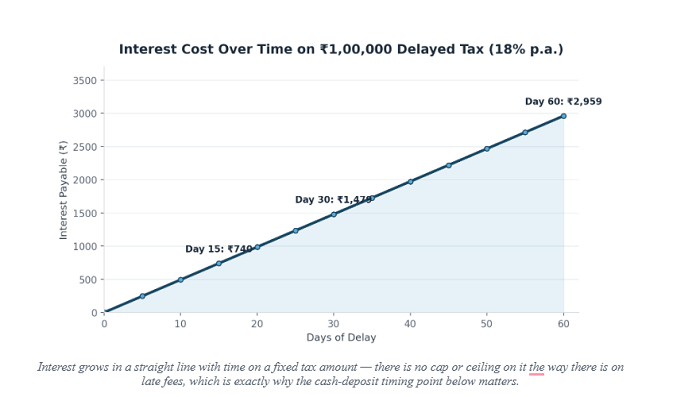
Interest = Net Tax Liability × 18% × (Days of Delay ÷ 365)
For example, ₹1,00,000 in tax paid 30 days late works out to roughly ₹1,479 in interest, in addition to the applicable late fee. Wrongly claimed and utilised ITC attracts a steeper interest rate of up to 24% per annum rather than the standard 18%.
Interest grows in a straight line with time on a fixed tax amount — there is no cap or ceiling on it the way there is on late fees, which is exactly why the cash-deposit timing point below matters.
One recent change worth knowing: from the January 2026 tax period onward, the GST portal calculates interest based on the lowest cash balance held in the Electronic Cash Ledger between the due date and the actual payment date, rather than the full net liability. In practical terms, this means depositing the required cash into the ledger on time — even if the return itself is filed a few days late — can meaningfully reduce the interest charged. It rewards businesses that separate "having the money ready" from "filing the paperwork," which is a useful distinction to build into a monthly routine.
7. Not Maintaining Proper Documentation for ITC Claims
Under GST, the burden of proof for any ITC claim sits with the recipient, not the supplier. That means valid tax invoices, proof of receipt of goods or services, and proof of payment all need to be maintained and readily retrievable. Businesses that keep invoices but not the surrounding documentation — delivery challans, payment records, contracts — often struggle to substantiate claims during a departmental audit, even when the underlying transaction was entirely genuine.
A Simple Monthly Compliance Routine
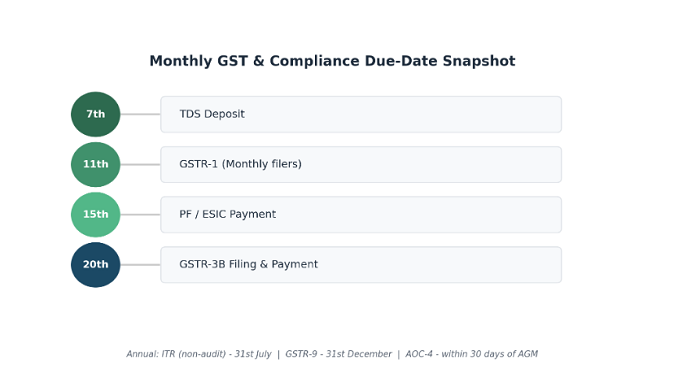
Most of the issues above are prevented by the same handful of habits, repeated consistently rather than done perfectly. The due dates below are worth building a calendar reminder around, since they recur every month:
- Reconcile GSTR-1 against GSTR-3B before every filing, not after.
- Check GSTR-2B before claiming any ITC — never rely on the purchase register alone.
- Deposit the estimated cash liability into the Electronic Cash Ledger before the due date, even if the return itself will be filed a day or two later.
- Track turnover monthly if operating close to the Composition Scheme threshold.
- Retain full documentation — invoices, delivery proof, and payment records — for every ITC claim, not just the invoice itself.
When It Makes Sense to Bring in Support
A monthly reconciliation habit works well once it is set up correctly, but the setup itself getting GSTR-1, GSTR-3B, and GSTR-2B genuinely aligned, correcting past mismatches, and building a clean documentation trail — is where most small businesses benefit from a professional review. This is core to what we handle through our GST Registration & Returns service: monthly filing, reconciliation, and notice response support for businesses that would rather not track every rule change themselves.
GST rarely sits in isolation. Businesses that get their GST reconciliation right often find their TDS compliance and income tax filing need the same discipline consistent monthly tracking rather than a scramble at the deadline. For businesses that are also managing statutory filings like ROC returns, our ROC Filings & Annual Returns service covers that side of compliance as well, so the full calendar is handled by one point of contact rather than juggled across multiple consultants.
For businesses at an earlier stage that have not yet registered, it is also worth checking eligibility for MSME (Udyam) Registration , which unlocks benefits like priority sector lending, delayed payment protection, and certain tax and compliance concessions that many eligible businesses simply never claim.
In Summary
Most GST issues are not about businesses trying to evade tax — they are about small procedural gaps that compound quietly over time. A monthly reconciliation habit across GSTR-1, GSTR-3B, and GSTR-2B, disciplined tracking of turnover against scheme thresholds, timely cash deposits to reduce interest exposure, and clean documentation for every ITC claim resolve the large majority of the problems covered here, well before any of them turn into a departmental notice.











 CAclubindia