
For AY 2026–27, whether a tax audit is required often hinges on factors beyond a business's turnover alone. Although Section 44AB sets the general threshold at ₹1 crore, this limit can rise to ₹10 crore provided cash receipts and cash payments each stay within the specified 5% cap.
A clear grasp of these thresholds, the cash-transaction conditions, and the applicable exceptions is therefore essential for businesses and professionals seeking to determine their tax-audit obligations correctly.
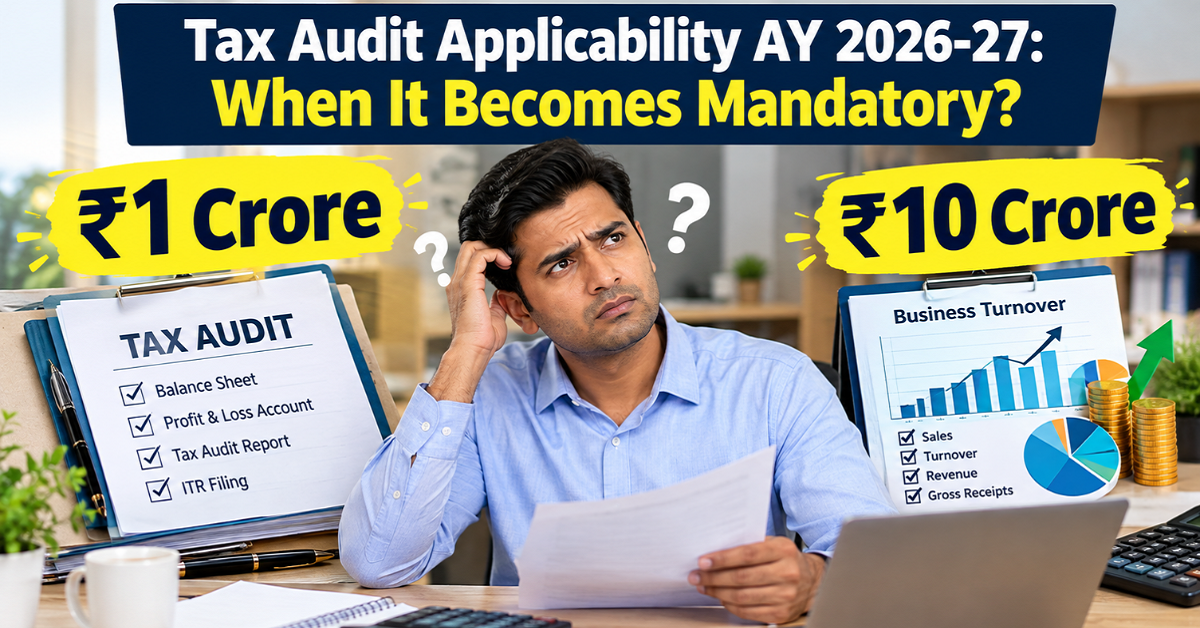
When the ₹1 Crore Limit Applies?
Tax audit is mandatory if your business turnover exceeds ₹1 Crore and:
- Your total cash receipts exceed 5% of total receipts, OR
- Your total cash payments exceed 5% of total payments.
Note: If either limb fails the 5% cash restriction, you revert to the standard ₹1 Crore threshold.
When the ₹10 Crore Limit Applies?
The tax audit limit is relaxed to ₹10 Crore if your business meets both conditions simultaneously:
Cash receipts are 5% or less of aggregate receipts (including turnover, sales, and loan proceeds).
Cash payments are 5% or less of aggregate payments (including expenses, inventory purchases, and capital expenditure).
The higher ₹10 crore threshold is available only if both conditions are satisfied at the same time. Satisfying the cash receipts test alone does not suffice, cash payments must also stay within the 5% limit.
Special Exceptions & Presumptive Schemes
(Cases Where Tax Audit Is Mandatory Even If Turnover Is Below ₹1 Crore)
Opting out of Presumptive Taxation (Section 44AD)
If you opted for the presumptive tax scheme under Section 44AD in any previous year, then opted out within 5 years, and your income exceeds the basic exemption limit.
Declaring Lower Profits under Section 44AD/44ADA
- Businesses (Section 44AD): Turnover up to ₹2 Cr (or ₹3 Cr if cash receipts are 5% or less), but declaring profits lower than 6% (digital) / 8% (non-digital), and income exceeds the basic tax exemption limit.
- Professionals (Section 44ADA): Gross receipts up to ₹50 Lakh (or ₹75 Lakh if cash receipts are 5% or less), but declaring profits lower than 50%, and total income exceeds the basic exemption limit.
Due Dates & Penalties for AY 2026-27
- Tax Audit Report Submission (Form 3CA/3CB + 3CD): 30 September 2026
- ITR Filing (Audit Cases): 31 October 2026
- Penalty for Non-Compliance (Section 271B): 0.5% of total sales/turnover, subject to a maximum cap of ₹1,50,000.
Also Read - Income Tax Audit Last Date For The AY 2026-27
Practical Examples
Example 1: ₹1.50 crore turnover
- Turnover: ₹1.50 crore.
- Cash receipts: 3% of total receipts.
- Cash payments: 4% of total payments.
Both cash limits are within 5%. Since turnover does not exceed ₹10 crore, tax audit is not mandatory solely because of turnover, assuming no other Section 44AB condition applies.
Example 2: ₹1.50 crore turnover, excessive cash payments
- Turnover: ₹1.50 crore.
- Cash receipts: 3%.
- Cash payments: 6%.
The cash-payments condition fails. The normal ₹1 crore limit applies, so tax audit is mandatory.
Example 3: ₹10.20 crore turnover
Even if cash receipts and cash payments are each within 5%, turnover exceeds ₹10 crore. Tax audit is therefore mandatory, subject to other applicable provisions.
Professionals
For a person carrying on a specified profession, tax audit is required when professional gross receipts exceed ₹50 lakh. The enhanced ₹10 crore threshold applies to businesses; it does not replace the ₹50 lakh professional receipts limit.
Presumptive Taxation Cases
Turnover alone does not determine audit applicability in every case. Audit may also become applicable where the taxpayer:
- Declares business income under Section 44AD but later declares income below the presumptive rate within the specified lock-in period, and total income exceeds the basic exemption limit.
- Is eligible for Section 44ADA but declares professional income below the presumptive income, and total income exceeds the basic exemption limit.
- Claims income lower than the deemed presumptive income under provisions such as Sections 44AE, 44BB or 44BBB.
A taxpayer declaring income in accordance with the applicable presumptive taxation provisions may generally remain outside tax audit, subject to the conditions of the relevant section.
Important Cash-Treatment Point
For the Section 44AB cash test, certain non-account-payee cheques or bank drafts are treated as cash. The law also requires the audit report to be furnished electronically in the prescribed form. Depending on whether the accounts are audited under another law, the applicable reports are generally Form 3CA or Form 3CB, along with Form 3CD.
Explore More in Details - Form 3CA, 3CB and 3CD: Know Which Tax Audit Report Applies to You for AY 2026-27.
Bottom line
- Business turnover up to ₹1 crore: ordinarily no tax audit under the turnover criterion.
- Turnover above ₹1 crore but up to ₹10 crore: audit is not required on turnover grounds only if cash receipts and cash payments are each within 5%.
- Turnover above ₹10 crore: tax audit is generally mandatory.
- Professional receipts above ₹50 lakh: tax audit is generally mandatory.
- Failure of even one 5% cash test: the normal ₹1 crore business threshold applies.
This assessment should be checked against the taxpayer’s exact business structure, presumptive taxation history and other Section 44AB triggers before filing.
FAQs
1. Does tax audit apply to a person carrying on both business and profession?
Business and professional receipts should be examined separately under the applicable provisions. The business threshold and the professional-receipts threshold are not interchangeable.
2. Which form is required when accounts are audited under another law?
Where the taxpayer’s accounts are already required to be audited under another law, the tax-audit report is generally furnished in Form 3CA, along with Form 3CD. In other cases, Form 3CB is used along with Form 3CD.
3. Is Form 3CD submitted separately from the audit report?
Form 3CD contains the prescribed statement of particulars accompanying the tax-audit report. The applicable combination is generally Form 3CA or Form 3CB, together with Form 3CD.
4. Can a taxpayer file the income-tax return without completing the tax audit?
Where tax audit is mandatory, the taxpayer should first ensure that the audit report is obtained and furnished within the prescribed timeline. Filing the return without complying with the audit requirement may expose the taxpayer to compliance issues and possible penalty.
5. Are GST receipts automatically treated as separate turnover for tax-audit purposes?
GST treatment depends on the nature of the receipt and the applicable method of determining turnover. A taxpayer should reconcile the turnover reported in the books, GST returns and income tax records rather than simply adding GST to turnover in every case.
6. Does a loss-making business still require tax audit?
Yes. Tax-audit applicability is not determined solely by whether the business earned a profit or incurred a loss. Turnover, cash-transaction conditions and other statutory triggers must be examined independently.
7. Does having no cash transactions automatically remove the audit requirement?
No. Having no cash transactions may help the taxpayer satisfy the 5% conditions for the enhanced business threshold, but it does not remove tax-audit applicability if turnover exceeds ₹10 crore or if another provision independently triggers an audit.
8. Are bank transfers treated as cash receipts or cash payments?
Ordinary banking-channel transactions are generally not treated in the same manner as cash transactions for the 5% test. Nevertheless, the taxpayer should examine the precise nature of payments, cheques, drafts and other instruments while preparing the audit particulars.
9. Can tax-audit applicability change after the books are finalised?
Yes. Applicability may change after considering year-end adjustments, credit notes, sales returns, omitted receipts, cash transactions or a revised computation of turnover. A final review should be conducted before the audit report is filed.
10. What is the most common mistake in determining tax-audit liability?
A common mistake is to apply the ₹10 crore limit merely because cash receipts are low. The enhanced limit requires both cash receipts and cash payments to remain within 5% of their respective totals. Failing either condition can bring the taxpayer back to the normal ₹1 crore threshold.











 CAclubindia