
Overview
Every year, thousands of businesses and professionals discover - often too late - that they were filing the wrong tax audit form. A company mistakenly using Form 3CB instead of 3CA, or a proprietor missing a Form 3CD clause that triggers a scrutiny notice, are more common than you'd think. If your turnover has crossed the audit threshold this year, this guide will tell you exactly which form applies to you, what changed for AY 2026-27, and how to avoid the mistakes that cost taxpayers penalties every September.
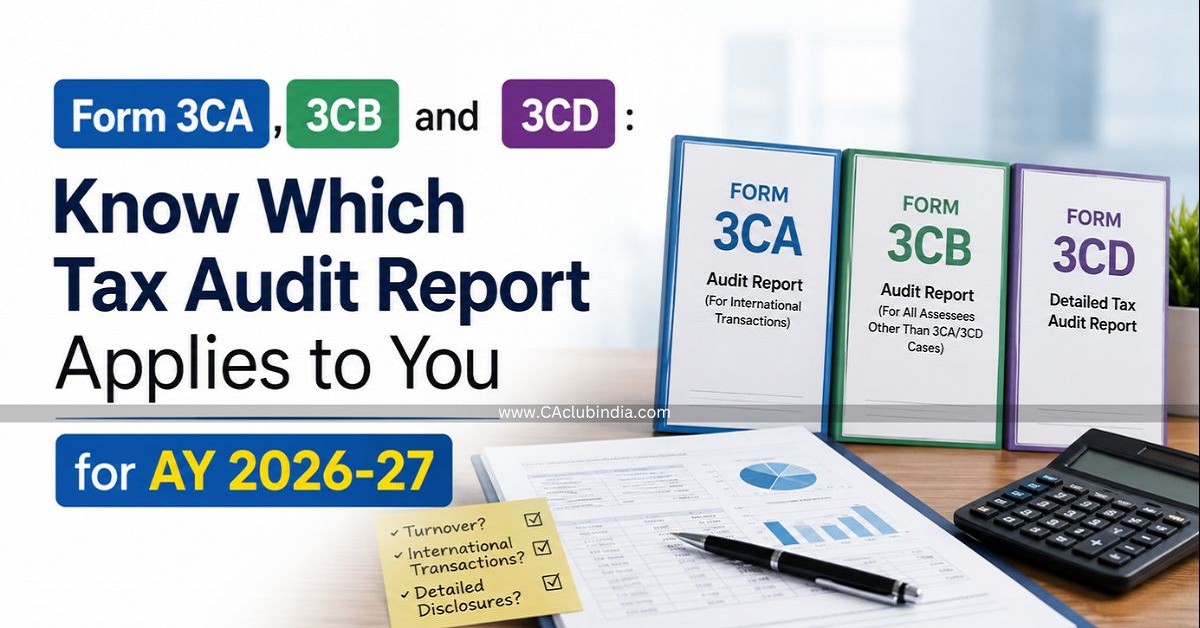
What Is a Tax Audit and Who Needs One?
A tax audit under Section 44AB of the Income-tax Act, 1961 is a verification exercise conducted by a Chartered Accountant to confirm that a taxpayer's books of account, deductions and disclosures are in order before the return is filed. It doesn't create additional tax liability by itself, but discrepancies flagged in the report can trigger closer scrutiny from the department.
For AY 2026-27, the applicability thresholds are:
- Businesses: Mandatory if turnover exceeds ₹1 crore.
- Businesses with mostly digital transactions: Threshold rises to ₹10 crore where cash receipts and cash payments each stay below 5% of total receipts and payments.
- Professionals: Mandatory if gross receipts exceed ₹50 lakh.
Once you know you're covered, the next question is which form your CA should file - and that depends entirely on whether your accounts are already audited under some other law.
Explore in Details : Income Tax Audit Limit for AY 2026-27: Guide to Section 44AB, 44AD and 44ADA Thresholds
Form 3CA: Who Should Use It?
Form 3CA applies when your accounts are already required to be audited under a law other than the Income-tax Act. In this case, the tax auditor doesn't conduct a fresh audit from scratch - they rely on the existing statutory audit and simply certify that the accounts are consistent with the return of income, adding the tax-specific disclosures separately.
Typical taxpayers who fall here:
- Companies, since audit is mandatory under Section 139 of the Companies Act, 2013
- LLPs required to be audited under the LLP Act, 2008
- Co-operative societies audited under their governing statute
Form 3CB: Who Should Use It?
Form 3CB is used when there is no other law mandating an audit of your accounts - the tax audit is the only audit being conducted, and the CA carries it out purely for income-tax purposes.
This is the form that applies to most:
- Proprietary concerns
- Partnership firms (other than LLPs covered under the LLP Act's own audit mandate)
- Individual professionals - doctors, lawyers, consultants, freelancers - crossing the ₹50 lakh threshold
Form 3CA vs Form 3CB: Side-by-Side Comparison
| Parameter | Form 3CA | Form 3CB |
| Applies to | Entities already audited under another law | Entities with no other statutory audit requirement |
| Typical taxpayers | Companies, LLPs, co-operative societies | Proprietors, partnership firms, professionals |
| Nature of audit | Reliance on existing statutory audit + tax certification | Independent audit conducted solely for tax purposes |
| Accompanying form | Form 3CD | Form 3CD |
| Authentication for AY 2026-27 | Digital Signature Certificate (DSC) | DSC, or EVC now permitted for individuals/HUFs |
Form 3CD: The Statement of Particulars
Regardless of whether Form 3CA or 3CB applies, both are filed together with Form 3CD - a detailed, 44-clause statement covering business particulars, accounting methods, disallowances, TDS compliance and more. Think of Form 3CA/3CB as the CA's certification, and Form 3CD as the fine print the department actually digs into.
For AY 2026-27, a few clauses deserve extra attention:
- Clause 44 (GST expenditure break-up): Must reconcile precisely with GSTR filings and the ITR - this is one of the most scrutinised clauses this year.
- Clause 36B: Newly relevant for reporting on share buybacks.
- Clauses 21, 26 and 34: Continue to draw close review, covering disallowances, deemed income, and TDS/TCS compliance respectively.
Pro tip: Before finalizing Form 3CD, cross-check your Clause 44 GST figures against your GSTR-3B and GSTR-9 filings. Mismatches here are one of the most common triggers for a scrutiny notice post-filing.
Due Dates for AY 2026-27
| Compliance | Due Date |
| Tax audit report (Form 3CA/3CB + 3CD) | 30 September 2026 |
| Tax audit report - transfer pricing cases | 31 October 2026 |
| Income tax return (where audit applies) | 31 October 2026 |
These dates can be extended by CBDT notification, as has happened in previous years, so it's worth tracking official announcements closer to the deadline rather than assuming the standard date will hold.
Explore in Details: Income Tax Audit Last Date For The AY 2026-27
Penalty for Non-Compliance
Missed the deadline?
Under Section 271B, failure to get accounts audited or to furnish the report in time attracts a penalty of 0.5% of turnover or gross receipts, capped at ₹1.5 lakh - unless reasonable cause for the delay can be demonstrated. Beyond the direct penalty, a late or unfiled audit report also delays your ITR filing, since the return due date for audit cases is linked to audit completion.
The Shift to Form 26: What's Coming Next
Here's the part most taxpayers haven't caught up on yet: Forms 3CA, 3CB and 3CD are on their way out. Under the Income Tax Act, 2025, they are being consolidated into a single unified Form No. 26, governed by Section 63 of the new Act.
Important nuance - this does not affect AY 2026-27. Audits relating to FY 2025-26 continue to use the existing Form 3CA/3CB and 3CD framework. Form 26 becomes mandatory only for Tax Year 2026-27 onward, i.e., income earned from 1 April 2026.
What Form 26 will look like, once it applies:
- Part A: General information and identification
- Part B: Audit opinion (merging today's 3CA and 3CB)
- Part C: Statement of particulars (replacing today's Form 3CD clauses)
- Part D: Quantitative and compliance details - digital transactions, TDS, GST reconciliation
- Part E: Auditor verification, with mandatory UDIN and Firm Registration Number
For now, treat AY 2026-27 as business as usual under the existing forms.
FAQs
What is the difference between Form 3CA and Form 3CB?
Form 3CA applies where accounts are already audited under another law, such as the Companies Act or LLP Act. Form 3CB applies where the tax audit is the only audit being conducted.
Is Form 3CD filed separately from Form 3CA or 3CB?
No - Form 3CD always accompanies either Form 3CA or Form 3CB as one composite audit report package.
What is the due date for filing the tax audit report for AY 2026-27?
Generally 30 September 2026, with transfer pricing cases extending to 31 October 2026, subject to any CBDT extension.
What is the turnover threshold for a mandatory tax audit?
₹1 crore for businesses (₹10 crore where cash transactions are under 5%), and ₹50 lakh gross receipts for professionals.
Will Forms 3CA, 3CB and 3CD continue after AY 2026-27?
No - they're being replaced by a unified Form 26 from Tax Year 2026-27 onward, though AY 2026-27 itself continues under the existing forms.
What is the penalty for not filing the tax audit report on time?
0.5% of turnover or gross receipts under Section 271B, capped at ₹1.5 lakh, unless reasonable cause is shown.










 CAclubindia