
Over the past few weeks, there have been significant changes in the value of the Japanese Yen, with several key events leading to a major shift:
1. Yen Exchange Rate Two Weeks Ago: The Japanese Yen was trading at 165 Yen per US Dollar
2. Japan's Long-Standing Zero Interest Rates: For over three decades, Japan maintained zero interest rates, offering zero-interest loans

3. Exploiting Low Rates: Many organizations, funds, and hedge funds capitalized on these low rates by borrowing large sums in Yen and investing in US markets, benefiting from both zero interest and a consistently rising Dollar against the Yen
4. Hedging Strategies: To safeguard their investments, these hedge funds also hedged by shorting the Yen, akin to selling call options for additional easy gains
5. Steady Profits: This strategy led to steady profits for years, establishing Japan as a major investor in US markets due to its zero-interest loans
6. Shift in Monetary Policy: Last week, the Japan Central Bank (JCB) raised interest rates by 25 basis points for the first time in over 30 years, disrupting the status quo
7. Market Reaction: The introduction of interest rates meant that previously zero-interest loans now had costs. Consequently, funds began liquidating their US market investments to repay loans, leading to a sharp decline in the Dow Jones Industrial Average (DJI), which dropped nearly 2000 points in 2-3 days
8. Yen Appreciation: The rise in interest rates caused the Yen to strengthen rapidly against the Dollar, reaching an exchange rate of 145 Yen per Dollar, a significant appreciation in just two days
9. Covering Short Positions: Investors who had shorted the Yen were forced to cover their positions quickly due to the rapid rise in the Yen's value.
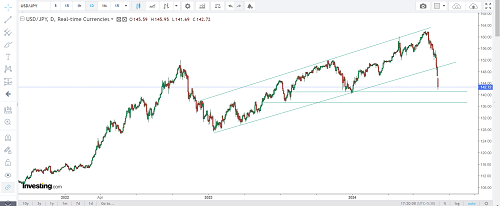
If the Yen continues to strengthen, risk assets could experience a more significant sell-off. Due to the increased interest rates and the market's reaction, investors are concerned that the previously "free" borrowed money is no longer cost-free. As a result, they are unwinding their trades and repatriating their funds back to Japan.
Assumption of the carry trade and the markets reacting to rate hike
1. Initial Position: (Assuming)
- Borrow 1 billion Yen.
- Exchange 1 billion Yen for $10 million USD (assuming 1 USD = 100 Yen).
2. Investment in US
- Invest $10 million in US stocks.
3. Hedging the Currency Risk
- Short USD/JPY at the current rate (1 USD = 100 Yen).
- This means they sell USD and buy Yen in the futures or options market.
Scenario Analysis
If the Yen Appreciates
- Suppose the Yen appreciates and the exchange rate moves to 1 USD = 90 Yen.
- Their investment in US stocks is still worth $10 million, but now they need to repay 1 billion Yen.
- Without hedging, they would need approximately $11.1 million (1 billion Yen / 90) to repay the debt, incurring a loss.
- With hedging, the short position in USD/JPY will gain value as the Yen appreciates, offsetting the loss due to currency appreciation.
If the Yen Depreciates
- Suppose the Yen depreciates and the exchange rate moves to 1 USD = 110 Yen.
- Their investment in US stocks is still worth $10 million, and now they need only approximately $9.1 million (1 billion Yen / 110) to repay the debt, gaining a profit.
- The short position in USD/JPY will incur a loss, but this loss is offset by the gain in currency conversion.
To address this situation, the solution is straightforward: the US should lower interest rates to counterbalance the effects. It's possible that the Federal Reserve might make an off-cycle policy announcement to mitigate the sell-off and stabilize the markets. They may adopt a cautious approach over the next day or two to observe whether the sell-off continues. Although rate cuts were anticipated last week, this event could serve as the catalyst for initiating them. In the meantime, long-term bonds might be impacted by these developments.











 CAclubindia
