One Nation One Election means structuring the Indian election cycle in a manner such that elections to Lok Sabha and State Assemblies are synchronized together.
Bill In The Parliament
The Central Government Tabled 'One Nation, One Election' Bill in Lok Sabha on Tuesday 17th December 2024.
Who introduced it?
The Cabinet approved the proposal last week, and Law Minister Arjun Ram Meghwal introduced it.
About The Plan
- The plan was proposed by a committee chaired by Former President Ram Nath Kovind.
- The committee argues that frequent elections negatively impact the economy, polity and society.
- The committee recommended conducting simultaneous elections to solved these issues.
- The first phase of the plan will align Lok Sabha and States Assembly election dates.
- Municipal and Panchayat election will be synchronised in the Second Phase within 100 Days.
- After a general election, the president will declare the appointed date for the Lok Sabha.
- Newly formed State Assemblies will have a shortened term to align with General Elections.
- Article 324A will be inserted into constitution to facilitate simultaneous Panchayat and Municipal Polls.
- Article 325 will be amended to create a unified voter roll and photo ID card.
Provisions
It indicates that the process of simultaneous elections itself will not take place till 2034.
"As per a copy of the bill circulated on the night of December 13 -
if the Lok Sabha or any State assembly is dissolved before of its full term, mid-term elections will be held only for that legislature to complete the remainder of its 5 year term.
Note:
- The provision of the amendment will come into effect on an "appointed date" which the President will notify on the first sitting of the Lok Sabha after a general election.
- According to the bill' the "appointed date" will be after the next Lok Sabha elections in 2029, with simultaneous elections slated to begin in 2034.
Tenure
The tenure of the House of the People (Lok Sabha) will be five years from the appointed date and the tenure of all Legislative Assembles elected after the appointed date will end with the tenure of Lok Sabha.
and, if
the tenure of the House of the People or a Legislative Assembly is dissolved before the end of its full term, the term of the new House or Assembly will be the unexpected portion of the previous term, it says.
Historical Background
- The concept of simultaneous elections is not a new idea in India.
- It is already conducted in 1952, 1957, 1962, 1967.
Why Got Discontinued?
- The cycle of synchronised elections was disrupted in 1968 and 1969 due to the premature dissolution of some State Legislative Assemblies.
- The Fourth Lok Sabha was also dissolved prematurely in 1970, with fresh elections held in 1971.
- Unlike the First, Second, and Third Lok Sabha, which completed their full five-year terms, the Fifth Lok Sabha's term was extended until 1977 under Article 352 because of the declaration of Emergency.
- Since then, only a few Lok Sabha terms have lasted the full five years, such as the Eighth, Tenth, Fourteenth, and Fifteenth. Others, including the Sixth, Seventh, Ninth, Eleventh, Twelfth, and Thirteenth, were dissolved early.
- State Assemblies have faced similar disruptions over the years.
- Premature dissolutions and term extensions have become a recurring challenge.
These developments have firmly disrupted the cycle of simultaneous elections, leading to the current pattern of staggered electoral schedules across the country.
Rationale for Simultaneous Elections
The points below are based on the findings of the report issued by the High-Level Committee on Simultaneous Elections, headed by former President Ram Nath Kovind:
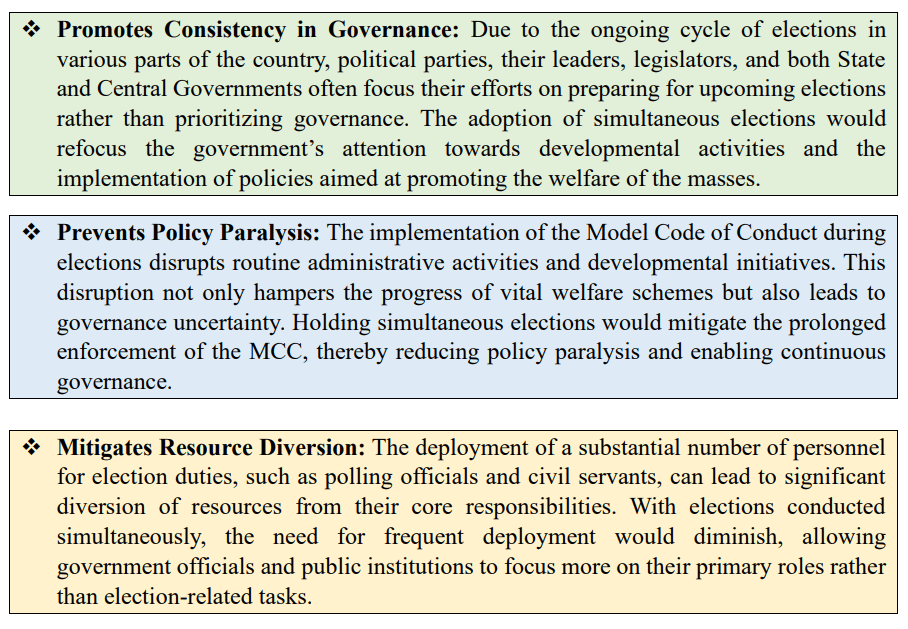
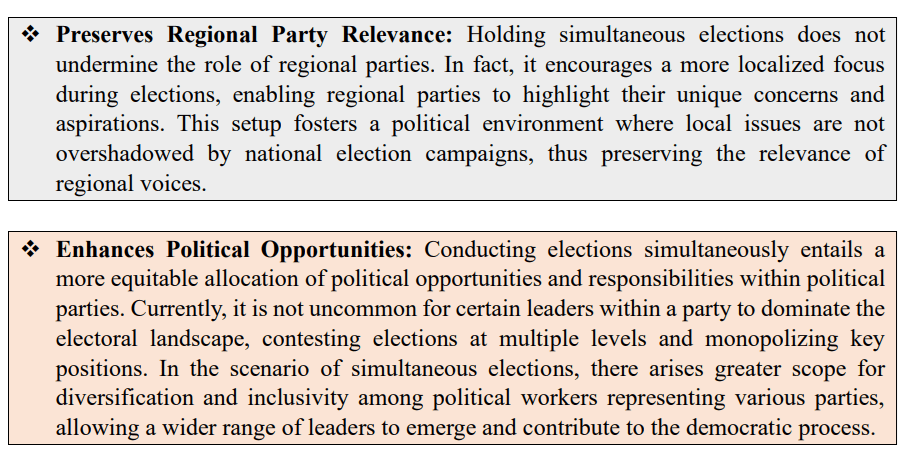
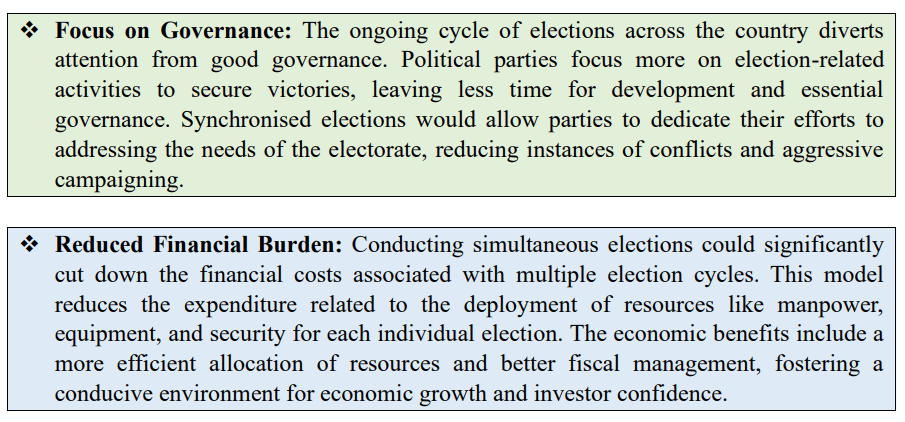
Conclusion
The High-Level Committee on Simultaneous Elections, led by former President Ram Nath Kovind, aims to align Lok Sabha and State Assembly election cycles to reduce costs, and minimizing policy disruptions caused by frequent elections.
Its phased implementation plan, requiring constitutional amendments, seeks to create a more efficient and stable electoral system.
With public and political backing, this initiative could streamline India’s democratic processes and bolster governance efficiency.










 CAclubindia