 Neha Redekar
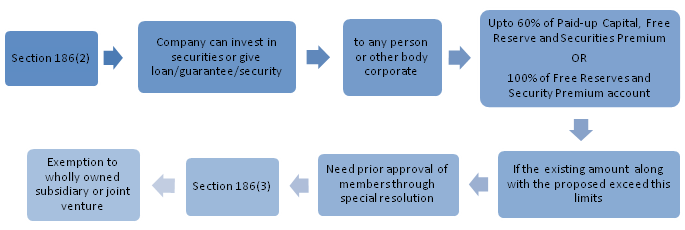
Section 186(2) of the Companies Act, 2013 provides that no company shall directly or indirectly
- Give any loan to any person or other body corporate;
- Give any guarantee or provide security in connection with a loan to any other body corporate or person; and
- Acquire by way of subscription, purchase or otherwise, the securities of any other body corporate,
exceeding 60% of its paid-up share capital, free reserves and securities premium account or 100% of its free reserves and securities premium account, whichever is more.
For the purpose of this sub-section, the word "person" does not include any individual who is in the employment of the company.

Further Section 186(3) provides that where the aggregate of the loan and investment made or the amount for which guarantee or security so far provided along with the investment, loan, guarantee or security proposed to be made, exceed the limits specified under sub-section (2), no investment or loan shall be made or guarantee or security shall be provided unless previously authorized by a special resolution passed in general meeting.
However, this will not apply if the loan/guarantee/security is provided by the company to its wholly owned subsidiary company or a joint venture company or acquisition is made by a holding company, by the way of subscription or purchase of securities of its wholly owned subsidiary company.
Section 186(1) states that the company shall make investment through not more than 2 layers of investment companies;
HERE THE 2 LAYER OF INVESTMENT MEANS
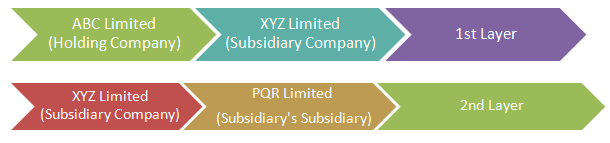
ABC Ltd. is a holding company and XYZ Ltd. is a subsidiary company of ABC Ltd. and PQR Ltd. is a subsidiary company of XYZ Ltd, then the investment of ABC Ltd into XYZ Ltd will be 1st Layer and from XYZ Ltd to PQR Ltd will be 2nd Layer and hence ABC Ltd will have indirect investment in PQR Ltd.
EXCEPTIONS TO NUMBER OF LAYERS OF INVESTMENT COMPANIES
- Acquiring any other company incorporated in a country outside India if such other company has investment subsidiaries beyond two layers as per the laws of such country;
- A subsidiary company from having any investment subsidiary for the purposes of meeting the requirements under any law or under any rule or regulation framed under any law for the time being in force.
DISCLOSURES
|
(1) In Financial Statements |
The company shall disclose in the financial statements the full particulars of the loans given, investment made or guarantee given or security provided and the purpose for which the loan or guarantee or security is proposed to be utilized by the recipient of the loan or guarantee or security. |
|
In Board's Report |
The company shall disclose particulars of loans, guarantee and investments by the company. |
MAINTAINING RECORDS
Every company giving loan or giving a guarantee or providing security or making an acquisition under this section shall keep a register in MBP-2 which shall contain such particulars and shall be maintained in such manner as may be prescribed.
The register referred to in sub-section (9) shall be kept at the registered office of the company and-
- Shall be open to inspection at such office; and
- Extracts may to taken therefrom by any member, and copies thereof may be furnished to any member of the company on payment of such fees may be prescribed.
OTHER TERMS AND CONDITIONS
- No investment shall be made or loan or guarantee or security given by the company unless the resolution sanctioning it is passed at a meeting of the board with consent of all the directors present at the meeting and the prior approval of the public financial institution concerned where any term loan is subsisting, is obtained. However prior approval of the public financial institution shall be required if the aggregate amount does not exceed the limit and there is no default in repayment of loan.
- No loan shall be given under this section at a rate of interest lower than the prevailing yield of 1 year, 3 Year, 5 year or 10 Year Government Security closest to the tenor of the loan.
- No company which is in default in the repayment of any deposits accepted before or after the commencement of this Act or in payment of interest thereon, shall give any loan or given any guarantee or provide any security or make an acquisition.
EXEMPTIONS
Except sub-section (1), provisions of Section 186 shall not apply-
(a) To any loan/investment made or guarantee/security provided by
- a banking company or
- an insurance company or
- a housing finance company in the ordinary course of its business or
- a company established with the object of and engaged in the business of financing industrial enterprises, or of providing infrastructural facility.
(b) To any investment
- Made by an investment company;
- Made in shares allotted in pursuance of clause (a) of sub-section (1) of section 62 or in shares allotted in pursuance right issues made by a body corporate;
- Made, in respect of investment or lending activities, by a non-banking financial company registered under chapter III-B of the Reserve Bank of India Act, 1934 and whose principal business is acquisition of securities.
PENALTY FOR NON-COMPLIANCE
If any default is made in complying with the provisions of this section:
|
Company |
shall be punishable with fine which shall not be less than Rs. 25,000/- but which may extend to Rs. 5,00,000/- |
|
Every officer of the company who is in default |
shall be punishable with imprisonment for a term which may extend to 2 years and with fine which shall not be less than Rs. 25,000/- but which may extend to Rs. 1,00,000/- |
The author can also be reached at csneharedekar@gmail.com
Disclaimer: Please note that the above article is based on the interpretation of related laws, which may differ from person to person and is not a legal advice.










 CAclubindia
