
Let's learn the basics of it
The Universal crisis caused by COVID-19 has led to revolutionary changes in the way the restaurant industry operates. With restaurants and hotels being shut, delivery kitchens, ghost restaurants or cloud kitchens are increasingly becoming more relevant. Even five-star chains across the country are counting on delivery operations to survive the crisis. The Oberoi Bengaluru, the Taj Group of Hotels, The Park Hotel and many other top chains are delivering their most popular dishes to customers' doorsteps in the wake of the ongoing nationwide lockdown. As India's largest cities have been shut, there is likely going to be an even sharper dip in sales than seen in 2009.
The online food delivery market is projected to grow from a $35 billion industry to $365 billion by 2030, globally, and restaurants' food delivery sales are growing more than three times the rate of on-premises revenue. Considering the high rentals and the increasingly tightening margins, restaurant operators are now closing up the storefront altogether and moving towards the more economically profitable, Cloud Kitchen business. Cloud kitchens thereby are becoming the need of the hour.
Here's All You Need to Know to Run a Successful Food Delivery Business in India
What Is A Cloud Kitchen
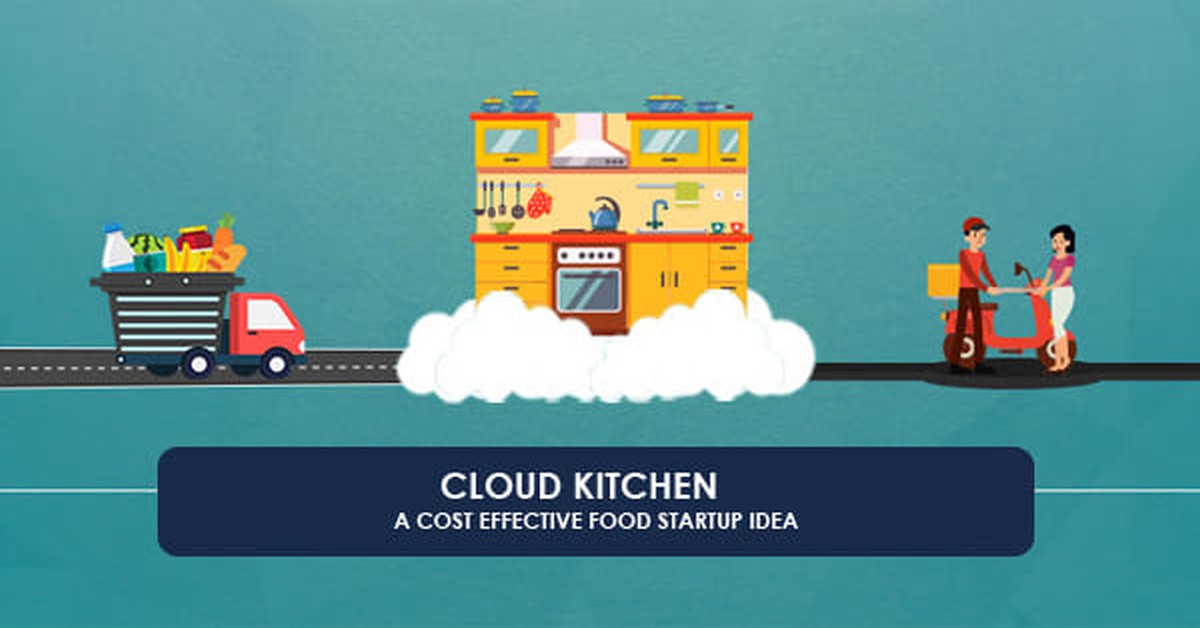
A cloud kitchen, also known as the ghost kitchen, dark kitchen, virtual restaurant, is a delivery-only restaurant format that offers no dine-in facility. Cloud Kitchens accept orders online or through telephone. They primarily rely on online food aggregators such as Swiggy, Zomato, Ubereats and/or websites or mobile apps to accept online orders.
Cloud kitchens are considered as a low investment, low risk, yet high on profit format since the cost of setting up a cloud kitchen is significantly less as compared to a traditional dine-in or takeaway restaurant.
Cloud kitchens may have their online ordering website and online ordering app or accept orders through various food delivery platforms. Since the primary source of revenue for these internet restaurants is through various food ordering platforms such as Swiggy, FoodPanda, Zomato, etc., it is important to have a check-in system that keeps track of the deliveries and the volume the company generates from different platforms. This will save you the trouble of adding and measuring orders from various ordering systems at the end of each day.
The cloud kitchen business provides restaurateurs the opportunity to experiment with different formats and concepts, which has in turn, given birth to varied food delivery business models.
Starting A Cloud Kitchen Business
The low investment and risk, along with the ease in replicating and scaling the business make cloud kitchen, one of the most profitable food business formats in the food industry.
Here are the things you need to consider to open a cloud kitchen business in India.
(i) Location & Property
Undoubtedly, the location and property are the biggest differentiators between a traditional dine-in/takeaway restaurant and a cloud kitchen. A cloud kitchen does not require a location with a high cricket stadium and prime property position. Rather, it can very easily be set up in a 250-300 Sq Ft space since there is no Front of the House.
The cloud kitchen can be in a fairly inaccessible area, but with high customer demand, particularly for a specific kitchen. Residential areas, market backsides, unused parking lots make a perfect cloud kitchen spot. Instead, you can also go for a shared kitchen room, as this helps reduce initial investment.
(ii) Licenses
For many reasons, obtaining proper licenses and certification is important to open a cloud kitchen. Second, getting the licenses in order will save you from legal difficulties. Second, because consumers can not visit the outlet themselves to test for sanitation, food safety and preparation, proper licensing gives them a sense of satisfaction. You can promote these on your website and in your marketing campaigns to convince your customers that you prepare high-quality food.
The major licenses required to start a cloud kitchen business are FSSAI, GST Registration, NOC from the fire department, etc. To ensure that you have these in place before starting a food delivery business.
1. FSSAI: Food Safety and Standards Authority of India. FSSAI Licenses are mandatory for food-related business in India and must be obtained on behalf of the company and its owner. The license period can range from 1 year to 5 years and must be renewed before expiry. It's also nice to mention FSSAI on the packaging and invoice to build confidence in our customers about our offers.
2. GST: GST registration is mandatory for any business in India and also it is recommended to file all the company related taxes timely. GST must be submitted weekly, quarterly and annually. GST also helps to procure licensed vendors, as it reduces the tax amount if all parties have a GST number. Upon obtaining a bank account, we will apply for a GST number.
3. Trade License: Every business will require to possess a trade license, and so does the cloud kitchen. This can be obtained from the local municipal office by furnishing all necessary documents. Apart from the cost, we might need some extra money to get the job finished. It is a one-time job and its kind of mandatory legal action.
4. Fire and Safety License: Now it's not mandatory to start with, but it is great to save yourself from future troubles. This is part of the law, and fire and human health agreements are compulsory for any workplace.
5. Trademark registration is also very relevant for the cloud kitchen company because the idea of this company doesn't allow the customer to step in, so the brand name of the business is the customer's HERO. To protect the brand, the business owner must file trademark applications for the logo, name, wordmark consisting of different colors, patterns to create their unique identity on the market.
(iii) Kitchen Equipment & Packaging
The kitchen equipment depends on the type of cuisine you serve. The basic equipment required to start a cloud kitchen is – stove and oven, refrigerator, knives, etc. Here is a full list of kitchen equipment to operate a food delivery company.
The packaging is a vital part of running a food company. No matter how good the food is, it will end up destroying the whole consumer experience and giving the company a bad name. Packaging also depends on the food type. You'd need plastic containers, bottles, spoons, etc. to ensure proper food packaging.
Because there's no House Front, you don't need many people in your cloud kitchen. Only 2-3 people concentrated on preparing and distributing food, you can easily open a shop. When you have several kitchen brands, the same chef will prepare food for various brands. Starting with a small team is best, and you can recruit more staff as incoming order volumes increase.
(iv) Staff
Since there would be employees, to stay compliant, the business owner will take care of all relevant rules and laws. Professional tax registration, TDS, PF, Payroll and wage measurement becomes an essential and critical part of the business.
Salary Accounts, PF, etc: Unfortunately, this is the last thing most cloud kitchen owners do as the blue-collar employees aren't too concerned about paying taxes and getting Provident Fund . When you're in serious business with a long-term target, it's important to start the cycle from day 1. It helps the team in the long run, building trust and friendly relationships with everyone.
Generating Online Orders And Marketing
Once you've set up the kitchen and staff, generate online orders for your cloud kitchen company.
Since a cloud kitchen doesn't have a dine-in facility and relies solely on online and telephone food orders, spending on promoting the food delivery brand is important , at least in the initial days. Without a shop with no display boards and signage, online marketing is important in this situation.
a) Listing Your Cloud Kitchen On Online Food Aggregators
b) Promoting Your Cloud Kitchen On Online Aggregators
c) Social Media Marketing
d) Search Engine Optimization
e) Loyalty Programs And SMS & Email
Technology Needed For A Cloud Kitchen
Since a cloud kitchen typically relies on online food websites and mobile apps to generate orders, technology plays a crucial role in this business. A cloud kitchen requires an integrated online restaurant ordering system for accepting online orders and for aiding operations
While cloud kitchens involve low risk and high benefit, one should be alert to the competition ahead to make profits. A cloud kitchen will be the next theme. If you plan to grow your company or start a food channel, the cloud kitchen is the safer and wiser alternative considering that you keep it compliant.
Optimizing Food Delivery
Preparing food while generating orders is just one part of the food delivery business. The bigger challenge here is ensuring that your food is delivered to your customers on time and in perfect condition. You can either tie-up with third-party aggregators or logistics company or have your in-house food delivery fleet to fulfill orders.
Packaging plays a crucial role in ensuring a great delivery service. You need to ensure that the food has been packaged and handled well when it is delivered to the customer.
Conclusion:
Admittedly, the FnB industry seems to be all set to witness the second round of the Food Tech revolution. With the increasing internet penetration, the demand for food delivery will further continue to Tier 2 and Tier 3 cities.
While cloud kitchens involve low risk and high benefit, one should be alert to the competition ahead to make profits. A cloud kitchen will be the next theme. If you plan to grow your company or start a food channel, the cloud kitchen is the safer and wiser alternative considering that you keep it compliant.
DISCLAIMER- This write-up is based on the understanding and interpretation of the author and the same is not intended to be professional advice.











 CAclubindia
