 CA Umesh Kumar Jethani
What is Corporate Tax Return Filing?
Corporate tax filing is the formal declaration of a company’s income, expenses, deductions, and tax liabilities to the Income Tax Department of India for a specific Financial Year (FY). Unlike individual filers, every corporate entity registered under the Companies Act, 2013 (or previous acts) must file an annual tax return using designated forms—primarily ITR-6 or ITR-7.

Which Form Should Your Company File?
Selecting the right tax form is the first step toward error-free compliance:
- ITR-6: Applicable to all companies except those claiming exemption under Section 11 (income from charitable or religious trusts). Private limited, public limited, and OPCs use ITR-6
- ITR-7: Applicable to companies and entities required to furnish returns under Sections 139(4A), 139(4B), 139(4C), or 139(4D) (e.g., trusts, political parties, research associations, and scientific institutions).
Important Company Tax Return Due Dates in India
Missing statutory deadlines results in penalties, mandatory interest under Sections 234A, 234B, and 234C, and the loss of the right to carry forward corporate losses. Knowing what the due date to file company income tax return in India helps maintain institutional compliance.
Key Compliance Deadlines for Assessment Year (AY) 2026-27:
| Entity Category | Compliance Requirement | Statutory Due Date |
| Companies requiring Tax Audit | Tax Audit Report submission (Form 3CA/3CD) | September 30 |
| Standard Companies (Audited) | Filing Income Tax Return (ITR-6) | October 31 |
| Companies with Transfer Pricing | Filing Form 3CEB (International/Specified Domestic Transactions) | November 30 |
| Delayed / Belated Returns | Filing Belated or Revised Return under Sec 139(4)/139(5) | December 31 |
Key Documents Required for Company ITR Filing
Before initiating the online return filing process, keep the following documentation organized. Having these records ready accelerates the filing workflow and reduces verification errors.
- Audited Financial Statements: Profit & Loss Statement, Balance Sheet, Notes to Accounts, and Auditor’s Report.
- Tax Audit Report: Form 3CA and Form 3CD (where tax audit under Section 44AB applies).
- Form 26AS & Annual Information Statement (AIS): Tax Credit Statement showing TDS deducted, TCS collected, and advance tax payments.
- Class 3 Digital Signature Certificate (DSC): Registered on the e-filing portal under the Director’s PAN.
- Incorporation Documents: Corporate Identification Number (CIN), Company PAN, and registered address details.
- Bank Statements: Complete details of all active company bank accounts operating during the financial year.
- Form 29B: Report for computation of Minimum Alternate Tax (MAT) under Section 115JB (if applicable).
Tax Audit Under Section 44AB for Companies
A crucial component of corporate tax filing in India is assessing whether your company requires a statutory tax audit.
When is a Tax Audit Mandatory?
Under Section 44AB of the Income Tax Act , a company must have its accounts audited by a practicing Chartered Accountant if:
- Business Turnover Exceeds ₹1 Crore: Applies to corporate entities operating primarily in cash.
- Business Turnover Exceeds ₹10 Crore: Applies when digital transactions account for 95% or more of total receipts and payments.
Corporate Tax Rates Overview
Companies can choose between standard taxation rules or concessional corporate tax regimes:
- Section 115BAA: Allows domestic companies to pay a concessional base tax rate of 22% (effective tax rate approx. 25.17% including surcharge and cess), provided they forego specific incentives/deductions and do not claim MAT benefits.
- Standard Tax Regime: 25% base rate for domestic companies with turnover up to ₹400 crore in the prior year, or 30% for larger entities, subject to Minimum Alternate Tax (MAT) under Section 115JB.
Step by Step Process to File ITR 6 Online for Private Limited Company
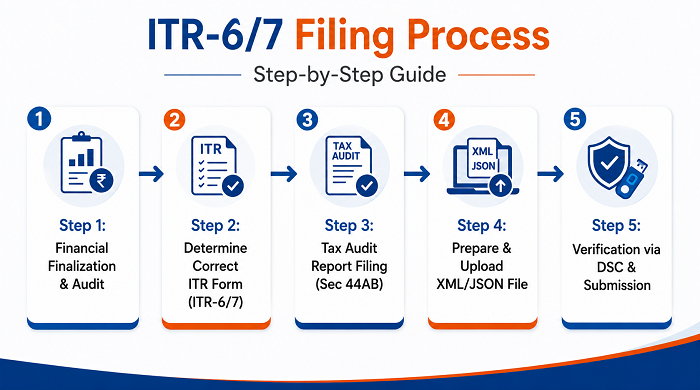
Follow this execution roadmap to submit your company’s return on the official Income Tax e-filing portal.
Step 1: Register and Log In to the E-Filing Portal
- Visit the official Income Tax e-filing website
- Log in using the company’s PAN as the User ID and enter the master password.
- Verify that the registered Director’s Class 3 DSC is active and updated in the user profile.
Step 2: Reconcile Financial Data with AIS and Form 26AS
- Navigate to Services > Annual Information Statement (AIS).
- Cross-verify total income, contract receipts, interest income, and TDS credits with the company’s audited Profit & Loss statement.
- Resolve any discrepancies prior to populating return data to prevent automated tax notices.
Step 3: Complete Tax Audit Filings (If Applicable)
- If Tax Audit under Section 44AB for companies applies, assign the CA through the portal dashboard.
- The CA uploads Form 3CA/3CD.
- The company director must log in to accept and approve the submitted audit report using their DSC before filing ITR-6.
Step 4: Download and Prepare ITR-6
- Go to e-File > Income Tax Returns > File Income Tax Return.
- Select the correct Assessment Year (e.g., AY 2026-27) and choose ITR-6.
- Fill in mandatory schedule details:
- General Information & Shareholding Pattern
- Balance Sheet and Profit & Loss details
- Computation of Total Income and Tax Liabilities
- Schedules for Losses, MAT (Section 115JB), and Tax Adjustments
- Details of Advance Tax and TDS Payments.
Step 5: Validate schedules and generate JSON Schema
- Utilize offline utilities or integrated software to perform schema checks.
- Ensure every schedule passes system validations without error flags.
Step 6: Submit Return with Digital Signature Certificate (DSC)
- Attach the XML or JSON return file to the e-filing engine.
- Select Verify via Digital Signature Certificate (DSC).
- Attach the signature using the emSigner utility and submit.
- Download Form ITR-V (Acknowledgement) for company records.
Common Pitfalls to Avoid in Corporate Tax Filing
Errors in corporate filings lead to delayed refunds, processing adjustments under Section 143(1), or non-compliance notices.
- Mismatching TDS Credits: Failing to match Form 26AS/AIS entries with ledger entries.
- Ignoring MAT Calculations: Forgetting to compute MAT liability under Section 115JB when opting out of Section 115BAA.
- Delaying Audit Approvals: Leaving CA audit report approvals until the last minute, causing missed statutory deadlines.
- Incorrect Shareholding Details: Omission of details regarding beneficial owners holding 10% or more voting power.
Conclusion
Filing corporate tax returns in India involves more than basic form-filling—it requires strategic tax planning, strict deadline tracking, and accurate reporting. Understanding how to file a company income tax return in India ensures your enterprise maintains operational credibility, avoids steep penalties, and remains fully compliant with Indian tax laws.
Don’t let complex schedules and tight statutory deadlines disrupt your business growth. Streamline your company ITR filing with automated tools and expert guidance today.
Frequently Asked Questions (FAQs)
Q1. What happens if a company fails to file its ITR on time?
Late filing incurs late fees under Section 234F up to ₹5,000, interest on unpaid tax liabilities under Section 234A, and forfeits the right to carry forward business or capital losses.
Q2. Is ITR filing compulsory for companies with zero turnover or losses?
Yes. Every registered company in India (Private Limited, Public, or OPC) must file an annual income tax return, even if no business operations occurred or zero revenue was recorded during the financial year.
Q3. Can a company alter its chosen tax regime during ITR filing?
Companies choosing the Section 115BAA tax regime must submit Form 10-IC on or before the due date specified under Section 139(1). Once exercised, this option cannot be withdrawn for subsequent years.
Q4. Is a Digital Signature Certificate (DSC) mandatory for company return filing?
Yes. Companies must sign and verify Form ITR-6 exclusively using a valid Class 3 Digital Signature Certificate belonging to a registered Director or authorised signatory.
You have reached your daily limit of 2 Free Articles
Subscribe to CCI PRO for unlimited access
Why Upgrade to CCI PRO?
- No Ads
- WhatsApp Community
- Daily E-Newsletter
- Unlimited Articles Access
- Profile Visitors
- Link Social Profiles
- Featured Job Posts
- Pro Badge
- Expert GST Guidance
- Unlimited Forum Replies
- Download Content in PDF
Already a PRO member? Login here for an ad-free experience. 011-411-70713











 CAclubindia
