
For decades, the Indian tax landscape felt like walking through a minefield. You could be a perfectly honest business owner, but one "oops" moment, a delayed TDS payment or a missed filing and suddenly, you are looking at the possibility of a prison sentence. This "aggressive enforcement" model, often dubbed "Tax Terrorism," led to thousands of court cases that dragged on for years over amounts that barely covered the cost of the legal paper.
But as of April 1, 2026, the game has changed. With the rollout of the Income-tax Act, 2025, the government has adopted NITI Aayog's blueprint for "Trust-Based Governance." The goal? Stop treating every taxpayer like a criminal-in-waiting.
The Core Philosophy: Moving from Fear to Fairness
The old regime (the 1961 Act) was cluttered with over 54 different criminal actions. NITI Aayog's Series-II Working Paper identified that this over-criminalisation didn't actually increase revenue; it just scared off investors and clogged the courts.
The Stats That Matter
- The Purge: NITI Aayog recommended a 60% drop in the types of offences that lead to prosecution.
- The ₹1 Crore Safety Net: For many offences, prosecution is now only triggered if the tax amount involved exceeds ₹1 Crore. Below this, the focus is on recovery, not incarceration.
- Judicial Power: Under the 2026 reforms, judges finally have the power to say, "This was a mistake," and waive jail time in favour of a fine, a power they often lacked under "mandatory minimum" sentencing rules.
Are You a "Mistake-Maker" or a "Fraudster"?
This is the billion-dollar question that the 2026 reforms finally answer. The law now recognises that humans make mistakes, and a "wrong click" is no longer viewed the same as "wrong intent."
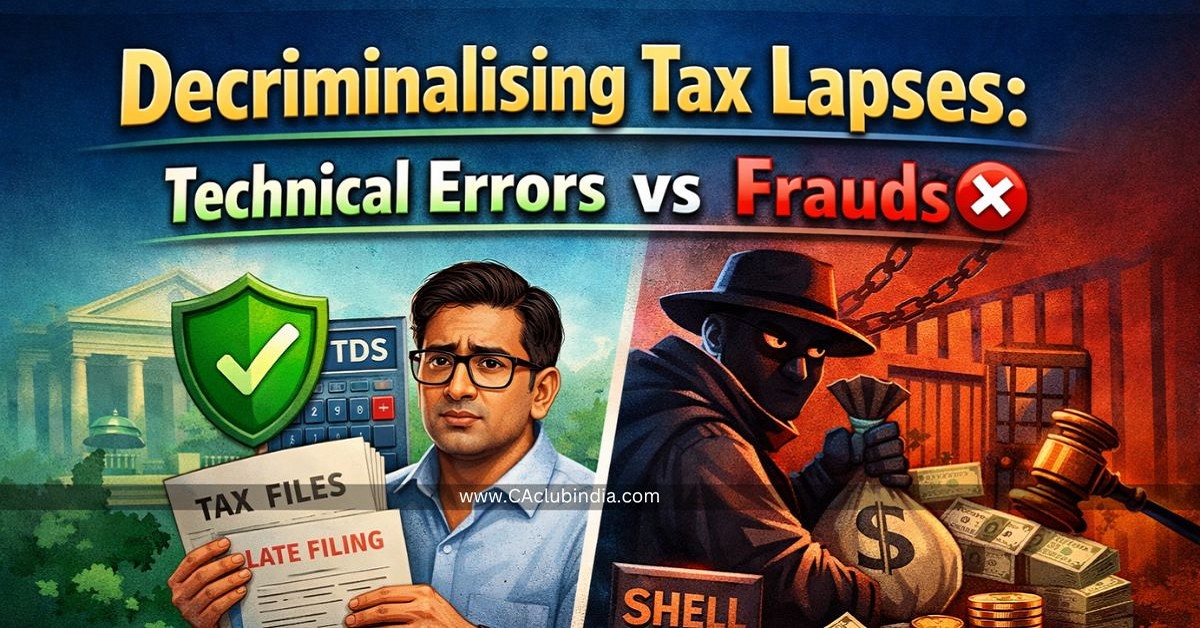
The "Technical Error" (The Safe Zone)
A technical error is a procedural slip-up where there was no intent to cheat. Under the new reforms, these are handled through monetary penalties rather than jail time.
- TDS/TCS Remittance Delays: If you've deducted the tax but paid it late, as long as it's deposited before you file your quarterly statement, you are generally protected.
- Non-Production of Books: Misplaced your receipts? Under the old law, this was a criminal offence. Now, it's a civil penalty.
- Minor ITR Filing Delays: Missed the deadline? You'll pay a late fee (Section 234F), but you won't be looking at a jail cell.
- If you're trying to game the system, don't expect a hug from the taxman. Criminality is still very much on the table for:
- Falsifying Books: Deliberately altering records to hide income.
- Shell Companies: Setting up "ghost" businesses to launder money or hide assets.
- Wilful Evasion: Knowing exactly what you owe and intentionally hiding it to bypass the system.
The "Mens Rea" Revolution: Previously, you were often presumed guilty. Now, for many sections, the prosecution must prove a "Culpable Mental State" (guilty mind). This is a massive legal victory for the honest taxpayer.
Why This Is a Win for Your Wallet (and Your Sanity)
Ready to grow without fear? Audit your books before the April deadline!
If you run a small business or an MSME, you likely don't have a team of 50 CAs. These reforms give you "Breathing Space." The "Ease of Doing Business" isn't just a buzzword anymore; it's backed by a 27% rise in new business registrations as entrepreneurs feel safer.
The "Updated Return" Safety Valve
The 2026 rules give you an "out." If you realise you made a mistake before the department catches you, you can file an Updated Return. It's essentially a voluntary disclosure that grants you automatic immunity from prosecution, provided you pay the tax and interest.
The Comparison: Old vs. New
|
Feature |
The Old Way (Before 2026) |
The NITI Aayog Way (Post April 2026) |
|
Philosophy |
Enforcement-Driven |
Trust and Partnership-Based |
|
Proof of Intent |
The taxpayer must prove innocence. |
The government must prove guilt. |
|
TDS Defaults |
1-7 years of imprisonment |
Civil Penalty/Fine (unless it is a fraud) |
|
Minor ITR Delays |
Risk of Prosecution |
Late Fee (Section 234F) |
|
Judicial Power |
Limited by mandatory jail terms |
Full discretion to impose fines |
How to Stay Safe in the 2026 Era
Don't wait for a notice, check your AIS/TIS data today!
Even though the law is friendlier, the ‘Tax-man' is getting smarter. The AI-driven Annual Information Statement (AIS) tracks everything from your stock flips to high-value spends.
1. Be Transparent: If the AIS shows income you forgot, report it. The system rewards honesty.
2. Digital First: Keep your records digital. The 2026 Act makes it much easier to prove a "Technical Error" if your digital trail is clean.
3. Know the Thresholds: Keep that ₹1 Crore number in mind. If your transactions are high-value, your compliance needs to be airtight.
Conclusion: A Fairer Tax Future
The NITI Aayog 2026 reforms represent a "Viksit Bharat" mindset, treating citizens as partners in nation-building rather than potential suspects. By decriminalising technical lapses, the government is ensuring that an honest mistake doesn't cost a citizen their freedom or reputation. As India aims for a $30 trillion economy by 2047 , it needs taxpayers who feel like partners, not suspects.
As long as you aren't intentionally trying to rob the treasury, you can sleep a lot easier tonight.
Disclaimer: This article provides general information existing at the time of preparation and we take no responsibility to update it with the subsequent changes in the law. The article is intended as a news update and Affluence Advisory neither assumes nor accepts any responsibility for any loss arising to any person acting or refraining from acting as a result of any material contained in this article. It is recommended that professional advice be taken based on specific facts and circumstances. This article does not substitute the need to refer to the original pronouncement.











 CAclubindia
