 Neethi V. Kannanth
A Corporate Identification Number (CIN) is a unique identification number that is assigned by the Registrar of Companies (ROC) to the companies registered in India. The ROC gives the CIN to the companies while issuing their Registration Certificate.
The CIN is an important number as every company must mention this unique CIN in the forms to be submitted to the Ministry of Corporate Affairs (MCA), particularly in audits and reports.
Table of Contents
What is Corporate Identification Number (CIN)?
Corporate Identification Number (CIN) is a 21 digits alpha-numeric code issued to companies incorporated within the country on being registered by the ROC situated in different states across India under the MCA.
CIN is provided to all companies registered in India, except Limited Liability Partnerships (LLP) registered in India. For the LLPs, the ROC gives the LLPIN (Limited Liability Partnership Identification Number) that acts as a unique 7-digit identification number of the LLP.

Importance of Corporate Identification Number
CIN is used for tracking all the aspects and activities of a company from its incorporation by the ROC and is required to be provided on all the transactions with the respective ROC.
The 21 digit CIN has its own meaning which is easily translatable and which helps in finding basic information relating to a company. It is used for finding the primary details of the companies which are registered within the country under MCA.
CIN is a unique number that can be used for identifying or tracking companies for several levels of information that ROC / MCA holds. The CIN contains the identity of an organisation and additional information regarding the registered company under the ROC.
Decoding Corporate Identification Number
The 21-digits CIN represents and provides information about the company. The CIN can be broken down into six sections. In the above example, the CIN can be broken down as follows:
- Section-1: Consists of the first character of CIN that reveals whether a company is “Listed” or “Unlisted” on the Indian stock market. In other words, the first character implies the Stock Market listing status. In case a company is listed, the CIN would start with the letter ‘L’ and in case a company isn’t listed it would start with the letter ‘U’.
- Section-2: Consists of the next set of five numeric digits that categorizes the economic activity of a company or to which industry the company belongs to. This classification is based on the nature of the economic activities which would be carried out by such an establishment. The Ministry of Corporate Affairs (MCA) has allotted a number to every category or industry.
- Section-3: Consists of the next two letters that denote the Indian state where the company is registered. For instance, KA is for Karnataka, MH is for Maharashtra, DL is for Delhi, etc. It works in a similar fashion as the car registration number.
- Section-4: Consists of the next set of four numeric digits that signifies the year of incorporation of a company.
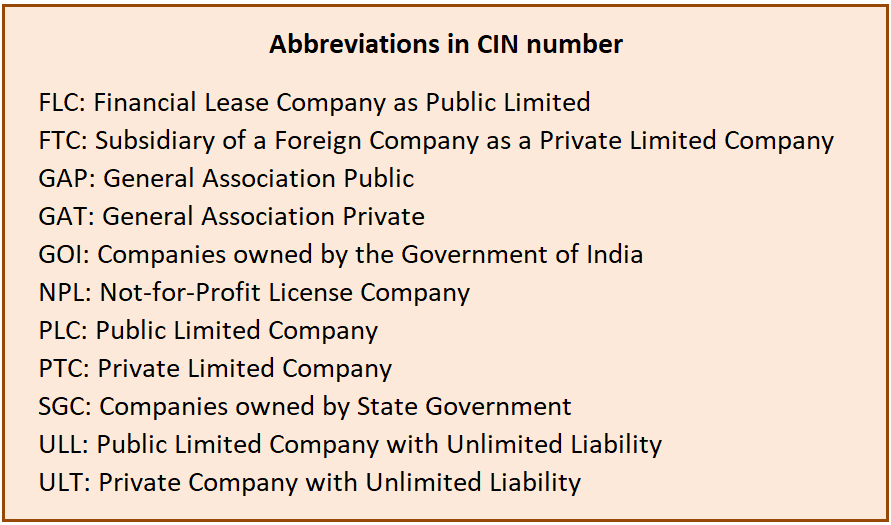
- Section-5: Consists of the following three letters that denote the company classification. These three letters help to identify whether a company is a private limited company or a public limited company. If the CIN number here is FTC, it would mean that such a company is a subsidiary of any foreign company or if it’s GOI, it would imply that such company is owned by the Indian Government.
- Section-6: Consists of the remaining six numeric digits that denote the registration number provided by the respective Registrar of Companies (ROC).
Usage of Corporate Incorporation Number
Every company that is established in India needs to quote its Corporate Identification Number on various documents which include:
- On invoices, bills and receipts
- On notice
- On memos
- On letterheads
- Annual Reports and audits
- Every e-form submission on the MCA portal
- Company’s official publications
- Any other company publications
Abbreviations in CIN number
Penalty for Non-compliance of Mentioning CIN
In case the above-mentioned requirements aren’t adhered to, there’s a penalty of INR 1,000/day on the defaulting company and on its, every officer is in default, till such default continues. However, the maximum penalty for this default is limited to INR 1,00,000.
Changing Corporate Identification Number
CIN which is provided to every registered company for the purpose of identification can be changed in certain cases such as:
- Any change in the listing status of a company
- Any change in the location or change of state where the company’s registered office is situated
- Any change in the industry/sector to which a company belongs










 CAclubindia