
Introduction
Every founder eventually hits the same wall: the business idea is ready, but the company registration structure isn't decided. Should it be a Private Limited Company that investors love, a One Person Company (OPC) built for solo founders, or an LLP that keeps compliance light? Get this decision wrong during the business registration process, and you could end up paying for an audit you didn't need, losing the ability to raise equity funding, or spending months converting from one structure to another later.
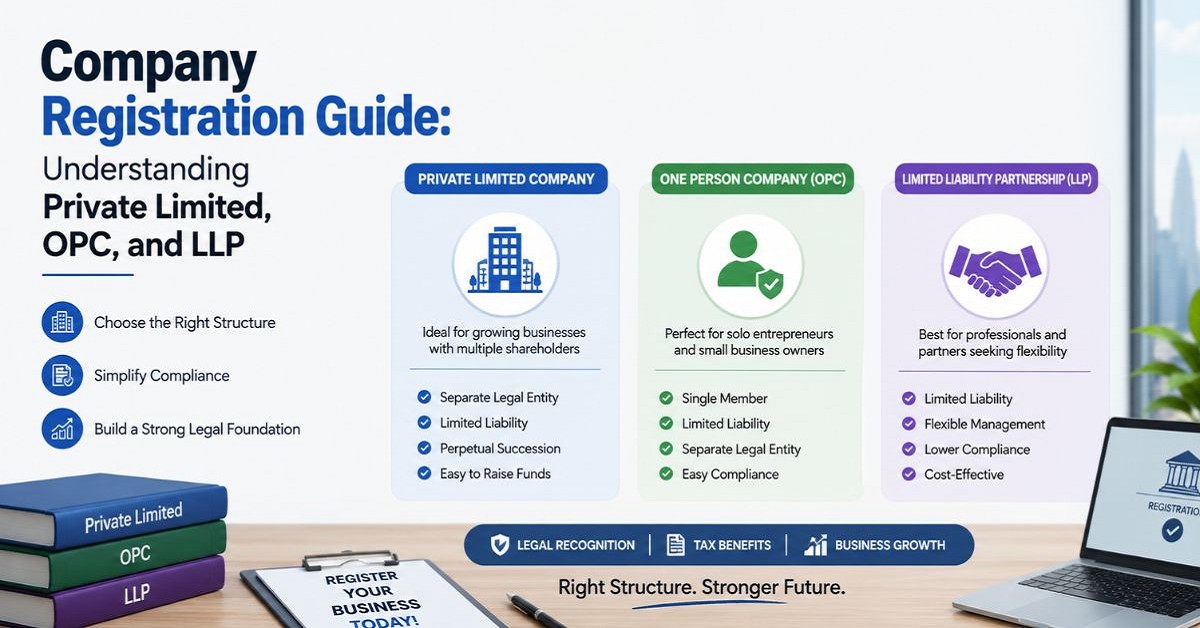
This choice matters because your business structure decides who is liable for debts, how much tax you pay, what compliance you file every year, and whether venture capital firms will even consider investing. A Private Limited Company Registration offers the most credibility and fundraising flexibility but comes with the heaviest compliance. An OPC suits a solo entrepreneur who wants limited liability without a co-founder. An LLP works best for professional services and bootstrapped businesses that want flexibility without shareholding complexity.
What Is Company Registration in India?
Company registration is the legal process of incorporating a business as a distinct entity under the Companies Act, 2013 (for companies registration) or the Limited Liability Partnership Act, 2008 (for LLP Registration), through the Ministry of Corporate Affairs (MCA). Once registered, the business gets a separate legal identity, limited liability protection for its owners, and the ability to enter contracts, own property, and raise capital in its own name.
In India, the three most common structures for startups and small businesses are:
- Private Limited Company (Pvt Ltd), registered under Section 2(68) of the Companies Act, 2013
- One Person Company (OPC), registered under Section 2(62) of the Companies Act, 2013
- Limited Liability Partnership (LLP), registered under the LLP Act, 2008
All three offer limited liability, meaning the personal assets of owners are protected from business debts, a key advantage over a sole proprietorship or traditional partnership firm.
Private Limited Company: Features, Eligibility, and Process
A Private Limited Company is a business entity privately held by shareholders, offering limited liability, a separate legal identity, and perpetual succession, registered under the Companies Act, 2013.
Key Features
- Minimum 2 shareholders, maximum 200
- Minimum 2 directors, maximum 15
- No minimum paid-up capital requirement (post the Companies (Amendment) Act, 2015)
- Shares cannot be traded publicly, restricting transferability
- Suffix: Private Limited mandatory in the company name
- Can raise equity funding from venture capitalists, angel investors, and private equity funds
- Governed by a Board of Directors and requires statutory audits regardless of turnover
Who Should Choose a Private Limited Company?
- Startups planning to raise venture capital or angel funding
- Businesses wanting to issue Employee Stock Options (ESOPs)
- Founders who need strong credibility with banks, vendors, and enterprise clients
- Businesses with more than one founder or investor
Documents Required
- PAN and Aadhaar of all directors and shareholders
- Passport-size photographs
- Proof of registered office (rent agreement or sale deed + utility bill, not older than 2 months)
- No Objection Certificate (NOC) from the property owner
- Digital Signature Certificate (DSC) for all subscribers and directors
- Director Identification Number (DIN), allotted through SPICe+ if not already held
Pros and Cons
|
Pros |
Cons |
|
Easiest structure to raise funding |
Higher compliance cost (audit, board meetings, ROC filings) |
|
Limited liability for shareholders |
Cannot have more than 200 shareholders |
|
Separate legal entity with perpetual succession |
Mandatory annual audit regardless of turnover |
|
Strong brand credibility with investors and clients |
Higher setup and maintenance cost than LLP |
One Person Company (OPC): Features, Eligibility, and Process
A One Person Company is a company with a single shareholder who is also usually the sole director, offering limited liability and a separate legal identity to solo entrepreneurs under Section 2(62) of the Companies Act, 2013.
Key Features
- Only 1 member (shareholder) and a mandatory nominee appointed via Form INC-3
- Minimum 1 director (the sole member may also be the director)
- No minimum paid-up capital requirement
- Company name must end with (OPC) Private Limited
- Cannot be converted into a Section 8 (non-profit) company
- Cannot carry out Non-Banking Financial Investment activities, including investing in securities of other companies (Rule 3, Companies (Incorporation) Rules, 2014)
Eligibility Criteria
Under the Companies (Incorporation) Second Amendment Rules, 2021, effective 1 April 2021:
- Only a natural person who is an Indian citizen can be a member or nominee of an OPC, resident or non-resident
- The residency requirement for a resident in India was reduced from 182 days to 120 days in the preceding financial year
- NRIs are now permitted to incorporate an OPC in India
- A natural person can be a member of only one OPC at a time
Did You Know? Before the 2021 amendment, an OPC was mandatorily required to convert into a Private or Public Limited Company once its paid-up capital crossed ₹50 lakh or its annual turnover crossed ₹2 crore. That mandatory conversion trigger has since been removed entirely, an OPC can now grow without forced restructuring, though voluntary conversion is still allowed at any time.
Who Should Choose an OPC?
- Solo founders who want limited liability without finding a co-founder
- Freelancers and consultants formalising their practice
- Small business owners not planning to raise external equity funding immediately
Pros and Cons
|
Pros |
Cons |
|
Full control with a single owner |
Cannot raise equity funding from multiple investors easily |
|
Limited liability protection |
At least one director must be resident in India (182 days under Section 149(3)) |
|
No mandatory conversion thresholds since 2021 |
Cannot accept public deposits under Section 76 |
|
Simple governance, no board complexities |
Not suitable for businesses expecting multiple co-founders |
Limited Liability Partnership (LLP): Features, Eligibility, and Process
A Limited Liability Partnership is a hybrid business structure combining the operational flexibility of a partnership firm with the limited liability protection of a company, governed by the LLP Act, 2008.
Key Features
- Minimum 2 designated partners; no upper limit on partners
- At least one designated partner must be resident in India
- No minimum capital contribution required
- Governed by an LLP Agreement rather than a Memorandum and Articles of Association
- Registered through the FiLLiP form on the MCA portal
- Audit is not mandatory unless turnover exceeds ₹40 lakh or partner contribution exceeds ₹25 lakh (Rule 24(8), LLP Rules, 2009)
- Cannot issue equity shares, not suitable for equity-funded, VC-backed startups
Who Should Choose an LLP?
- CA, CS, legal, and other professional practices
- Consulting firms and service businesses
- Bootstrapped businesses that want lighter compliance and no dividend distribution tax
- Real estate holding structures and family-run businesses
Documents Required
- PAN and Aadhaar of all designated partners
- Digital Signature Certificate (DSC) for designated partners
- Designated Partner Identification Number (DPIN)
- Proof of registered office and NOC from the property owner
- Drafted and stamped LLP Agreement
Pros and Cons
|
Pros |
Cons |
|
Lower compliance cost than a Pvt Ltd |
Cannot raise equity funding or issue ESOPs |
|
No mandatory audit below ₹40 lakh turnover or ₹25 lakh contribution |
Less attractive to VC and institutional investors |
|
Flexible internal management via LLP Agreement |
Perceived as less prestigious for enterprise clients |
|
Partners' liability limited to their agreed contribution |
Conversion to Pvt Ltd later involves additional filings |
Private Limited vs OPC vs LLP: Full Comparison Table
|
Feature |
Private Limited Company |
OPC |
LLP |
|
Governing Law |
Companies Act, 2013 |
Companies Act, 2013 |
LLP Act, 2008 |
|
Minimum Members |
2 shareholders |
1 member + 1 nominee |
2 designated partners |
|
Maximum Members |
200 |
1 |
No limit |
|
Liability |
Limited to shares held |
Limited to shares held |
Limited to agreed contribution |
|
Equity Funding |
Fully supported |
Not practical (single member) |
Not permitted |
|
ESOPs |
Allowed |
Not applicable |
Not allowed |
|
Mandatory Audit |
Yes, regardless of turnover |
Yes, regardless of turnover |
Only above ₹40 lakh turnover or ₹25 lakh contribution |
|
Compliance Burden |
High |
Moderate |
Low to Moderate |
|
Foreign Ownership |
Permitted (FDI rules apply) |
Only Indian citizens (resident or NRI) |
Permitted (FDI rules apply) |
|
Ideal For |
Startups seeking funding |
Solo entrepreneurs |
Professional or service firms |
How to Register a Company in India: Step-by-Step SPICe+ Process
SPICe+ (Simplified Proforma for Incorporating Company Electronically Plus) is the single, integrated web form on the MCA V3 portal that bundles name reservation, incorporation, DIN allotment, PAN, TAN, GSTIN, EPFO, ESIC, and bank account opening into one filing. It is the only route for incorporating a Private Limited Company or OPC in India; LLPs are registered separately through the FiLLiP form.
- Create a Business User account on the MCA portal (mca.gov.in) and log in.
- File SPICe+ Part A for name reservation, the proposed name must not resemble an existing company or trademark. Part A approval is valid for 20 days.
- File SPICe+ Part B, covering director and shareholder details, registered office address, share capital structure, and geo-coordinates of the office.
- File linked forms simultaneously: e-MOA (INC-33), e-AOA (INC-34), AGILE-PRO-S (for GST, EPFO, ESIC, and bank account), and INC-9 (declaration).
- Attach a Digital Signature Certificate (DSC) for every director and subscriber, and digitally sign all forms.
- Pay applicable fees, government incorporation fee is nil for companies with authorised capital up to ₹15 lakh; state-specific stamp duty still applies.
- Receive the Certificate of Incorporation (COI) along with PAN and TAN, typically within 2 to 10 working days if all documents and details are error-free.
- File INC-20A (declaration of commencement of business) within 180 days of incorporation before starting business operations.
For an LLP, the process instead runs through FiLLiP: reserve the name, obtain DPIN and DSC for designated partners, file FiLLiP for incorporation, receive the Certificate of Incorporation, then draft and file the LLP Agreement, and apply for PAN, TAN, and GST separately.
Company Registration Fees and Government Charges
|
Cost Component |
Private Limited or OPC |
LLP |
|
Government incorporation fee |
Nil for authorised capital up to ₹15 lakh |
Based on contribution slab |
|
State stamp duty |
Varies by state (auto-calculated on MCA V3) |
Varies by state |
|
DSC issuance |
Approx. ₹1,000–₹1,500 per person |
Approx. ₹1,000–₹1,500 per person |
|
Professional or certification fees |
Varies by service provider |
Varies by service provider |
|
PAN & TAN |
Included in SPICe+ filing |
Applied separately post-incorporation |
Timeline: Under normal processing, and with error-free documentation, the Registrar of Companies (ROC) typically issues the Certificate of Incorporation within 2 to 10 working days for a Private Limited Company or OPC, and 7 to 15 working days for an LLP.
Post-Registration Compliance Requirements
Registration is only the beginning, every structure carries ongoing annual compliance checklist obligations.
Private Limited Company or OPC:
- Appointment of a statutory auditor within 30 days of incorporation
- Annual filing of financial statements (Form AOC-4) and annual return (Form MGT-7 or MGT-7A)
- Board meetings (minimum 4 a year for Pvt Ltd; relaxed for OPC) and Annual General Meeting (for Pvt Ltd)
- Income Tax Return filing (ITR-6)
- DIR-3 KYC for every director annually
LLP:
- Form 11 (Annual Return) within 60 days of financial year closure, due 30 May every year
- Form 8 (Statement of Account and Solvency), due 30 October every year
- Mandatory audit only if turnover exceeds ₹40 lakh or partner contribution exceeds ₹25 lakh
- Income Tax Return (ITR-5), due 31 July (non-audit cases) or 31 October (audit cases)
- DIR-3 KYC for designated partners
Did You Know? An LLP must file Form 11 even if it did zero business during the year, the ₹100-per-day penalty for late filing has no upper cap, so a delay of even a few months can add up quickly.
Common Mistakes to Avoid During Company Registration
- Choosing a proposed name that closely resembles an existing company or registered trademark, leading to rejection
- Uploading mismatched or low-quality address and identity proofs
- Forgetting to file INC-20A within 180 days, which can lead to penalties and even removal of the company's name from the register
- Ignoring state-specific stamp duty while budgeting for incorporation
- Selecting a Private Limited structure purely for credibility without evaluating the compliance cost involved
- Missing LLP Form 8 and Form 11 deadlines, which attract uncapped daily penalties
- Not appointing a nominee for an OPC at the time of incorporation, delaying the entire filing
Which Business Structure Should You Choose?
- Choose a Private Limited Company if you plan to raise funding from investors, issue ESOPs, or eventually list publicly.
- Choose an OPC if you are a solo founder who wants limited liability and a separate legal identity without bringing in a co-founder.
- Choose an LLP if you run a professional or service-based business, want lower compliance costs, and do not need external equity funding.
Quote: The right business structure is not the one that sounds the most impressive, it's the one that matches how you plan to fund, run, and eventually scale the business.
Latest News: The MCA's continued push toward the V3 portal has made SPICe+ the sole incorporation route for new companies, with linked services like EPFO, ESIC, and profession tax enrolment bundled into a single filing, cutting down the multi-portal registration process that founders faced before 2020.
Case Study: A two-founder SaaS startup initially considered an LLP for its lower compliance cost. However, once they began fundraising conversations with angel investors, they had to convert to a Private Limited Company mid-negotiation, delaying their funding round by several weeks. Evaluating fundraising plans before registration would have avoided this detour entirely.
Conclusion
Choosing between a Private Limited Company, OPC, and LLP is one of the most consequential early decisions a founder makes, it shapes liability, taxation, fundraising ability, and the compliance workload you'll carry every year. A Private Limited Company suits funding-driven startups, an OPC fits solo entrepreneurs, and an LLP works well for professional and service-oriented businesses that value lower compliance. Getting the structure wrong doesn't just cost money to fix later, it can cost you a funding round or months of avoidable paperwork. Before filing, weigh your growth plans, funding needs, and compliance appetite carefully, and when in doubt, consult a professional before locking in your entity type.
Why Choose Zolvit
Expert lawyers, Chartered Accountants, and Company Secretaries under one roof
- End-to-end handling of SPICe+ and FiLLiP filings on the MCA V3 portal
- Fast, error-free processing to avoid resubmissions and delays
- Transparent, affordable pricing with no hidden charges
- Complete post-incorporation compliance support, ROC filings, audits, and annual returns
- Dedicated relationship manager for every business, from incorporation to ongoing compliance
Key Takeaways
- Private Limited, OPC, and LLP all offer limited liability, but differ sharply in compliance, funding, and ownership flexibility.
- A Private Limited Company is best for startups planning to raise equity funding or issue ESOPs.
- An OPC suits solo founders, since the 2021 amendment, NRIs are eligible and there is no mandatory conversion threshold based on turnover or capital.
- An LLP offers the lightest compliance, with audit required only above ₹40 lakh turnover or ₹25 lakh contribution, but cannot raise equity funding.
- Registration for Pvt Ltd or OPC runs through SPICe+; LLPs register through FiLLiP, both on the MCA V3 portal.
- Missing post-registration compliance (INC-20A, Form 8, Form 11, DIR-3 KYC) attracts daily penalties with no upper cap in several cases.
FAQs
1. Can I convert an LLP into a Private Limited Company later?
YES. An LLP can be converted into a Private Limited Company by following the prescribed procedure under the Companies Act, 2013, including obtaining partner consent, filing conversion forms with the ROC, and meeting minimum shareholder and director requirements.
2. Should a solo founder always choose an OPC over a Private Limited Company?
Not necessarily. An OPC suits solo founders avoiding external funding, but if you plan to bring in co-founders or investors soon, starting directly with a Private Limited Company can save you a conversion process later.
3. Can an NRI incorporate a One Person Company in India?
YES. Since the Companies (Incorporation) Second Amendment Rules, 2021, NRIs can incorporate an OPC in India, provided they meet the reduced 120-day residency requirement or otherwise qualify as an eligible Indian citizen.
4. Is a mandatory audit required for every LLP?
NO. An LLP requires a mandatory audit only if its annual turnover exceeds ₹40 lakh or partner contribution exceeds ₹25 lakh under Rule 24(8) of the LLP Rules, 2009. Below these thresholds, audit is optional.
5. What is the minimum capital required to register a Private Limited Company?
There is no minimum paid-up capital requirement for registering a Private Limited Company in India, following the Companies (Amendment) Act, 2015, though a nominal authorised capital is typically set for operational purposes.
6. Can a Private Limited Company be registered with just one director?
NO. A Private Limited Company requires a minimum of two directors and two shareholders. If you want a single-owner structure, a One Person Company (OPC) is the appropriate choice instead.
7. How long does company registration take in India?
Under normal MCA V3 processing timelines, a Private Limited Company or OPC typically receives its Certificate of Incorporation within 2 to 10 working days, while LLP registration through FiLLiP usually takes 7 to 15 working days.
8. Does an OPC have to convert to a Private Limited Company once it grows?
NO. Since the 2021 amendment removed the mandatory conversion thresholds, an OPC is no longer forced to convert based on turnover or paid-up capital, though voluntary conversion remains available at any time.









 CAclubindia
