 Niyati
Introduction
When it comes to success in trading, strategy is a core factor. It is what determines the profit you will make in that trade. If you apply it well, it guarantees you something to take out of a trade as a gain; if not, you will just be contributing to the trading platform. This is why it is essential to explore strategies to make profits before starting any sports trade.
The importance of knowing trading strategies cannot be overemphasized, especially if you are new to sports trading. Best Betfair Trading Strategy for Beginners can help if you are new to it. In this guide, we shall be looking at the five most famous sport trading strategies.
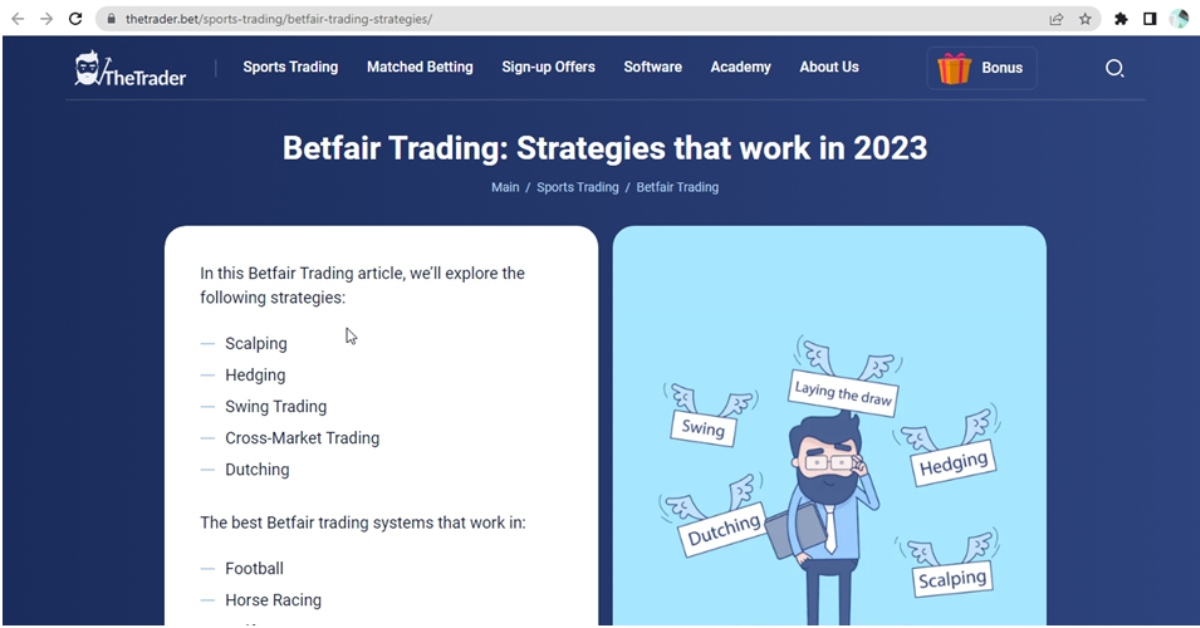
Sport Trading Strategies on Betfair
Scalping
Scalping explores price movements in sports trading. Here, you can make small profits based on the market's price movement. This strategy requires a trader to place a bet on a selection and then quickly close that bet at a slightly higher price. The trader then repeats this process several times to make a profit. Scalping is a strategy that is high-rewarding. However, it has some associated risk that requires you to know the sports trade well to make profits.
The odds associated with scalping on Betfair depending on the market being traded. In some markets, such as horse racing, scalping can be profitable if the trader can identify small price movements. However, the odds may not be as favorable for scalping in other markets, such as football.
Hedging
Hedging is a sport trading strategy that involves placing bets on opposite outcomes in the same market to reduce risk. For instance, you may place bets on teams playing a particular sport. This means that you will be getting profits from the wins of any of the teams playing you bet on. This helps to reduce the chances of making losses.
The outcome of the bets placed on the games using the heading strategy depends on the number of bets placed. This is because you may lose if you place win bets on the teams playing if the game ends in a draw. In some markets, such as tennis, hedging can be profitable if the trader can identify opportunities to reduce risk. However, in other markets, such as horse racing, the odds may not be as favorable for hedging.
Swing Trading
Swing trading is a sports trading strategy that involves holding bets for more extended periods, usually several hours or even days. This strategy requires a trader to identify trends in a market and place bets based on those trends. For example, a trader may place a bet on a football team to win a match and hold that bet until the odds change.
In some markets, such as cricket, a swing trading strategy increases the chances of wins, provided the trader can detect long-term trends. However, the odds may not be as favorable for swing trading in other markets, such as football.
Cross-Market Trading
Cross-market trading is a sports trading strategy involving simultaneously trading in multiple markets. This strategy requires a trader to identify correlations between different markets and place bets based on those correlations. For example, a trader may bet on a football team to win a match and then place a second bet on the total number of goals scored.
Cross-market trading on Betfair depends on the markets being traded and the trader's ability to identify correlations. In some markets, such as horse racing and football, cross-market trading can be profitable if the trader can identify correlations between different markets.
Dutching
Similar to hedging, the Dutching strategy is a sports trading strategy that involves betting on multiple games and the best possible outcomes to secure a profitable end. This means that a good knowledge of the games is needed to make predictions that can give you profit even if you suffer some losses. The odds associated with dutching on Betfair depend on the market being traded and the size of the bets.
Mistakes to Avoid on Betfair Sports Trading
Regardless of the betting strategies, winning is not always guaranteed. Always wager with a budget. amount. Some of the mistakes sports traders make will be considered, outlined below.
- Overtrading: One of the major reasons why people engage in over-trading is because of a series of failures. In their hunt to gain what they've lost and make a profit by all means, they tend to lose more. Situations like this occur when the trade lacks strategy
- Poor Staking: It is advised not to trade with more than 5% of your budget. Don't be too confident to make bets beyond your limit despite your profits.
- High Expectation: This is common to newbies in sport trading. Reducing your expectations while you hope to gain from your trade is essential.
Conclusion
Making profits in sport trading requires paying attention to strategies. A trader's good knowledge of the trade is essential before you start betting. The game could still go bad for you despite exploring the best strategies. Ensure you don't engage in overtrading to win back your losses. Get strategy before you jump on a sports trade today.
You have reached your daily limit of 2 Free Articles
Subscribe to CCI PRO for unlimited access
Why Upgrade to CCI PRO?
- No Ads
- WhatsApp Community
- Daily E-Newsletter
- Unlimited Articles Access
- Profile Visitors
- Link Social Profiles
- Featured Job Posts
- Pro Badge
- Expert GST Guidance
- Unlimited Forum Replies
- Download Content in PDF
Already a PRO member? Login here for an ad-free experience. 011-411-70713











 CAclubindia
