
When a Number Plate Costs Rs 70 lakh
Luxury often reveals itself not only in the car one drives but also in the number displayed on it. Imagine a gleaming BMW worth Rs 1.50 crore rolling out of a showroom onto the streets of Delhi. The car itself reflects prestige, engineering excellence, and success. But what truly catches the eye is the vehicle's number plate - the coveted registration mark DL-0001.
What many people may not realise is that this simple-looking number plate may have cost its owner Rs 70 lakh, almost half the price of the car. In auctions conducted by transport authorities, such premium or "fancy" numbers are often purchased by bidders willing to pay large sums for the exclusivity and prestige they offer.
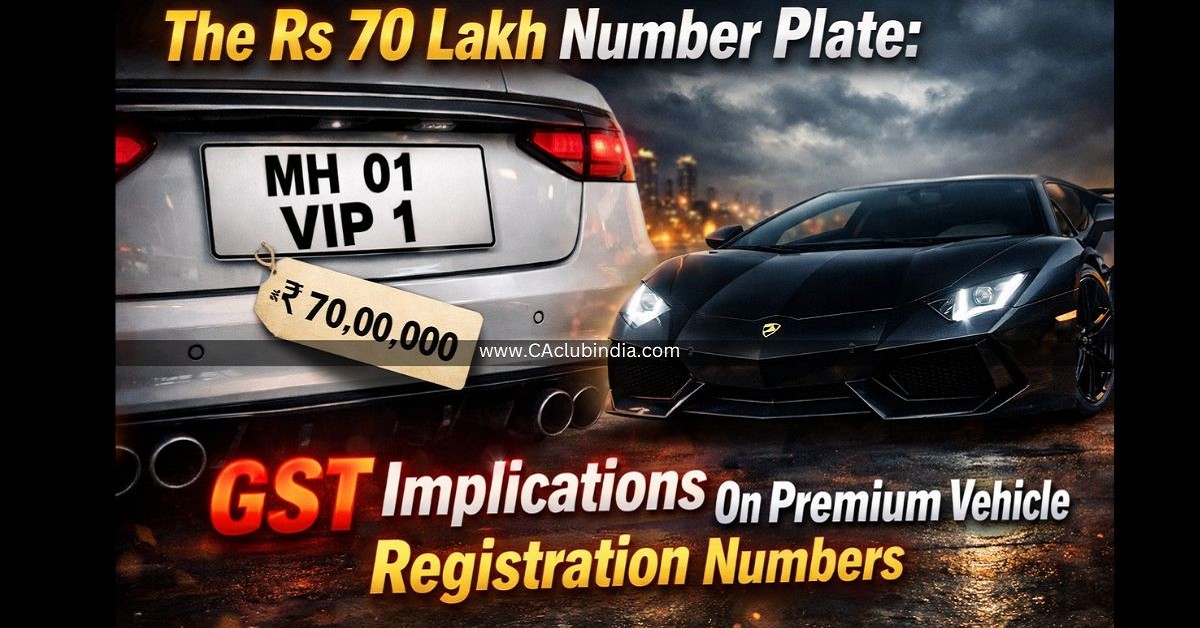
While buying a premium registration number may seem a matter of personal choice or status, it raises an important question under the Goods and Services Tax (GST) law. When a transport authority allots such a number for a high premium, is the amount paid simply a government fee, or is it payment for a taxable service?
The answer to this question has important implications for businesses that acquire luxury vehicles with such premium numbers. If the Government treats the transaction as a supply of services, GST may be payable under the Reverse Charge Mechanism, potentially increasing the vehicle's effective cost. Furthermore, the availability of input tax credit for such tax payments must be examined in light of the restrictions under Section 17(5) of the CGST Act.
The issue becomes even more interesting when the vehicle is acquired for personal use rather than for business purposes, or when it is used for activities such as passenger transportation, where aninput tax credit may be available.
This article examines the GST implications of purchasing a premium vehicle registration number through a practical illustration involving a BMW costing Rs 1.50 crore and a registration number acquired for Rs 70 lakh. The discussion explores the nature of the transaction, the applicability of GST and reverse charge provisions, the availability of input tax credit, and the accounting treatment of the premium amount.
What begins as a symbol of prestige on the road thus becomes an interesting case study at the intersection of luxury, law, and taxation.
Nature of the Transaction under GST Law
When a transport authority auctions or allots a preferred vehicle registration number, it gives the applicant the exclusive right to use that specific number on the vehicle. This goes beyond the standard registration fee. In reality, it is the Government granting a special right or privilege in return for a payment.
Under the CGST Act, the scope of "supply" under Section 7 is wide enough to cover transactions where consideration is paid for the grant of a right or privilege. In this context, Paragraph 5(c) of Schedule II treats the temporary transfer or permitting the use or enjoyment of any intellectual property right as a supply of services. Although a vehicle registration number is not an intellectual property right in the strict sense, the underlying principle reflected in this provision supports the view that permitting the use of an identifiable intangible right for consideration constitutes a supply of services. The allotment of a premium vehicle registration number closely resembles such a transaction, since the transport authority permits the successful bidder to use a specific and exclusive registration mark on the vehicle upon payment of a premium. The essence of the transaction is therefore the grant of a special and identifiable right for consideration, which fits within the broader principle embodied in Paragraph 5(c).
At the same time, the transaction does not appropriately fall within Paragraph 5(f) of Schedule II, which deals with the transfer of the right to use goods for any purpose for consideration. A vehicle registration number cannot be regarded as "goods" within the meaning of Section 2(52) of the CGST Act, as it does not constitute movable property capable of ownership or independent transfer. What is granted by the transport authority is merely a permission or privilege to display and use a particular registration mark, and not the right to use goods as such. Consequently, the allotment of a premium registration number is more appropriately viewed as the permitting of the use of an intangible right, rather than a transfer of the right to use goods under Paragraph 5(f) of Schedule II.
Premium Paid for Fancy Vehicle Numbers is a Supply of Service under GST and Not Merely a Statutory Fee — Judicial Guidance from Advance Rulings
The nature of premium paid for obtaining a preferred or "fancy" vehicle registration number has also been examined in certain advance rulings under the GST regime. In Mukesh Kumar Agarwal v. Rajasthan Authority for Advance Ruling (Order No. RAJ/AAR/2018-19/28 dated 26 February 2019 ), the authority held that the assignment of a preferred vehicle registration number involves the grant of a specific right by the Government for consideration. Accordingly, the transaction was held to constitute a supply of service under GST, and not merely the collection of a statutory fee.
A similar view was taken in Kalyan Banerjee v. West Bengal Authority for Advance Ruling (2021), where the authority observed that the allotment of fancy registration numbers by the transport department represents a service provided for consideration, rather than a sovereign function performed without charge.
Although advance rulings are binding only on the applicants and the concerned jurisdictional authorities, they nevertheless provide useful interpretative guidance and indicate the likely approach that tax authorities may adopt in analysing the GST implications of premium vehicle registration numbers.
Applicability of Reverse Charge Mechanism
Once the transaction is recognised by the Government as a supply of services, the next question concerns the mechanism for payment of GST. Under Services Reverse Charge Notification No. 13/2017-Central Tax (Rate)(28.06.2017), services supplied by the Central Government, State Government, Union Territory or local authority to a business entity are liable to GST under the Reverse Charge Mechanism (RCM), subject to certain exclusions namely renting of immovable property services, services provided by the Department of Posts and the Ministry of Railways(Indian Railways), Services in relation to an aircraft or a vessel and Transport of goods or passengers.
The service of allotting a premium vehicle registration number does not fall within the excluded categories of services. Therefore, where the recipient of the service is a business entity, GST liability generally shifts to the recipient under the reverse charge mechanism.
Position When the Vehicle is Used for Personal Purposes
The situation changes significantly when an individual obtains a premium registration number for personal use. The reverse charge provisions apply only to recipients that are business entities. If the purchaser is not carrying on business and the vehicle is acquired purely for personal use, the individual does not qualify as a business entity for the purpose of the notification.
In such circumstances, where the premium registration number is obtained by an individual for personal use and not in the course or furtherance of business, the service provided by the transport authority may fall within the scope of Entry No. 6 of Notification No. 12/2017–Central Tax (Rate) dated 28 June 2017, which exempts certain services supplied by the Central Government or State Government to persons other than business entities. If the transaction is covered by this exemption, the premium collected for the allotment of the special registration number would remain outside the levy of GST, and consequently, the question of applying the reverse charge mechanism does not arise.
From the individual purchaser's perspective, the amount paid for the premium registration number therefore becomes part of the personal cost ofowning the vehicle and enjoying the prestige of the special number. Since the expenditure is purely personal in nature, the question of input tax credit does not arise in any case, whether the amount is treated as an exempt government service or as a payment collected without GST.
Capitalisation of the Premium Amount
A pertinent inquiry that naturally emerges pertains to the accounting treatment of the premium paid for the prestige number when the vehicle is obtained for commercial purposes. The premium paid for the registration plate is not an expense that recurs periodically; rather, it grants an exclusive right that endures as long as the vehicle remains registered under that number.
From an accounting perspective, the premium therefore represents an enduring benefit. In many cases, it is considered appropriate to capitalise the amount along with the cost of the motor vehicle.
An alternative view is to recognise the premium separately as an intangible asset representing the right to use a particular registration number. Both approaches are conceptually defensible, although in practice, many taxpayers prefer to include the premium in the vehicle's overall cost, since the number plate is inseparable from the vehicle under the Motor Vehicles law.
Availability of Input Tax Credit
The most critical issue from a GST perspective concerns the availability of input tax credit on the GST paid under reverse charge. Even though the tax may be paid by the business entity, the credit eligibility must be examined in light of Section 17(5) of the CGST Act, which contains the provisions relating to blocked credits.
Section 17(5)(a) specifically restricts input tax credit in respect of motor vehicles for transportation of persons having an approved seating capacity of not more than thirteen persons , including the driver. Credit is permitted only in limited circumstances, such as when the vehicle is used to further supply motor vehicles, transport passengers, or provide driving training.
Where a motor vehicle is acquired for general business use—for example, as a director's car or an administrative vehicle for office use —the input tax credit on the motor vehicle itself is blocked. In such cases, the GST paid on the premium registration number also becomes ineligible for credit because the expenditure is intrinsically connected with the motor vehicle whose credit is restricted.As a result, the GST paid under reverse charge effectively becomes part of the asset's capitalised cost.
On the other hand, if the vehicle is used in an eligible business such as passenger transportation, taxi services, vehicle rental operations, or vehicle trading, the restriction under Section 17(5)(a) does not apply. In such cases, the GST paid under reverse charge on the premium registration number may also qualify for input tax credit, provided the other conditions under the GST law are satisfied.
Prestige, Privilege and the Reach of GST
The example of a Rs 1.50 crore BMW bearing the prestigious number DL-0001 purchased for Rs 70 lakh illustrates how a symbol of luxury can also raise important tax implications. What appears to be merely a stylish number plate is, in legal terms, a special privilege granted by the Government for consideration. From a GST perspective, such a transaction may involve issues related to taxable supply, reverse-charge implications, blocked input tax credit, and possible capitalisation of the expenditure in the cost of the vehicle, particularly where Section 17(5) of the CGST Act restricts credit.
The broader lesson is that taxation often operates in areas where one might least expect it. A fancy vehicle number may symbolise individuality and prestige, yet GST law views it through the lens of legal rights obtained for consideration. In this way, even something as simple as a vehicle number plate serves as a reminder that law quietly accompanies luxury, ensuring that every privilege acquired at a price is examined through the discipline of taxation.
By CA Raj Jaggi & Adv Kirti Jaggi
You have reached your daily limit of 2 Free Articles
Subscribe to CCI PRO for unlimited access
Why Upgrade to CCI PRO?
- No Ads
- WhatsApp Community
- Daily E-Newsletter
- Unlimited Articles Access
- Profile Visitors
- Link Social Profiles
- Featured Job Posts
- Pro Badge
- Expert GST Guidance
- Unlimited Forum Replies
- Download Content in PDF
Already a PRO member? Login here for an ad-free experience. 011-411-70713











 CAclubindia
