
For decades, Indian chartered accountants, tax practitioners, and corporate finance teams have operated on a delayed timeline: you earn the income in the Financial Year (FY), and you assess and tax it in the Assessment Year (AY). It was a rhythm ingrained in every tax professional's mind.
However, effective April 1, 2026, the implementation of the Income Tax Act, 2025 completely overhauls this foundational concept. The archaic separation of FY and AY is officially gone, replaced by a single, streamlined entity: the Tax Year . For practitioners handling hundreds of client files, the transition period presents a unique "dual-framework" challenge.
Here is exactly how you need to approach the shift from Assessment Year to Tax Year, and how to avoid compliance missteps during the crossover.
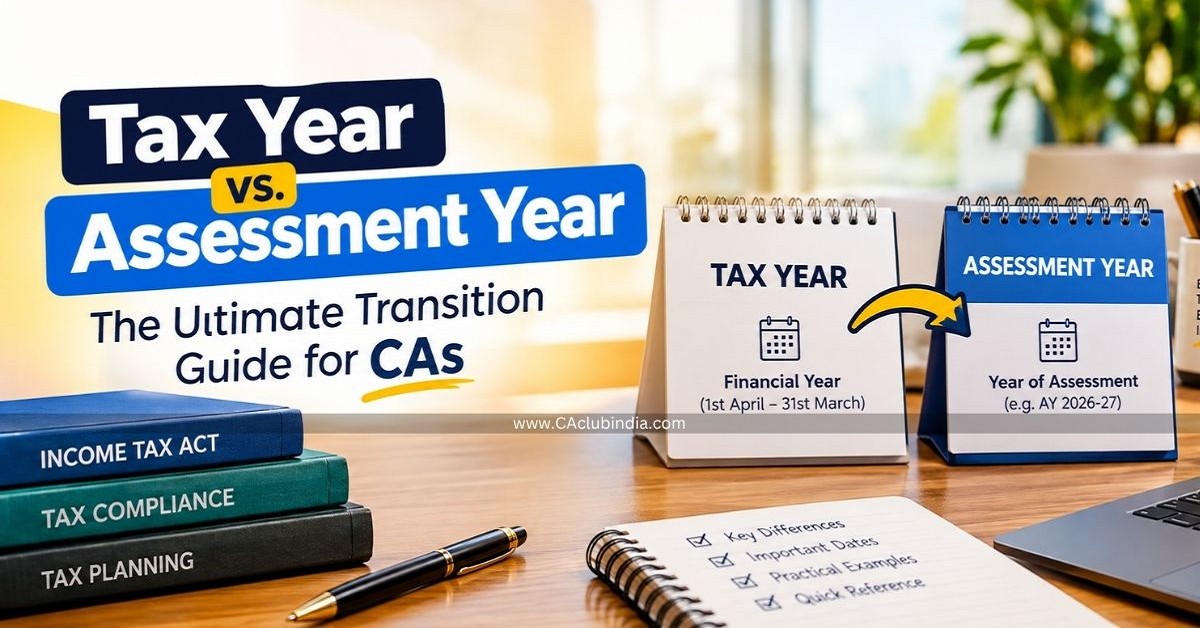
The End of an Era: Saying Goodbye to "Assessment Year"
Under the Income Tax Act, 1961, the disconnect between the year of earning (Previous Year) and the year of taxation (Assessment Year) often caused confusion for lay taxpayers, leading to incorrectly filed returns, mismatched challans, and unnecessary notices.
What Prompted the Change?
The Ministry of Finance designed the new Act to simplify the law (reducing sections from 819 to roughly 536). A major part of this simplification was eliminating the cognitive load of adding "+1" to every financial year when filing an ITR. By collapsing the earning period and the reporting period under a single banner, India aligns itself with global best practices used in jurisdictions like the US and UK.
Decoding the "Tax Year" (Section 3 of the Income Tax Act, 2025)
Under Section 3 of the new Act, the Tax Year is defined simply as the twelve-month period commencing on the 1st of April of any given year.
Key Statutory Definitions
- Old Regime (Income Tax Act, 1961): Income earned from April 1 to March 31 is the Previous Year (PY). It is assessed in the subsequent 12 months, known as the Assessment Year (AY).
- New Regime (Income Tax Act, 2025): Income earned from April 1 to March 31 is simply the Tax Year. The income is earned, taxed, and subsequently reported under the exact same year label.
For example, income earned between April 1, 2026, and March 31, 2027, belongs to Tax Year 2026-27.
The Dual-Framework Challenge: Navigating 2026-27
Here is where things get tricky for CAs and tax consultants. During the calendar year 2026, you will be operating under two different Acts simultaneously. Understanding this bifurcation is critical for correct tax challan payments and portal filings.
FY 2025-26 / AY 2026-27 (The Old Act)
Income earned between April 1, 2025, and March 31, 2026, is still governed entirely by the Income Tax Act, 1961. When you log into the e-Filing portal in July or August 2026 to file client returns, you are filing for AY 2026-27 . All self-assessment tax payments, deductions (like the old 80C), and audit reports for this period follow the legacy rules.
FY 2026-27 / Tax Year 2026-27 (The New Act)
Simultaneously, from April 1, 2026, your clients will begin earning income for the new fiscal cycle. This income is governed by the Income Tax Act, 2025 . If a client needs to pay Advance Tax in June, September, or December of 2026, those challans must be paid under Tax Year 2026-27 using the new Act's provisions.
Quick Comparison: AY vs. Tax Year
| Parameter | Under Income Tax Act, 1961 | Under Income Tax Act, 2025 (Effective April 1, 2026) |
| Core Terminology | Financial Year (FY) & Assessment Year (AY) | Tax Year |
| Income Earning Period | Previous Year (e.g., FY 2025-26) | Tax Year (e.g., Tax Year 2026-27) |
| Applicability of Law | Income earned up to March 31, 2026 | Income earned from April 1, 2026, onwards |
| Example of Reporting | Income of FY 25-26 is reported in AY 26-27 | Income of FY 26-27 is reported for Tax Year 26-27 |
Practitioner's Perspective: Common Transition Mistakes to Avoid
Based on the new compliance framework, tax professionals must avoid the following pitfalls:
- Challan Head Errors: Selecting the wrong Act when generating tax payment challans. Self-assessment tax for the return filed in July 2026 goes under the 1961 Act (AY 2026-27). Advance tax for the ongoing year goes under the 2025 Act (Tax Year 2026-27).
- Confusing the Deadlines: While the nomenclature has changed, the compliance deadlines for the new Tax Year largely mirror the old ones, but note the recent shifts (e.g., ITR-3 and ITR-4 deadlines pushed to August 31 under the new rules).
- Misapplying Deductions: Do not accidentally apply the new Income Tax Act 2025 rules (which remove certain exemptions like dividend interest deductions) to the AY 2026-27 filings you execute in July 2026.
Conclusion & Next Steps for Tax Professionals
The transition from "Assessment Year" to "Tax Year" is more than just a change in vocabulary; it represents the largest administrative shift in Indian taxation in over six decades. As the financial year turns, CA firms must run dual-track compliance systems, closing out the legacy of 1961 while onboarding the streamlined realities of 2025.
Ensure your firm's tax software is updated to reflect the new challan structures, and begin educating your corporate and individual clients now so they aren't surprised when they no longer see "Assessment Year" on their future tax computation sheets.
Frequently Asked Questions (FAQs)
Q: Is Assessment Year 2026-27 the same as Tax Year 2026-27?
A: No. Assessment Year 2026-27 relates to income earned during FY 2025-26 under the old Income Tax Act, 1961. Tax Year 2026-27 relates to income earned during FY 2026-27 under the new Income Tax Act, 2025.
Q: When I file my ITR in July 2026, which Act applies?
A: When filing your ITR in July 2026 for income earned between April 2025 and March 2026, the old Income Tax Act, 1961 applies. Your first return under the new "Tax Year" concept will be filed in 2027.
Q: Have the tax slabs changed under the new Tax Year 2026-27?
A: No, the fundamental tax slabs remain the same as announced in previous budgets. However, the new regime remains the default, keeping income up to ₹12 lakh effectively tax-free due to the Section 87A rebate.











 CAclubindia
