
If you are a business owner, employer, company, firm, trust, or other organisation responsible for deducting or collecting tax, you may need a TAN (Tax Deduction and Collection Account Number).
TAN is a unique 10-digit alphanumeric number issued by the Income Tax Department to persons responsible for deducting tax at source (TDS) or collecting tax at source (TCS).
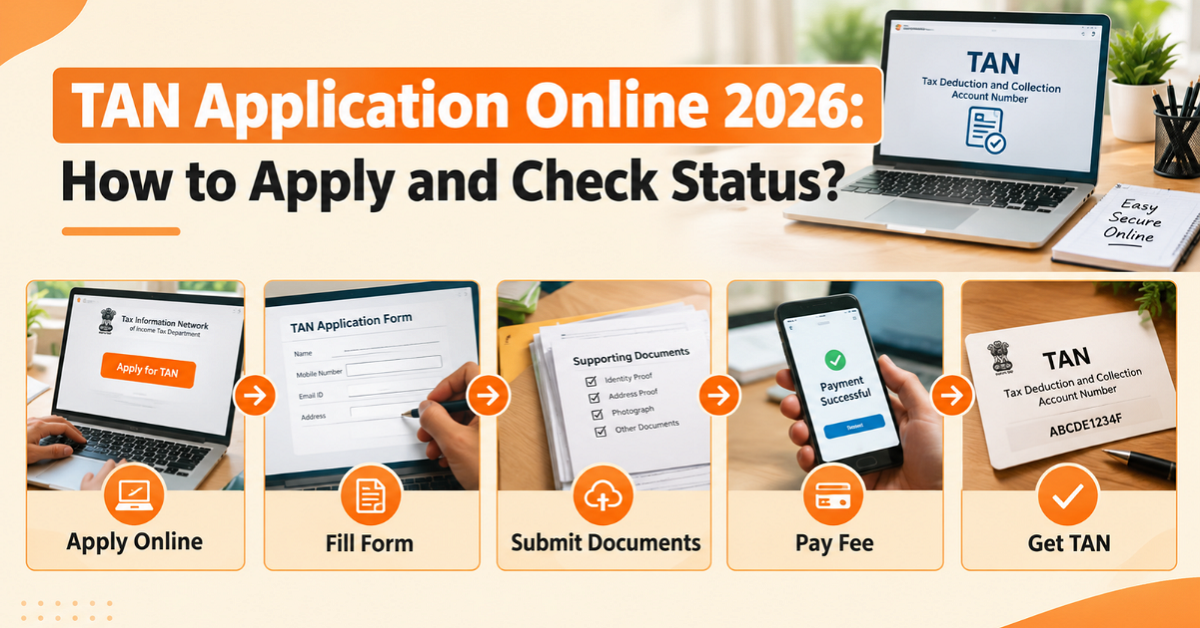
In this guide, we explain TAN application online in 2026, who needs TAN, who is exempt, documents and information required, the application process, fees, status tracking, penalties, and frequently asked questions.
2026 Update: The Income-tax Act, 2025 has come into effect from 1 April 2026. Existing PAN and TAN numbers continue to remain valid; the transition does not require existing TAN holders to obtain a new TAN merely because of the change in law.
What is TAN?
TAN stands for Tax Deduction and Collection Account Number.
It is a 10-digit alphanumeric number issued by the Income Tax Department to persons who are responsible for:
- Deducting tax at source (TDS); or
- Collecting tax at source (TCS).
TAN is generally required to be quoted on applicable:
- TDS/TCS challans
- TDS/TCS statements
- TDS certificates
- Other prescribed communications and documents
The Income Tax Department specifically states that TAN is compulsory for persons responsible for TDS/TCS, subject to certain exceptions.
Example of TAN
A TAN may appear in a format such as:
BLRA12345B
The TAN is system-generated and should not be confused with a PAN.
Why is TAN Required?
TAN serves as an identification number for the person or organisation responsible for TDS/TCS compliance.
- TDS compliance: The TAN is used when depositing TDS and filing applicable TDS statements.
- TCS compliance: A TAN already allotted to a person can also be used for TCS compliance. A separate TAN is generally not required solely because the person also becomes liable to collect tax.
- TDS certificates: TAN is associated with TDS certificates such as Form 16 and Form 16A.
- Tax credit reporting: Correct TAN reporting helps ensure that tax deducted from a taxpayer is appropriately reported against the deductee's tax records.
- Compliance tracking: The Income Tax Department uses TAN-related information to identify deductors and collectors and monitor TDS/TCS compliance.
Who Needs to Apply for TAN?
Generally, every person responsible for deducting tax at source or collecting tax at source must obtain TAN and quote it in the applicable TDS/TCS documents.
This can include:
- Private limited companies
- Public companies
- One Person Companies
- Partnership firms
- LLPs
- Proprietorship businesses, where applicable
- Trusts
- Societies
- Associations
- Government departments
- Local authorities
- Statutory and autonomous bodies
- Other persons or organisations liable to deduct or collect tax
Important: TAN is not based simply on the type of entity
For example, being a proprietorship does not automatically mean that TAN is required in every situation. The requirement depends on whether the person is responsible for TDS/TCS under the applicable provisions.
Important Exceptions: When PAN Can Be Used Instead of TAN
One of the most important points to understand is that TAN is not required for every type of TDS deduction.
The Income Tax Department specifically provides that a person deducting tax under the following provisions can quote PAN instead of TAN:
- Section 194-IA: TDS on transfer of certain immovable property
- Section 194-IB: TDS on rent by certain individuals/HUFs
- Section 194M: TDS on certain payments by individuals/HUFs
Therefore, an individual should not automatically apply for TAN merely because one of these transactions attracts TDS.
Practical example
Example 1 – Property purchase
- Ravi purchases an eligible property from a resident seller and is required to deduct TDS under Section 194-IA.He does not need to obtain TAN merely for this transaction. PAN-based compliance is permitted.
Example 2 – Rent
- An individual/HUF covered by Section 194-IB pays rent requiring TDS. The person can use PAN instead of TAN as prescribed.
Example 3 – Contractor/professional payments
- A business regularly deducts TDS from payments to contractors or professionals under applicable TDS provisions. In such a case, the business will generally need a TAN.
TAN vs PAN: What is the Difference?
| Particular | TAN | PAN |
| Full form | Tax Deduction and Collection Account Number | Permanent Account Number |
| Main purpose | TDS/TCS compliance | Taxpayer identification |
| Issued by | Income Tax Department | Income Tax Department |
| Format | 10-character alphanumeric | 10-character alphanumeric |
| Used for | TDS/TCS-related compliance | ITR, tax payments, financial transactions and identification |
| TDS returns | TAN generally required | PAN alone generally cannot replace TAN |
| Important exceptions | - | PAN may be used instead of TAN for specified provisions such as 194-IA, 194-IB and 194M |
Simple way to remember
- PAN identifies the taxpayer.
- TAN identifies the TDS/TCS deductor or collector.
TAN Application Online 2026: What Details Are Required?
Before starting the application, keep the following information ready.
Basic details
- Name of deductor/collector
- Constitution/category of the applicant
- PAN, where applicable
- Communication address
- Mobile number
- Email address
- Nationality
Person responsible for TDS/TCS
You may need details of the person responsible for making payments or collecting tax, including:
- Name
- Designation
- Address
- Contact details
- Other particulars required in the application
Assessing Officer details
The TAN application requires the applicable AO details, including:
- Area Code
- AO Type
- Range Code
- AO Number
Protean's Form 49B instructions state that applicants must provide the relevant Assessing Officer details.
TAN Application Form
Historically, a new TAN application was made using Form 49B.However, applicants should check the current form and application process on the official Protean/Income Tax portal because the tax administration has transitioned to the Income-tax Act, 2025 and Income-tax Rules, 2026 from 1 April 2026.
Existing TANs continue to remain valid.
How to Apply for TAN Online in 2026
The online TAN application process is generally completed through the authorised TAN application facility.
Step 1: Visit the official TAN application facility
- Access the TAN application facility provided through the authorised Protean e-Gov/TIN system.
- Choose the option for applying for a new TAN.
Step 2: Select the applicant category
Select the appropriate category, such as:
- Company
- Individual
- Firm/LLP
- HUF
- Trust
- Government body
- Other applicable category
Step 3: Enter applicant details
- Enter the applicant's details carefully. The name should correspond with the relevant tax records and supporting information.
Step 4: Enter AO details
Provide the appropriate:
- Area Code
- AO Type
- Range Code
- AO Number
Make sure you select the correct jurisdiction.
Step 5: Enter communication details
Provide the:
- Address
- Mobile number
- Email ID
Use active contact details because communications relating to the application may be sent using these details.
Step 6: Enter responsible person's details
Provide the required information regarding the person responsible for making payments or collecting tax. For a company, this may be an authorised responsible person; for another entity, it may be the person responsible for TDS/TCS compliance.
Step 7: Verify the application
Before submission, carefully check:
- Applicant name
- Category
- PAN
- Address
- AO details
- Mobile number
- Email ID
- Responsible person's details
Errors can create difficulties later when registering the TAN for TDS/TCS compliance.
Step 8: Pay the applicable processing fee
- Pay the applicable TAN application processing fee through the payment method offered during the application process.
Step 9: Save the acknowledgement
- After successful submission, retain the acknowledgement/reference number.
- A 14-digit acknowledgement number has traditionally been used for tracking TAN applications through the Protean system. Protean's published TAN instructions specifically refer to the 14-digit acknowledgement number for status tracking.
How Much Does TAN Application Cost?
The historical TAN application processing fee is ₹65 plus applicable GST, which results in ₹76.70 when 18% GST is applied and is commonly rounded/displayed as approximately ₹77.
Because fees and application workflows can change, applicants should rely on the amount displayed on the official application portal at the time of submission.
How to Check TAN Application Status Online?
After submitting the application, you can track its status using the acknowledgement/reference details provided during the application.
Step 1: Open the TAN status tracking facility
Visit the authorised Protean TAN/TIN status tracking facility.
Step 2: Select the relevant application type
Choose the option applicable to a TAN application/new TAN or correction request.
Step 3: Enter the acknowledgement number
Enter the 14-digit acknowledgement number, where applicable.
Step 4: Complete verification
Enter the captcha or other verification details requested by the portal.
Step 5: View the application status
The system will display the available processing status of the application.
How long does TAN allotment take?
Processing time can vary depending on the application and verification requirements.
Therefore, 3–7 working days should be treated only as an indicative timeframe and not as a guaranteed statutory processing period.
How to Find an Existing TAN Online?
The Income Tax Department provides a Know TAN Details service that can be used even without logging in to the e-Filing portal.
You can search using either:
- Deductor's name; or
- TAN
You will generally need:
- Deductor category
- State
- Valid mobile number
An OTP is sent to the mobile number entered during the search process. The service can display basic and Assessing Officer details associated with the TAN.
Why is this useful?
Suppose an employee wants to verify the TAN of their employer.
They can use Know TAN Details to verify the employer's TAN and compare it with the information appearing on their TDS records.
Can One Person Have More Than One TAN?
A person should not obtain or use multiple TANs for the same deductor/collector merely because of an error or duplication.
However, there is an important distinction:
Different branches may have separate TANs
Protean's published instructions state that although having or using more than one TAN is not permitted, different branches or divisions of a deductor/collector may apply for separate TANs.
Example
ABC Ltd. has:
- Head Office in Bengaluru
- Branch in Mumbai
- Branch in Delhi
Depending on its organisational and compliance structure, separate TANs may be applicable to different branches/divisions.Therefore, it is incorrect to say that a business can never have more than one TAN.
What If I Already Have a TAN?
If you already have a valid TAN, you generally should not apply for another TAN merely because:
- The responsible person changes
- The address changes
- The company's details change
- You start TCS in addition to TDS
Instead, use the appropriate TAN correction/change process where required.
A TAN already allotted for TDS can also be used for TCS compliance; a separate TAN is generally not required solely for TCS.
What Happens If TAN Details Change?
Suppose a company changes its:
- Registered address
- Name
- Responsible person
- Contact details
- Other TAN particulars
The organisation should update the TAN information through the prescribed correction/change procedure.Keeping TAN records updated is important because the TAN is used for ongoing TDS/TCS compliance.
TAN and TDS Compliance: Practical Example
Example: Company paying professional fees
ABC Private Limited pays ₹1,00,000 to a professional and the payment is subject to TDS under the applicable provisions.
The company:
- Determines the applicable TDS provision.
- Deducts TDS at the prescribed rate.
- Deposits the TDS using its TAN.
- Reports the transaction in the applicable TDS statement.
- Issues the applicable TDS certificate.
- Ensures the deductee receives appropriate TDS credit.
In this situation, the company's PAN does not ordinarily replace its TAN for regular business TDS compliance.
What If an Employer Does Not Have TAN?
An employer responsible for deducting salary TDS generally needs a valid TAN.
The Income Tax Department states that an employer that has not obtained TAN may face consequences for failure to obtain or quote TAN, and it may not be able to properly deposit TDS or file the applicable TDS statement. Employees should therefore verify their employer's TDS details where necessary.
Advantages of Having a TAN
- Enables TDS/TCS compliance: A valid TAN facilitates the required TDS/TCS payment and reporting process.
- Helps issue TDS certificates: TAN is used in applicable TDS certificates such as Form 16 and Form 16A.
- Supports accurate tax reporting: Correct TAN reporting helps connect TDS information with the deductee's tax records.
- Required for regular TDS compliance: Businesses regularly making TDS-liable payments generally need TAN to meet their withholding obligations.
- No annual TAN renewal: TAN is not a yearly registration that needs to be renewed. Existing TANs continue to remain valid unless surrendered/cancelled or otherwise dealt with under applicable rules.
Common TAN Mistakes to Avoid
Applying for TAN when PAN can be used
- Do not automatically obtain TAN for every TDS transaction.
- Check whether the transaction falls under a specific PAN-based exception such as Sections 194-IA, 194-IB or 194M.
Applying for duplicate TAN
- Check whether the entity already has a TAN before submitting a new application.
Incorrect AO details
- Selecting the wrong jurisdictional AO details can create application and compliance issues.
Incorrect entity name
- Use the appropriate legal/entity name and ensure the information is consistent with tax records.
Ignoring changes in TAN information
- If the address or responsible person changes, update the TAN details through the prescribed correction procedure.
Confusing PAN with TAN
- PAN and TAN are separate identification numbers serving different purposes.
TAN Penalties and Compliance Consequences
Failure to obtain or quote TAN where required can attract consequences under the applicable income-tax law.
Similarly, TDS compliance involves separate obligations relating to:
- Deduction of tax
- Deposit of tax
- Filing of TDS statements
- Issuing TDS certificates
- Correct reporting
- Interest and late-payment consequences
- Late filing consequences
Therefore, obtaining TAN is only the first step. Businesses must also comply with the applicable TDS provisions and filing requirements.
Important: Penalty and interest provisions can vary depending on the nature of the default and the applicable law. Do not assume that every TDS default results in the same penalty.
Conclusion
A TAN is an important compliance requirement for businesses and other persons responsible for TDS or TCS. It enables the deductor or collector to make applicable tax payments, file TDS/TCS statements and issue the required certificates.
However, not every TDS transaction requires TAN. Specific provisions such as Sections 194-IA, 194-IB and 194M allow PAN to be quoted instead of TAN, making it important to identify the correct TDS provision before applying.
For businesses regularly deducting tax from salaries, professional fees, contractor payments, rent and other applicable payments, obtaining the correct TAN and maintaining accurate TDS records should be treated as an essential part of tax compliance.
The Income Tax Department's Know TAN Details facility can also be used to verify existing TAN information, including basic and Assessing Officer details.
In short: PAN identifies the taxpayer; TAN identifies the TDS/TCS deductor or collector.
For any TAN application or TDS compliance matter, always verify the applicable provision and the latest procedure on the official Income Tax Department/authorised TAN portal before filing.
FAQs
1. Is TAN mandatory for every person who deducts TDS?
Generally, yes. However, specified exceptions allow PAN to be quoted instead of TAN, including TDS under Sections 194-IA, 194-IB and 194M.
2. Can I use PAN instead of TAN for business TDS?
Generally, no. For regular business TDS obligations, TAN is generally required. PAN can replace TAN only where the law specifically permits it.
3. Can TAN be used for both TDS and TCS?
Yes. If a TAN has already been allotted, a separate TAN is generally not required merely because the person becomes liable for TCS.
4. Can a company have different TANs?
A duplicate TAN for the same deductor should not be obtained merely by mistake. However, different branches/divisions may apply for separate TANs where applicable.
5. Can I check TAN details without logging in?
Yes. The Income Tax Department's Know TAN Details service is available to both registered and unregistered users.
6. Does TAN expire every year?
No. TAN is not an annual registration requiring yearly renewal.











 CAclubindia