
Every enforcement officer learns one lesson early in his career. A fraud case is won or lost in the first forty-eight hours. That is when the books are still on the table, the phones are still switched on and the man who signs the invoices has not yet realised that the man who profits from them is about to vanish. Miss that window, and the case becomes a file. Files rarely recover money.
That window is what the GST law is now giving up. On 8 October 2026, the 57th meeting of the GST Council recommended that Section 69 of the CGST Act, 2017, the provision under which a Commissioner may authorise arrest, be omitted altogether, and that the threshold for prosecution under Section 132 be raised to Rs 5 crore. Three weeks later, CBIC put the decision into practice ahead of any amendment. Instruction No. 02/2026-GST dated 30 October 2026 tells Central Tax formations that no further arrests may be carried out under GST. The legislative changes are to follow from 1 April 2027.
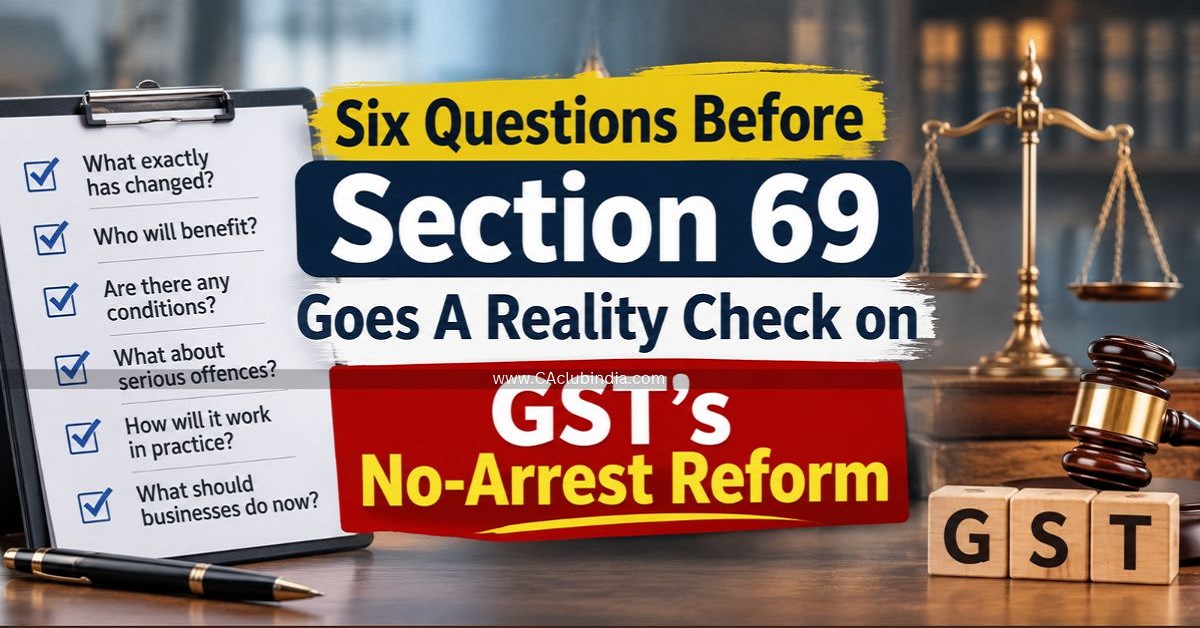
The reform has been welcomed as the arrival of trust in tax administration, and much of that welcome is deserved. Honest businesses have suffered at the hands of over-zealous investigations, and no one who practices in this field will mourn the end of arrests over classification disputes. But a reform of this size deserves scrutiny as well as applause. Six questions, in particular, remain unanswered.
1. Whom will the department hold while the money is traced?
A fake-invoice operation is not a single dealer cheating on his return. It is a supply chain of paper. Firms are registered on identities bought from the poor or stolen from the careless. Invoices are generated without a single truck leaving a godown. The credit is sold onwards, and the proceeds are pulled out through a web of current accounts before the first notice is even drafted. At the top sits a financier who never signs anything.
The law has not forgotten him. Section 122(1A) makes the person who retains the benefit of such transactions, and at whose instance they are conducted, liable to penalty. But that provision presupposes that the department can reach him. Reaching him depends on the people below him talking, and people below a financier talk only when they believe the consequences of silence are real. Summons under Section 70 and search under Section 67 remain on the statute book, but a summons is an invitation, not a compulsion, to a man who has already decided to disappear.
The Council's answer is that prosecution under Section 132 survives. It does. But prosecution comes at the end of an investigation, and the investigation is precisely what becomes difficult without the power to secure the key accused at the beginning.
A summons is an invitation, not a compulsion, to a man who has already decided to disappear.
2. What stops the cash seller?
Ask a carpenter in any Indian city what a sheet of plywood costs, and he will answer with a question of his own: with bill, or without? The debate on the 57th Council's reform has been fixated on fake input tax credit. But a large part of GST evasion never generates an invoice at all. Goods are removed from the factory without being entered in the books, sold for cash through a chain of trusted dealers, and paid for through angadias and cash couriers. The tax simply never comes into existence on paper.
This kind of evasion thrives where the buyer has no use for credit. The household buying plywood, laminates, tiles or sanitaryware for a new home, and the small contractor building it, cannot claim input tax credit. For them, GST is a pure addition to the price, and an unbilled sale is an 18 per cent discount. Valuation games run alongside: undervaluing what is billed to pay less tax, or overvaluing exports to inflate credit and refunds.
The law treats supply without invoice with intent to evade tax as an offence under Section 132(1)(a), and above the monetary limits, Section 69 permitted arrest. That mattered, because clandestine removal is proved through parallel ledgers, transport records and the statements of the people who ran the operation, and those statements are most truthful before the network has had time to rehearse. Now, a manufacturer caught by a Central officer with an unbilled consignment faces detention and confiscation under Sections 129 and 130, a demand with interest and penalty under Section 74, and prosecution, extending to the company's directors under Section 137, only if the evasion crosses the raised threshold. For the habitual evader, the worst outcome is to pay the tax he tried to avoid.
A capped risk is not a deterrent. It is a line item in the evader's budget.
The real victim here is not only the exchequer. It is the honest manufacturer in the same market who invoices every sheet and pays every rupee, and who must now compete with a rival whose price is 18 per cent lower and whose downside has just been limited.
3. Why should one offence invite arrest from one officer and not another?
This is the question that has received the least attention and deserves the most. Instruction No. 02/2026-GST is addressed to the Principal Chief Commissioners, Chief Commissioners and Directors General of Central Tax. It binds the Central administration and no one else. State tax officers draw their powers from their own State GST Acts, and every one of those Acts still contains its own Section 69. Unless a State chooses to issue a similar direction, its officers can continue to arrest exactly as before.
Consider what this means on the ground. A mobile squad of the State tax department stops a truck whose e-way bill and invoice do not match any real supply. The trail leads to a cluster of shell firms passing crores of credit. The State Commissioner can still authorise arrest, provided the offence falls within Section 132(1)(b) or (c) above the monetary limit and the guidelines are followed. On the other side of the road, a Central GST team unearths an identical ring, through the same kind of invoices carrying the same CGST and SGST. Its officers cannot arrest anyone. They can only issue summons and wait.
The tax is one. The invoice is one. The fraud is one. Yet the consequence for the accused now depends on which administration the taxpayer was assigned to, or which team happened to knock first. A regime built on the promise of uniformity has, for now, created two standards of criminal exposure for the same act, a result that may well invite scrutiny under Article 14 before long.
The tax is one. The invoice is one. The fraud is one. The consequence is not.
4. What becomes of the cases already on the books?
The numbers placed before Parliament are sobering. Over the three financial years from 2023-24 to 2025-26, Central GST formations detected 54,635 cases of fraudulent input tax credit involving about Rs 1,69,928 crore. The annual count rose from 9,190 to 15,283 to 30,162. Across those three years, only 718 persons were arrested. In 11,193 cases, the registrations themselves had been obtained on forged Aadhaar and PAN credentials.
Even that figure understates the loss, because GST evasion never travels alone. A sale that escapes the invoice also escapes the income tax return. A fake purchase bill that inflates input credit also inflates expenses in the books, cutting the income tax payable on profit. The cash thrown up by unbilled sales flows into property, gold and hawala networks, and the inflated turnover created by circular trading is used to raise loans from banks. The Rs 1.7 lakh crore detected in GST is, in that sense, only the first visible layer of a much larger leak in the nation's revenue, and every layer beneath it begins at the same point where the GST officer has now been asked to put down his strongest tool.
Thousands of these investigations are still open. In many of them, the main accused have not been traced, have ignored repeated summons or are known to be operating new entities under new names. Until 30 October, each of them carried a risk that the next visit from the department would end in custody. That risk has now been lifted, not only for future offenders but for every one of them. The Instruction makes no distinction between an offence committed last week and one committed in 2023.
Once Section 69 is formally omitted, the position will be harder to reverse. Arrest is a procedural power, and changes in procedure generally apply to pending matters ad you cannot keep alive a power the statute no longer confers.
If the amended Section 132 also raises the prosecution threshold and softens punishment, accused persons will claim the benefit of the milder law in pending cases. Without a carefully drafted saving clause, the reform could operate as an unannounced amnesty for the backlog.
Rs 1.7 lakh crore of detected fraud. 718 arrests in three years. And now, not one more.
5. Who pays when the supplier vanishes?
Revenue does not write itself off. When the trail to the operator goes cold, the department's attention moves down the chain to the first party that is registered, solvent and easy to find. Almost always, that is the recipient who bought from the fake supplier.
Section 16(2)(c) makes the recipient's credit conditional on the tax actually havingbeen paid to the Government by the supplier. A manufacturer who paid in full through his bank, received the goods, recorded them in his stock register and holds a proper invoice may still be asked to reverse the credit, with interest and penalty, because a supplier he had no means of investigating never deposited the tax. Rule 86A allows that credit to be blocked in his electronic ledger even before he is heard, freezing his working capital while the fraudster's money sits safely elsewhere.
As fake chains grow, more genuine buyers will be caught in them. The reform was meant to lift the shadow of coercion from honest businesses. Without protection for the bona fide recipient, it may end up shifting the cost of somebody else's fraud onto them.
6. Will every State follow, and should it?
Omitting Section 69 from the CGST Act will not, by itself, remove it from the State GST Acts. Every State legislature must amend its own law. The Supreme Court made clear in Union of India v. Mohit Minerals (2022) that recommendations of the GST Council under Article 279A are persuasive and do not bind the legislatures. If even a few States hold back, the two-track enforcement described above will outlive April 2027.
There is reason to think some may hesitate. It is understood that several States had reservations, during the deliberations, about giving up the power of arrest entirely. The minutes of the 57th meeting, when released, will show how deep those reservations ran. States are equal partners in every rupee of GST, and their mobile squads and intelligence wings are often the first to confront fake-invoice rackets on the ground. Their caution is not resistance to reform. It may be the voice of experience.
The way forward lies between the old position and the new one. The power of arrest can survive in a far narrower form: confined to invoices issued without any supply and credit availed on them, above a high monetary limit, and exercisable only on a prior warrant from a Magistrate. Section 16(2)(c) needs a statutory safe harbour for the recipient who paid through banking channels and received the goods, so that recovery is pursued first against the supplier and the beneficiaries under Section 122(1A). The amending law must carry an express saving clause for pending investigations. Registration must be guarded at the gate through biometric authentication and physical verification. Trials must be time-bound, provisional attachment early, and information flowing freely to the police and other agencies so that forgery and money laundering are pursued under the laws that still apply. Above all, the Centre and the States must move as one, so that the same offence carries the same consequence everywhere in the country.
The States' caution is not resistance to reform. It may be the voice of experience.
The window before April
The GST Council has done something rare. It has admitted that a power was misused and chosen to give it up. That honesty deserves credit. But giving up a power is easy. Replacing it with something that protects the honest without freeing the dishonest is the harder task, and it has not yet been done.
Between now and 1 April 2027, Parliament and the State legislatures have a window to answer these six questions. If they do, India can have a GST that trusts its taxpayers and still frightens its fraudsters. If they do not, the first forty-eight hours of every fraud case will belong to the racketeer, and the bill for his fraud will be sent to the honest dealer who never knew his name.










 CAclubindia
