
Every finance team has a person the auditors ask for first, the one whose sign-off closes the books, and the one junior accountants go to when a reconciliation refuses to tie out. That person is usually the Senior Accountant. This role sits at the point where technical accounting knowledge turns into judgment and companies are increasingly specific about what they expect from it.
Who is a Senior Accountant?
A Senior Accountant is a mid-to-senior level finance professional responsible for the accuracy, completeness, and compliance of a company's accounting records. Unlike a Staff or Junior Accountant, who typically handles routine data entry and basic reconciliations, a Senior Accountant reviews that work, resolves the exceptions, and takes ownership of the numbers that eventually appear in the financial statements.
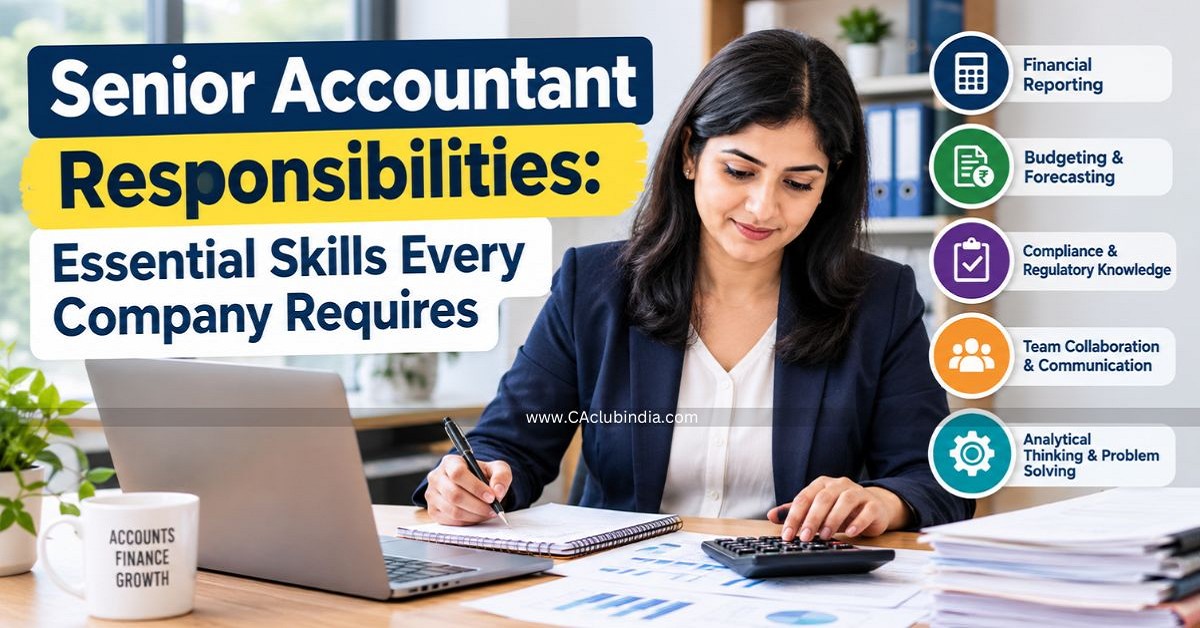
In most Indian companies - from mid-sized manufacturing firms to IT services and NBFCs - the Senior Accountant acts as the bridge between the operational accounting team and the CFO or Finance Controller, translating day-to-day transactions into statements that leadership, auditors, and regulators can rely on.
Core Responsibilities of a Senior Accountant
While the exact scope varies by industry and company size, most job descriptions converge on the same set of core duties:
1. Month-End and Year-End Close
Leading the close process - reviewing accruals, prepayments, and provisions, ensuring all subledgers tie to the general ledger, and finalising trial balances within the deadline set by management.
2. Financial Statement Preparation
Preparing or reviewing the profit and loss account, balance sheet, and cash flow statement in line with applicable standards (Ind AS or AS, depending on the company's applicability threshold).
3. Account Reconciliations
Owning reconciliations for higher-risk accounts - bank accounts, intercompany balances, vendor and customer ledgers, and GST/TDS control accounts - and investigating variances rather than simply flagging them.
4. Reviewing Junior Staff Work
Checking journal entries and reconciliations prepared by Staff Accountants or Accounts Executives before they are posted or finalised, and coaching juniors on recurring errors.
5. Statutory Compliance Support
Supporting GST returns, TDS compliance, advance tax computations, and tax audit data preparation, and acting as the primary point of contact for internal and statutory auditors during fieldwork.
6. Internal Controls
Identifying control gaps in the accounting process - duplicate payments, unauthorised journal entries, unreconciled suspense accounts - and recommending fixes.
7. Budgeting and Variance Analysis
Assisting with the annual budget, and explaining actual-versus-budget variances to department heads or the CFO in terms that go beyond "the number went up."
8. Process Improvement
Recommending automation or standardisation of manual reconciliation and reporting processes - increasingly a differentiator as companies push closes to be faster and less error-prone.
Special Note: The single biggest shift in this role over the last few years is the expectation of ERP and automation fluency. A Senior Accountant who can only "review and approve" is being replaced by one who can also build the Excel model or ERP report that prevents the error from recurring.
Essential Technical Skills
- Accounting standards knowledge: Working command of Ind AS/AS, revenue recognition, lease accounting, and provisioning norms.
- ERP proficiency: Hands-on experience with SAP, Oracle NetSuite, Microsoft Dynamics, Tally Prime, or Zoho Books, depending on the company's stack.
- Advanced Excel: Pivot tables, XLOOKUP/VLOOKUP, INDEX-MATCH, and the ability to build a reconciliation model from scratch.
- Direct and indirect tax exposure: Enough working knowledge of GST, TDS, and income tax provisions to prepare audit-ready data, even where a separate tax team exists.
- Financial reporting: Consolidation, intercompany elimination, and multi-entity reporting for companies with more than one legal entity.
- Audit readiness: The ability to prepare schedules and respond to auditor queries without hand-holding from the Controller.
Essential Soft Skills
- Attention to detail with judgment: Not just catching an error, but knowing which errors are material enough to escalate.
- Communication: Explaining a variance or an accounting treatment to a non-finance department head in plain language.
- Ownership under deadline pressure: Closing books on time, every month, without cutting corners on reconciliations.
- Mentoring: Reviewing and correcting junior work in a way that builds their skill rather than just fixing the entry.
- Stakeholder management: Coordinating simultaneously with auditors, tax consultants, and internal department heads during close and audit periods.
Senior Accountant vs Staff Accountant vs Accounting Manager
| Parameter | Staff Accountant | Senior Accountant | Accounting Manager |
| Typical experience | 0–3 years | 4–8 years | 8+ years |
| Primary focus | Recording transactions, basic reconciliations | Reviewing entries, closing books, resolving exceptions | Team supervision, process ownership, reporting to leadership |
| Team role | Individual contributor | Senior individual contributor, informal mentor | People manager |
| Audit involvement | Provides supporting data on request | Primary point of contact during fieldwork | Owns audit relationship and sign-off |
| Typical qualification | B.Com / M.Com, CA/CMA pursuing | CA Inter/CMA Inter or qualified CA/CMA, or equivalent experience | Qualified CA/CMA/CPA, often with an MBA |
Qualifications and Career Path
Most companies list a bachelor's degree in commerce, accounting, or finance as the baseline, paired with 4 to 8 years of progressively responsible accounting experience. A professional qualification - CA, CMA, CPA, or ACCA - is not always mandatory for the title, but it is increasingly the deciding factor between two otherwise similar candidates, particularly in larger companies and MNCs.
The typical progression looks like: Accounts Executive/Staff Accountant → Senior Accountant → Accounting Manager/Assistant Controller → Controller → Finance Director/CFO. Time spent at the Senior Accountant level varies widely - some move up in two to three years, others stay longer by choice, using the role's technical depth as a springboard into specialised tracks like FP&A, internal audit, or taxation.
Salary Expectations in India
Senior Accountant salaries in India generally fall between Rs 6 lakh and Rs 12 lakh per annum, with variation driven by city, industry, and qualification. Metro-based roles in IT, BFSI, and large manufacturing companies tend to sit at the higher end, while roles in smaller cities or trading companies are typically at the lower end of the range. Holding a CA or CMA qualification, even at the Inter level, tends to move compensation upward within this band.
FAQs
What is the main responsibility of a Senior Accountant?
A Senior Accountant is primarily responsible for the accuracy and integrity of a company's books - this includes finalising monthly and year-end closes, reviewing journal entries prepared by junior staff, reconciling key accounts, and ensuring financial statements comply with applicable accounting standards.
What qualification is required to become a Senior Accountant?
Most companies expect a bachelor's degree in commerce or accounting along with 4 to 8 years of relevant experience. A professional qualification such as CA, CMA, CPA or ACCA, or progress toward one, significantly improves prospects and is often mandatory in larger organisations.
How is a Senior Accountant different from an Accounting Manager?
A Senior Accountant is primarily an individual contributor focused on the technical accuracy of accounting records, while an Accounting Manager typically supervises a team, owns process design, and reports results to finance leadership. In many mid-sized companies, a Senior Accountant is the step just before an Accounting Manager role.
What software skills does a Senior Accountant need?
Proficiency in ERP systems such as SAP, Oracle NetSuite, or Tally Prime is expected, along with advanced Excel skills including pivot tables, VLOOKUP/XLOOKUP, and financial modelling. Familiarity with GST and TDS filing utilities and reconciliation tools is a strong advantage in Indian companies.
What is the average salary of a Senior Accountant in India?
Senior Accountant salaries in India typically range from about Rs 6 lakh to Rs 12 lakh per annum depending on city, industry, and whether the person holds a professional qualification, with metro cities and MNCs generally paying toward the higher end of that range.











 CAclubindia
