SBI Warns: Aggressive GST Scrutiny May Push Small Businesses Back to Cash


Quick Summary
The State Bank of India (SBI) has cautioned that overly aggressive Goods and Services Tax (GST) enforcement could inadvertently push small businesses back into the informal cash economy. This is a concern following instances like high tax notices issued to Bengaluru traders based on UPI transactions. While tax transparency is important, SBI stresses that such stringent measures risk discouraging digital payments and reversing the progress made towards formalisation under GST.

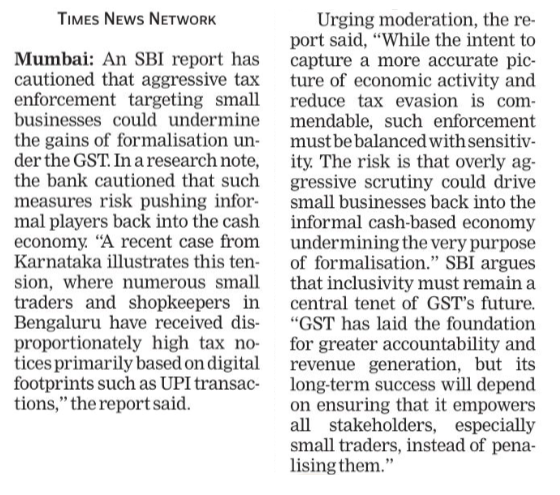
SBI warns that aggressive tax enforcement targeting small businesses could reverse gains made through formalisation under GST.

Key Issue

Such enforcement may push informal players back into the cash-based economy.

GST Scrutiny: Small Businesses May Return to Cash Economy

Example

A recent case from Karnataka creates tension, where small traders and shopkeepers in Bengaluru received high tax notices based on UPI transactions.
Image

SBI's View

While the intent to capture a more accurate picture of economic activity and reduce tax evasion is commendable, such enforcement must be balanced with sensitivity. The risk is that overly aggressive scrutiny could drive small businesses back into the informal cash-based economy, undermining the very purpose of formalisation.


While tracking digital payments helps in economic transparency and tax collection, overreach could backfire.

Excess scrutiny could discourage small businesses from using digital methods, thereby undermining GST's purpose.


Importance of Inclusive Formalisation

GST has laid the foundation for greater accountability and revenue generation, but its long-term success will depend on ensuring that it empowers businesses, especially small traders, instead of penalising them.

FAQ :

SBI is concerned that aggressive tax scrutiny, particularly targeting small businesses, might force them to revert to cash-based transactions, thus undermining the formalisation efforts of the GST regime.

A recent case in Karnataka, where small traders in Bengaluru received high tax notices based on their UPI transactions, exemplifies the aggressive scrutiny SBI is warning against.

Overly aggressive scrutiny and the potential for high tax notices, even for digital transactions like UPI, could discourage small businesses from using digital methods, leading them to prefer the informal cash economy.

No, SBI acknowledges that tracking digital payments aids economic transparency and tax collection. However, they believe such enforcement must be balanced and sensitive to avoid overreach.

The long-term success of GST, which aims for greater accountability and revenue generation, could be undermined if aggressive enforcement penalises small businesses rather than empowering them and encouraging formalisation.


1918 Views Comment   Share GST   Report


About the Author

Finance Professional

I write about Income Tax, GST, TDS, RBI updates, government schemes, and personal finance in India. My focus is on simplifying complex tax and compliance topics into easy-to-understand guides that help readers stay updated with the latest financial rules, investment options, and regulatory changes.

Comments :

Related Articles


Loading


Popular Articles


CCI Pro

CCI Articles

submit article