
Both standards put leases on the balance sheet. Only one of them lets a lessee keep a single, level lease cost in the profit and loss account. The difference sits in classification, and it moves EBITDA, ratios and the GAAP bridge.
I work under Ind AS. Out of curiosity, and with no link to any engagement or client, I have been reading US GAAP alongside it. Leases are the cleanest place to start, because both regimes did the same thing in the same year and then split on how to show the cost. Ind AS 116 applies to Indian reporting entities for periods beginning on or after 1 April 2019. ASC 842 became effective for US public business entities for fiscal years beginning after 15 December 2018, and later for private companies.
This piece compares the two lessee models on one worked lease, then sets out the other points where the standards diverge, and ends with what the difference means in a group that has to consolidate both.
The core divergence: one model or two
Ind AS 116 has a single lessee model. At commencement, the lessee recognises a right-of-use asset and a lease liability (paragraph 22). The liability is the present value of the lease payments not yet paid, discounted at the rate implicit in the lease if that can be readily determined, otherwise at the lessee's incremental borrowing rate (paragraph 26). Afterwards, the asset is depreciated, normally on a straight-line basis, and the liability carries interest (paragraphs 29 to 32 and 36). The profit and loss account therefore shows two lines, depreciation and finance cost, and paragraph 49 requires the interest to be presented separately from depreciation.
ASC 842 keeps a dual model for lessees. A lease is a finance lease if any one of five criteria in ASC 842-20-25-2 is met: ownership transfers; there is a purchase option the lessee is reasonably certain to exercise; the lease term is for the major part of the remaining economic life; the present value of payments is substantially all of the asset's fair value; or the asset is so specialised that it has no alternative use to the lessor. Everything else is an operating lease.
A finance lease under ASC 842 looks like every lease under Ind AS 116: amortisation plus interest. An operating lease is different. The balance sheet is the same, but the profit and loss account shows a single lease cost, spread on a straight-line basis, within operating expenses. Ind AS 116 has no such category for a lessee, which is why the same contract can produce a different profit and loss pattern, a different EBITDA and a different cash flow presentation.
A worked lease
Take a five-year lease of premises. The lessee pays Rs 10,00,000 at the end of each year. The rate implicit in the lease is not available, so the incremental borrowing rate of 10% per year is used. There are no initial direct costs, prepaid rent, incentives or options. The lease liability at commencement is Rs 10,00,000 x 3.790787, which is Rs 37,90,787, and the right-of-use asset starts at the same amount.
Ind AS 116 (and an ASC 842 finance lease), amounts in Rs
|
Year |
Opening liability |
Interest at 10% |
Payment |
Closing liability |
Depreciation |
Total charge |
|
Year 1 |
37,90,787 |
3,79,079 |
10,00,000 |
31,69,866 |
7,58,157 |
11,37,236 |
|
Year 2 |
31,69,866 |
3,16,987 |
10,00,000 |
24,86,853 |
7,58,157 |
10,75,144 |
|
Year 3 |
24,86,853 |
2,48,685 |
10,00,000 |
17,35,538 |
7,58,157 |
10,06,842 |
|
Year 4 |
17,35,538 |
1,73,554 |
10,00,000 |
9,09,092 |
7,58,157 |
9,31,711 |
|
Year 5 |
9,09,092 |
90,908 |
10,00,000 |
0 |
7,58,159 |
8,49,067 |
|
Total |
12,09,213 |
50,00,000 |
37,90,787 |
50,00,000 |
Depreciation is straight line over the five-year lease term. Year 5 interest is the balancing figure that closes the liability to nil.
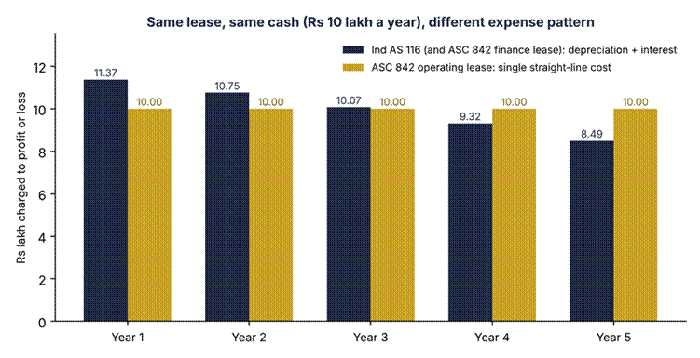
The total charge falls every year, from Rs 11,37,236 in Year 1 to Rs 8,49,067 in Year 5, because interest is highest when the liability is highest. Over the five years the charge equals the cash paid, Rs 50,00,000. Only the timing differs.
ASC 842 operating lease, amounts in Rs
|
Year |
Single lease cost |
Interest on liability |
ROU amortisation (balancing) |
Closing ROU asset |
Closing liability |
|
Year 1 |
10,00,000 |
3,79,079 |
6,20,921 |
31,69,866 |
31,69,866 |
|
Year 2 |
10,00,000 |
3,16,987 |
6,83,013 |
24,86,853 |
24,86,853 |
|
Year 3 |
10,00,000 |
2,48,685 |
7,51,315 |
17,35,538 |
17,35,538 |
|
Year 4 |
10,00,000 |
1,73,554 |
8,26,446 |
9,09,092 |
9,09,092 |
|
Year 5 |
10,00,000 |
90,908 |
9,09,092 |
0 |
0 |
|
Total |
50,00,000 |
12,09,213 |
37,90,787 |
The lessee recognises Rs 10,00,000 a year as one expense. The right-of-use asset is reduced by the lease cost less the interest accretion on the liability, which is why the amortisation line rises each year. In this simple case the asset and liability balances are equal.
The balance sheet is identical in both tables. What changes is the profit and loss pattern.
|
Year |
Ind AS 116 total charge |
ASC 842 operating cost |
Ind AS 116 minus ASC 842 |
|
Year 1 |
11,37,236 |
10,00,000 |
+1,37,236 |
|
Year 2 |
10,75,144 |
10,00,000 |
+75,144 |
|
Year 3 |
10,06,842 |
10,00,000 |
+6,842 |
|
Year 4 |
9,31,711 |
10,00,000 |
-68,289 |
|
Year 5 |
8,49,067 |
10,00,000 |
-1,50,933 |
|
Total |
50,00,000 |
50,00,000 |
0 |
Rs. The two patterns cross between Year 3 and Year 4 and net to zero over the term.
An Ind AS 116 lessee reports Rs 1,37,236 more expense in Year 1 than an ASC 842 operating lessee, and Rs 1,50,933 less in Year 5. This front-loading is the well-known effect of replacing a straight-line rent expense with depreciation and interest.
What it does to EBITDA and the cash flow statement
Take an entity whose operating profit before any lease cost is Rs 60,00,000 a year. Under Ind AS 116 the whole lease cost sits below EBITDA, in depreciation and finance cost, so EBITDA is Rs 60,00,000 . Under an ASC 842 operating lease the single lease cost is inside operating expenses, so EBITDA is Rs 50,00,000 . Same lease, same cash, a 17% lower EBITDA on the US GAAP presentation. This is the same reason an EBITDAR view matters for lease-heavy businesses such as retail and cafes.
Cash flows follow the same logic. Under Ind AS 116 (paragraph 50), the principal portion of lease payments is a financing outflow, and the interest portion follows the entity's Ind AS 7 policy for interest paid. Under ASC 842 an operating lease payment is entirely an operating outflow. A finance lease under ASC 842 splits into financing for principal and operating for interest. Operating cash flow is therefore higher under Ind AS 116 for the same contract.
Where else the two standards differ
|
Topic |
Ind AS 116 |
ASC 842 |
|
Lessee classification |
None. Every lease follows the single model. |
Finance or operating, using the five criteria in 842-20-25-2. |
|
Short-term leases |
Optional exemption for leases of 12 months or less with no purchase option (paragraph 5(a)). |
Similar policy election, by class of underlying asset. |
|
Low-value leases |
Optional exemption (paragraph 5(b), B3 to B8), assessed on the asset's value when new. |
No equivalent exemption. Entities rely on materiality and capitalisation thresholds. |
|
Discount rate |
Rate implicit in the lease, otherwise incremental borrowing rate (paragraph 26). |
Same hierarchy. Non-public entities may elect a risk-free rate by asset class. |
|
Index-linked payments |
Liability is remeasured when payments change because of a change in the index or rate (paragraph 42). |
Liability measured with the index at commencement. Later changes are variable lease cost in the period. |
|
Presentation |
Right-of-use assets shown separately or within the same line as owned assets, with disclosure (paragraph 47). |
Operating and finance lease balances presented separately from each other. |
|
Lessor |
Finance or operating lease. |
Sales-type, direct financing or operating lease. |
|
Sale and leaseback |
Sale is tested under Ind AS 115. Gain is limited to the rights actually transferred. |
Sale is tested under ASC 606. A leaseback that is a finance lease generally prevents sale accounting. |
Cross-standard interactions in India
- Impairment. A right-of-use asset is tested under Ind AS 36, not as part of the lease standard. Under US GAAP the corresponding test is ASC 360. The lease liability stays outside the impairment test in both.
- Deferred tax. Book depreciation and interest do not match the rent deducted for tax, so temporary differences arise on both the asset and the liability. Following the 2022 amendment to Ind AS 12, the initial recognition exemption no longer applies to leases, so a deferred tax asset and a deferred tax liability are recognised separately from commencement.
- Group consolidation. A US parent reporting under ASC 842 with an Indian subsidiary under Ind AS 116 needs a GAAP bridge. For each operating lease, the subsidiary's depreciation and interest are replaced by a single straight-line cost in the group numbers. The amounts reverse over the term, but the timing difference needs tracking, and the deferred tax needs to follow it.
What a reviewer should check
- Lease term. Extension and termination options are included only if the lessee is reasonably certain to exercise them, in both standards. A change in the term changes the whole schedule.
- Discount rate. The incremental borrowing rate is an estimate. A one percentage point change moves the liability, and every year's interest, in a visible way.
- Classification under US GAAP. On a group conversion, confirm each lease was tested against all five criteria rather than assumed to be operating.
- Disclosure. The maturity analysis, the weighted-average remaining term and the weighted-average discount rate are required under ASC 842. Ind AS 116 requires a maturity analysis under Ind AS 107 and its own lessee disclosures.
Takeaway
Both standards agree on the balance sheet and the total cost. They disagree on how the cost is spread. Ind AS 116 gives every lessee the same front-loaded pattern. ASC 842 lets an operating lessee keep a level one. If you compare a lease-heavy Indian company with a US peer on EBITDA, margins or operating cash flow without adjusting for this, the gap you see is partly accounting, not performance.
Learning with AGM explains Ind AS, audit standards, FEMA, company law and economics for finance professionals. This article is written out of personal interest in US GAAP and is not related to any client or engagement.
You have reached your daily limit of 2 Free Articles
Subscribe to CCI PRO for unlimited access
Why Upgrade to CCI PRO?
- No Ads
- WhatsApp Community
- Daily E-Newsletter
- Unlimited Articles Access
- Profile Visitors
- Link Social Profiles
- Featured Job Posts
- Pro Badge
- Expert GST Guidance
- Unlimited Forum Replies
- Download Content in PDF
Already a PRO member? Login here for an ad-free experience. 07941056694











 CAclubindia
