 efiletax
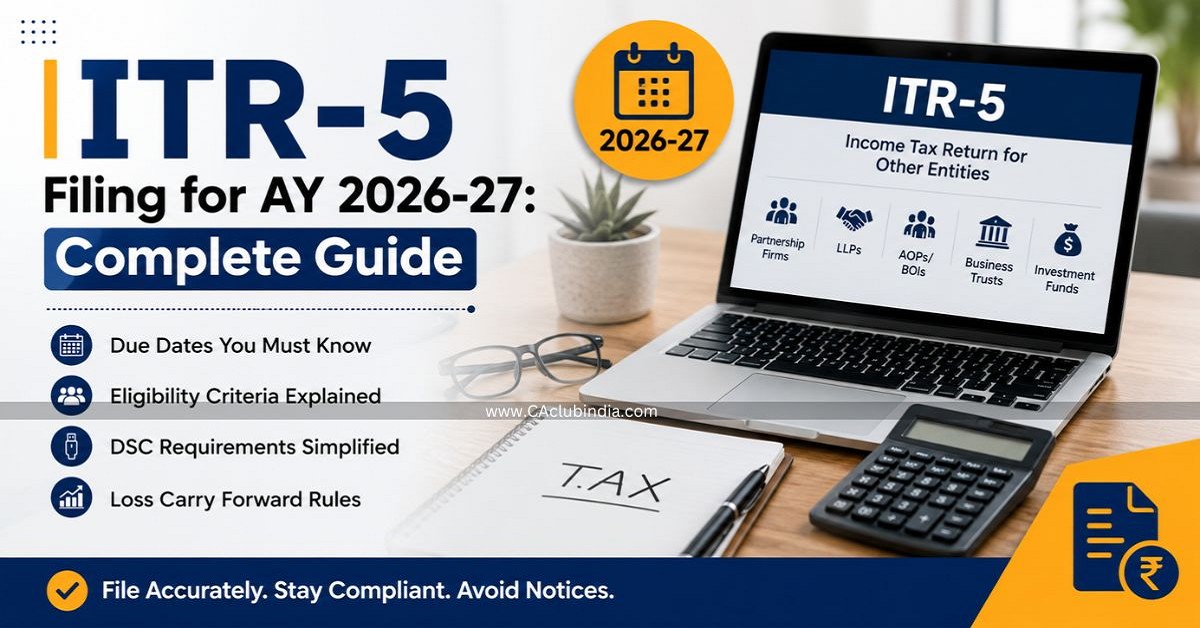
ITR-5 is the income tax return form for partnership firms, LLPs, AOPs, BOIs, business trusts, investment funds, co-operative societies and local authorities for AY 2026-27 (FY 2025-26). Individuals, HUFs, companies and trusts filing under ITR-7 cannot use it. Due dates range from 31 July 2026 for non-audit entities to 30 November 2026 for transfer pricing cases - and missing the deadline permanently blocks carry-forward of business and capital losses.
This complete checklist covers who should (and cannot) file ITR-5, all four due dates, presumptive taxation rules, the mandatory DSC requirement for audit cases, key reporting disclosures, the loss carry-forward trap, and the critical Form 3CD-to-ITR-5 reconciliation that prevents automated adjustments under Section 143(1)(a).
Who should file ITR-5 for AY 2026-27?
ITR-5 is meant for the following entities:
- Partnership firms (registered or unregistered)
- Limited Liability Partnerships (LLPs)
- Association of Persons (AOP)
- Body of Individuals (BOI)
- Artificial Juridical Persons (AJP)
- Estate of a deceased person and estate of an insolvent
- Business trusts
- Investment funds specified under the Income-tax Act
- Co-operative societies (where applicable)
- Local authorities - yes, local authorities are eligible to file ITR-5
Who cannot file ITR-5?
The following taxpayers must use a different form:
- Individuals and Hindu Undivided Families (HUFs) - use ITR-1 to ITR-4 as applicable
- Companies - use ITR-6
- Trusts and institutions required to file under ITR-7 - entities covered under Section 139(4A), (4B), (4C) or (4D), including political parties, scientific research associations, news agencies, educational/medical institutions and charitable or religious trusts, must file ITR-7, not ITR-5
What are the ITR-5 due dates for AY 2026-27?
| Due date | Applies to |
|---|---|
| 31 July 2026 | All other entities (no audit, no business/profession complications) |
| 31 August 2026 | Business/profession - non-audit cases |
| 31 October 2026 | Tax audit cases under Section 44AB (audit report itself due by 30 September 2026) |
| 30 November 2026 | Entities with international/specified domestic transactions under Section 92E (Form 3CEB - transfer pricing) |
Dates are subject to CBDT notifications and extensions - always verify before the deadline.
Can ITR-5 filers opt for presumptive taxation?
Yes. Eligible firms (but not LLPs) opting for presumptive taxation must report it within ITR-5 under:
- Section 44AD - presumptive income from eligible business
- Section 44ADA - presumptive income from specified professions
- Section 44AE - presumptive income from goods carriage/transport business
The key compliance point: correctly fill the relevant schedules with turnover and presumptive income figures. A mismatch between declared turnover and GST/AIS data is one of the most common triggers for scrutiny.
Note: LLPs are specifically excluded from Sections 44AD and 44ADA - an LLP cannot use presumptive taxation.
10 key compliance points before filing ITR-5
- Reconcile books with AIS and Form 26AS - every mismatch is a potential notice.
- Maintain and report financial statements (balance sheet, P&L) accurately.
- Report all heads of income correctly - business, capital gains, house property, other sources.
- Claim eligible deductions - Chapter VI-A, business expenses, depreciation, and loss set-offs.
- Verify partner/member details and transactions - remuneration, interest on capital, profit-sharing ratio.
- Check tax audit applicability under Section 44AB and file the audit report on time.
- Validate bank accounts and pre-validate the refund account on the e-filing portal.
- Verify MAT/AMT and loss carry-forward figures against prior-year returns.
- E-verify the return - see the DSC rule below for audited entities.
- File before the due date - late filing has irreversible consequences for losses.
Is DSC mandatory for ITR-5?
Yes, for audit cases. If the entity is subject to tax audit under Section 44AB, the return must be verified using a Digital Signature Certificate (DSC). Aadhaar OTP or EVC cannot be used for audited entities. Ensure the authorised partner/designated partner's DSC is registered and valid on the e-filing portal well before the deadline - expired DSCs are a classic last-week filing bottleneck.
Important reporting disclosures in ITR-5
- Unlisted equity shares - company name, PAN, opening balance, shares acquired, sold, and closing balance
- Partner/member disclosures - salary, bonus, commission, interest on capital, interest on loans, and profit-sharing ratio (with Section 40(b) limits in mind)
- Related party transactions
- Contingent liabilities and commitments
- Foreign assets/income (where applicable)
- GST turnover and reconciliation with books and ITR figures
- All exempt income, even if no tax is payable on it
The loss carry-forward rule: why the due date is non-negotiable
If ITR-5 is not filed on or before the due date under Section 139(1):
- Business losses cannot be carried forward
- Capital losses cannot be carried forward
- Only unabsorbed depreciation can still be carried forward
For a firm sitting on significant current-year losses, a single day's delay can permanently destroy tax benefits worth lakhs. Late filing doesn't just cost interest and late fees - it costs future set-offs.
Reconciling Form 3CD with ITR-5: the critical mapping
For audit cases, the tax audit report (Form 3CD) and ITR-5 must tell the same story. Key clauses to cross-check:
| Form 3CD clause | ITR-5 schedule/field | What must match |
|---|---|---|
| 8A | Part A - General | Special tax regime option (115BA/BAA/BAB/BAC/BAD/BAE, as applicable) |
| 12 | Schedule BP | Presumptive income (44AD/44ADA/44AE) |
| 18 | Schedule DEP & DC | Asset block, WDV, additions, deletions, depreciation |
| 21(a)/(b)/(d) | Schedule BP (11, 12, 15) | Disallowances under Sections 37, 40(a), 40A(3) |
| 20(b) | Schedule BP (10) | PF/ESI paid after the due date |
| 21(c) | Schedule BP (23) | Partner remuneration and interest under Section 40(b) |
| 26 | Schedule BP | Liabilities under Section 43B & MSME (43B(h)) |
| 33 | Schedule VIA | Chapter VI-A deductions |
| 41 | TDS/TCS schedules | TDS/TCS vs 26AS & AIS |
Why this matters: mismatches between Form 3CD, AIS, Form 26AS and ITR-5 can trigger automated adjustments under Section 143(1)(a) - additions made by the system before any human even looks at your return. Reconcile first, file second.
Key takeaways
- ITR-5 covers firms, LLPs, AOPs, BOIs, business trusts, investment funds, co-operative societies and local authorities - never individuals, HUFs, companies or ITR-7 entities.
- Four due dates for AY 2026-27: 31 July, 31 August, 31 October and 30 November 2026, depending on audit and transfer pricing status.
- DSC is mandatory for tax audit cases - Aadhaar OTP/EVC will not work.
- Late filing kills loss carry-forward - only unabsorbed depreciation survives.
- Reconcile Form 3CD, AIS and 26AS with ITR-5 before submission to avoid Section 143(1)(a) adjustments.
FAQs on ITR-5 for AY 2026-27
Can an LLP file ITR-5 with presumptive income under Section 44AD?
No. LLPs are excluded from presumptive taxation under Sections 44AD and 44ADA. An LLP must maintain books and report actual income in ITR-5, and get a tax audit done if Section 44AB thresholds are crossed.
Can a charitable trust file ITR-5?
No. Trusts and institutions covered under Section 139(4A), (4B), (4C) or (4D) - including charitable and religious trusts - must file ITR-7. Filing the wrong form makes the return defective.
What is the due date for a partnership firm with tax audit?
31 October 2026, with the tax audit report (Form 3CA/3CB-3CD) due by 30 September 2026. If the firm has transfer pricing transactions under Section 92E, the ITR due date extends to 30 November 2026.
What happens if a firm files ITR-5 after the due date?
Late fees under Section 234F and interest under Section 234A apply, and - far more damaging - business and capital losses of the year cannot be carried forward. Only unabsorbed depreciation retains carry-forward benefit.
Can partners file their personal ITR before the firm files ITR-5?
Practically, partners should wait - their share of remuneration, interest on capital and exempt profit share flows from the firm's return. Filing personal returns with figures that later differ from the firm's ITR-5 invites mismatch notices.
Is GST turnover reconciliation mandatory in ITR-5?
ITR-5 requires GST-related disclosures, and the department's systems auto-compare GST returns, AIS and ITR turnover. Any unexplained gap between GSTR-3B/GSTR-9 turnover and ITR turnover is a common scrutiny trigger - reconcile and document differences (e.g., non-GST income, exempt supplies) before filing.
You have reached your daily limit of 2 Free Articles
Subscribe to CCI PRO for unlimited access
Why Upgrade to CCI PRO?
- No Ads
- WhatsApp Community
- Daily E-Newsletter
- Unlimited Articles Access
- Profile Visitors
- Link Social Profiles
- Featured Job Posts
- Pro Badge
- Expert GST Guidance
- Unlimited Forum Replies
- Download Content in PDF
Already a PRO member? Login here for an ad-free experience. 011-411-70713











 CAclubindia
